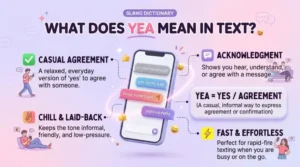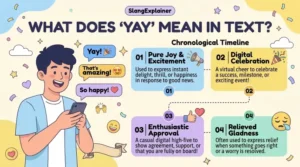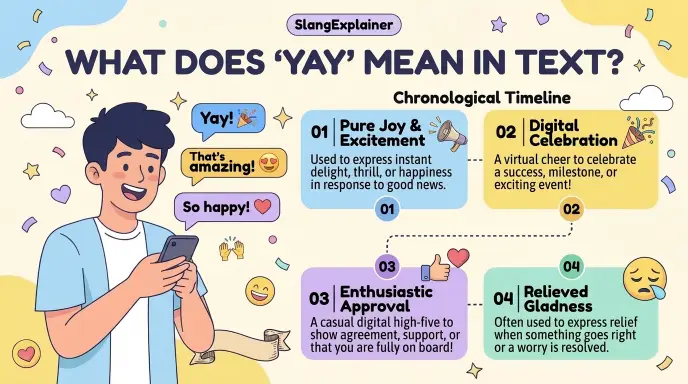
Yay means happiness, excitement, joy, or celebration in text messages. People use this cheerful expression when they receive good news, feel excited about something, or want to celebrate a special moment.
It is commonly seen on TikTok, Snapchat, Instagram, WhatsApp, and regular SMS conversations.
Imagine your friend tells you that they have passed an important exam. You might reply, “Yay! Congratulations!” to show that you are genuinely happy for them. This small expression can communicate a positive feeling without requiring a long message.
Unlike many internet abbreviations, yay does not have a hidden meaning. It is an informal English expression that people have used for a long time. Today, it remains popular because it makes digital conversations sound friendly, natural, and cheerful.
The spelling can also change the level of excitement. “Yay!” expresses happiness, while “Yayyy!” usually shows stronger enthusiasm. Understanding the situation helps you recognize exactly what someone wants to communicate.
Yay Meaning in Text: What Does It Actually Mean?
In texting, yay is an expression of happiness, excitement, approval, or celebration. People use it when something positive happens or when they want to respond enthusiastically to another person’s message.
Yay is an interjection, not an acronym or abbreviation. An interjection is a word that expresses an emotion or sudden reaction. Other familiar examples include “wow,” “oops,” “oh,” and “hooray.”
For example, imagine your friend sends you a message saying they have finally received their university admission letter. You could respond:
“Yay! I’m so happy for you!”
This response communicates excitement and support. You do not need to write a long explanation because the expression already makes your feelings clear.
What Feelings Can Yay Express?
Although the main meaning is happiness, the expression can communicate several emotions depending on the conversation.
- Happiness: When someone shares something wonderful.
- Excitement: When you are looking forward to an event.
- Relief: When a difficult situation finally ends.
- Approval: When you like someone’s suggestion.
- Celebration: When someone achieves an important goal.
For instance, “Yay, finally!” can express relief after waiting for something for a long time. On the other hand, “Yay! That’s amazing!” communicates excitement about another person’s success.
Is Yay Slang, an Acronym, or an Abbreviation?
Yay is best described as an informal English interjection. People sometimes treat it like internet slang because it frequently appears in online conversations, but it is not an acronym.
It does not stand for a longer sentence or phrase. Instead, it is a complete expression that communicates a positive emotion.
This is one reason beginners can understand it easily. Even someone unfamiliar with modern internet slang can usually recognize what yay means from the conversation.
Where Do People Use Yay?
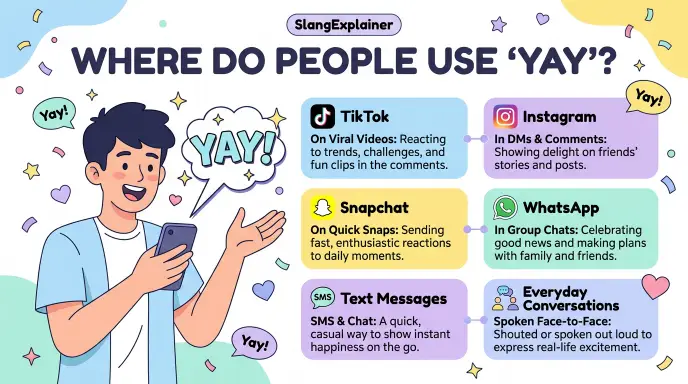
People use yay across different messaging apps and social media platforms. It appears in comments, captions, group chats, private messages, and everyday conversations.
The basic meaning remains the same, but the situation and relationship between people can affect how the expression sounds.
Yay on TikTok
On TikTok, people often use yay in comments when reacting to exciting videos, personal achievements, celebrations, and announcements.
For example, someone might upload a video about graduating from university. Their followers may comment:
- “Yay! Congratulations!”
- “Yayyy, you finally did it!”
- “So happy for you!”
Creators may also use it in captions when sharing positive updates with their followers. It helps communicate excitement without making the caption unnecessarily long.
Yay on Snapchat
Snapchat is popular for quick and casual conversations between friends. People use yay when reacting to pictures, sharing exciting news, or making plans.
For example:
Friend: My parents said yes to the weekend trip!
You: Yayyy! We are finally going!
In this conversation, the expression shows happiness about the upcoming experience. It makes the reply sound enthusiastic and friendly.
Yay on Instagram
On Instagram, yay commonly appears in comments, Stories, and direct messages. People use it when celebrating birthdays, achievements, holidays, and personal milestones.
For example, if someone posts about getting a new job, their friends might comment:
“Yay! You deserve this opportunity!”
It makes the response feel supportive and personal. People also combine the expression with emojis such as 🎉, 🥳, and ❤️ to add more emotion.
Yay on WhatsApp
WhatsApp conversations are usually personal and informal. People use yay in family groups, friendship chats, and everyday discussions.
For example:
A: Everyone is coming to dinner tonight.
B: Yay! I can’t wait to see everyone.
Here, the word communicates happiness about spending time with family or friends.
Yay in SMS Text Messages
Even in regular SMS messages, people use this expression to communicate excitement.
For example:
“Yay! Your package will arrive tomorrow.”
It is a simple way to show happiness without writing a long response. Because its meaning is familiar, people of different ages can understand it.
10 Real Chat Examples of Yay in Text Messages
The easiest way to understand an expression is to see how people use it in normal conversations. These examples show different situations where yay sounds natural.
Example 1: Celebrating Exam Results
A: I finally passed my final exam!
B: Yay! Congratulations!
A: Thank you! I’m so relieved.
Meaning: B uses yay to celebrate A’s achievement and express happiness about the good news.
Example 2: Making Weekend Plans
A: Do you want to go shopping this Saturday?
B: Yay, absolutely!
A: Great! Let’s meet at 2 PM.
Meaning: B is excited about the suggestion and happily agrees to the plan.
Example 3: Receiving a Birthday Surprise
A: I have a little surprise for your birthday.
B: Yay! Now I’m curious.
A: You’ll have to wait until tomorrow.
Meaning: B expresses excitement and anticipation about receiving a surprise.
Example 4: Getting a New Job
A: Guess what? I got the job I applied for!
B: Yay! That’s wonderful news.
A: I’m starting next Monday.
Meaning: B celebrates an important personal achievement.
Example 5: School Holiday
A: Our teacher just announced that tomorrow is a holiday.
B: Yay! Finally, a day to relax.
A: We definitely needed a break.
Meaning: B expresses happiness and relief about having free time.
Example 6: Meeting an Old Friend
A: I’ll be visiting your city next month.
B: Yayyy! We need to catch up.
A: Definitely. It’s been too long.
Meaning: B shows excitement about meeting someone after a long time.
Example 7: Shopping for Something Special
A: Your favorite shoes are back in stock.
B: Yay! I’m ordering them today.
A: Hopefully, your size is available.
Meaning: B expresses happiness about finding something they wanted.
Example 8: Planning a Movie Night
A: How about watching a movie tonight?
B: Yay! Let’s get some popcorn too.
A: Sounds perfect.
Meaning: B likes the suggestion and feels excited about spending time together.
Example 9: Family Dinner
A: Grandma is coming to visit us this weekend.
B: Yay! I haven’t seen her in months.
A: She is excited to see everyone.
Meaning: B communicates happiness about an upcoming family gathering.
Example 10: Completing a Difficult Task
A: I finally finished the project I’ve been working on.
B: Yay! Now you can enjoy your free time.
A: Exactly. It took longer than expected.
Meaning: The expression communicates happiness and relief after completing something difficult.
How to Reply When Someone Says Yay?
When someone sends you yay, you do not need to overthink your response. A short and positive reply is usually enough.
However, the best response depends on your relationship with that person and the topic of the conversation.
Funny Replies
If you are talking to a close friend, a playful response can make the conversation more entertaining.
- “Someone is in a very happy mood!”
- “Okay, calm down, superstar!”
- “Save some excitement for tomorrow!”
- “Yay times a million!”
- “Let’s celebrate before anything else!”
Casual Replies
These responses are suitable for everyday conversations with friends and people you know well.
- “Haha, definitely!”
- “I know, right?”
- “That’s awesome!”
- “Sounds like a plan!”
- “Can’t wait!”
Friendly Replies
If someone is sharing personal good news, you can respond with a warm and supportive message.
- “I’m genuinely happy for you!”
- “That’s wonderful news!”
- “You really deserve it!”
- “So glad everything worked out!”
- “Wishing you even more happiness!”
Neutral Replies
Sometimes you may want to respond politely without showing too much excitement.
- “Sounds good.”
- “That’s great.”
- “Nice!”
- “Glad to hear that.”
- “Good to know.”
The best approach is to match the other person’s energy. If someone is celebrating something important, a positive response will make the conversation feel more natural.
Is Yay Rude or Offensive?
No, yay is generally not rude, offensive, or disrespectful. It is a positive expression that people use to communicate happiness, excitement, and approval.
You can normally use it with friends, family members, classmates, and colleagues in casual conversations.
However, the meaning can sometimes change depending on the situation. Someone may use it sarcastically when they are disappointed or unhappy about something.
Can Yay Be Sarcastic?
Yes. Although it usually communicates happiness, it can sometimes express the opposite feeling.
For example:
A: We have another three hours of homework tonight.
B: Yay! Just what I wanted!
In this conversation, B is probably not genuinely excited. The response is sarcastic because the person is unhappy about having extra work.
This is why context matters when understanding online expressions.
Is Yay Appropriate at School?
Yes, students can use it in casual conversations with classmates and friends.
For example:
“Yay! We don’t have an exam tomorrow.”
However, it is better to avoid overly casual expressions in formal assignments, essays, and academic writing.
Is Yay Appropriate at Work?
It depends on the type of communication.
In a friendly workplace group chat, writing “Yay! We completed the project” is perfectly acceptable.
In a formal email to a manager, customer, or business partner, a more professional expression may be appropriate.
You could write:
- “That’s excellent news.”
- “I’m pleased to hear that.”
- “Congratulations on the achievement.”
The important thing is to understand your audience and choose language that fits the situation.
Who Uses Yay? Understanding Its Popularity
Yay is not limited to a particular age group or online community. People of different generations use it because its meaning is familiar and easy to understand.
Teenagers and Young Adults
Teenagers often use it in group chats, conversations with friends, and social media comments.
They may write “Yayyy!” to make their messages sound more energetic or playful. It is especially natural when discussing parties, holidays, school activities, or exciting plans.
Gen Z Users
Gen Z users are familiar with short digital expressions, emojis, and creative spelling variations.
They may combine yay with emojis to make their feelings more noticeable.
For example:
“Yayyy! Finally got my results! 🥳”
However, this expression is not exclusive to Gen Z. It has been used in English for much longer than modern social media platforms have existed.
Adults and Older Generations
Adults also use it in family conversations, personal messages, and workplace group chats.
For example:
“Yay! The whole family will be together this weekend.”
The expression feels natural because it does not depend on a particular internet trend.
Where Is It Commonly Used?
You may encounter it on:
- TikTok: Comments and video reactions.
- Instagram: Stories and direct messages.
- Snapchat: Casual conversations.
- WhatsApp: Family and friendship groups.
- SMS: Regular text messages.
- Online communities: Discussions and positive reactions.
Its familiar meaning makes it useful for people who want to communicate positive emotions quickly.
Origin of the Word Yay
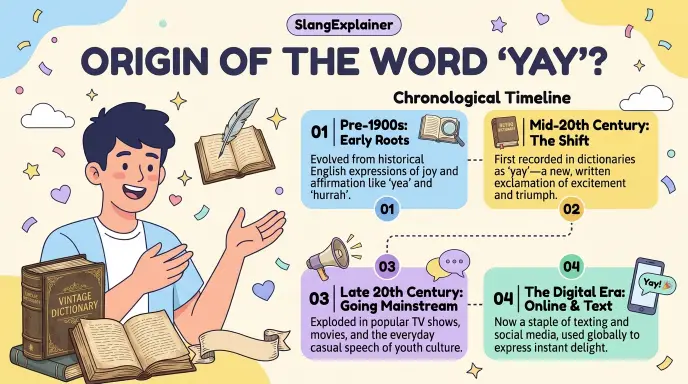
Unlike many modern internet abbreviations, yay did not originate as a social media trend.
It is an established English interjection used to express happiness, excitement, and celebration. Its exact historical development is not completely certain, but it became familiar through spoken English and everyday communication.
People have long used short expressions to communicate emotions. Words such as “hooray,” “hurrah,” and “yay” serve similar purposes.
How Did Internet Culture Influence Yay?
The growth of texting and social media made short emotional expressions especially useful.
Instead of writing a long sentence explaining how happy they feel, people can simply send:
“Yay!”
This makes conversations faster and more natural.
Digital communication also encouraged creative spelling variations. People started extending the word to make their emotions more noticeable.
Some common variations include:
- Yayyy! nShows extra excitement.
- Yaaaaay! Expresses strong enthusiasm.
- Yay 🙂 Adds a friendly feeling.
- Yay 🎉 Celebrates an achievement.
- Oh yay Shows excitement or, sometimes, sarcasm.
Is Yay a Modern Internet Slang Word?
Not exactly. It is more accurate to describe yay as an informal English interjection that is widely used in internet communication.
Social media helped make it visible in digital conversations, but the expression itself existed before platforms such as TikTok, Instagram, and Snapchat became popular.
Yay vs IDK, IDC, IMO, and BRB: What’s the Difference?
People often encounter different short expressions while chatting online. Although they may appear in the same conversation, they do not necessarily communicate the same thing.
Some express emotions, while others communicate uncertainty, opinions, or actions.
| Term | Meaning | Type | Usage | Popularity |
| Yay | Happiness or excitement | Interjection | Celebrating good news | Common |
| IDK | I Don’t Know | Acronym | Expressing uncertainty | Very common |
| IDC | I Don’t Care | Acronym | Showing indifference | Common |
| IMO | In My Opinion | Acronym | Sharing an opinion | Common |
| BRB | Be Right Back | Acronym | Temporarily leaving a chat | Common |
Understanding Each Expression
Yay: People use it when they feel happy or excited about something.
IDK: It means the person does not know the answer to a question.
IDC: It communicates that something does not matter to the person.
IMO: It introduces a personal opinion or point of view.
BRB: It tells someone that the person is temporarily leaving and will return shortly.
For example:
A: We are going to the beach tomorrow!
B: Yay! I can’t wait!
Here, B expresses excitement about the plan.
But if B replies “IDK,” it means they are unsure about something. The two expressions communicate completely different ideas.
Real: World Usage Example: When Would Someone Say Yay?
Imagine two friends, Sara and Emma, who have been planning a weekend trip for several weeks.
They have already selected their destination and arranged transportation. However, they are still waiting for confirmation from their hotel.
One afternoon, Sara receives a message confirming their reservation. She immediately contacts Emma to share the good news.
Sara: Guess what? Our hotel booking is confirmed!
Emma: Yayyy! I can’t wait for our trip!
Sara: Same! We should start packing.
Emma: Absolutely! This weekend is going to be amazing.
In this situation, Emma uses yay to communicate happiness and excitement about their plans.
She does not need to write a long explanation because one simple expression communicates her feelings.
Another example could happen at home. A child hears that their favorite meal is being prepared for dinner and happily says “Yay!”
These situations show that the expression is not limited to online communication. People also use it naturally in spoken conversations.
Common Mistakes People Make About Yay
Even though the expression is simple, beginners sometimes misunderstand it or confuse it with similariflooking words.
Understanding these common mistakes will help you use it correctly.
1. Confusing Yay With Yeah
These two words sound similar, but their meanings are different.
Yay expresses happiness or excitement.
Yeah usually means yes or agreement.
For example:
“Yay! We won the competition!”
This shows excitement.
“Yeah, I understand what you mean.”
This shows agreement or confirmation.
2. Thinking Yay Is an Acronym
Some people assume that every short internet expression stands for a longer phrase.
However, yay is not an acronym. It is an English interjection used to express emotion.
3. Using Yay in Every Conversation
Although it is a friendly expression, it does not belong in every message.
Use it when you genuinely want to express excitement, happiness, or approval.
4. Ignoring the Context
Sometimes people use yay sarcastically rather than genuinely.
For example, someone who receives extra homework might write “Yay!” to express disappointment humorously.
5. Assuming Only Young People Use It
Yay is understood and used by people of different ages. It is not restricted to teenagers or Gen Z.
Frequently Asked Questions
1. What does Yay mean in text messages?
Yay means happiness, excitement, or celebration. People use it when they receive good news or feel pleased about something.
2. What does Yay mean on TikTok?
On TikTok, yay expresses a positive reaction to exciting videos, achievements, announcements, and happy moments.
3. Is Yay slang?
Yay is an informal English interjection, not an acronym or abbreviation. It is commonly used in everyday conversations.
4. Is Yay rude or offensive?
No. Yay is generally friendly and positive. However, it can sometimes sound sarcastic depending on the context.
5. How should you reply to Yay?
You can respond with “That’s amazing!”, “I’m so happy!”, “Absolutely!”, or “Can’t wait!”
6. What is the difference between Yay and Yeah?
Yay expresses happiness, while yeah usually means yes or agreement. They sound similar but have different meanings.
7. What does Yayyy mean in texting?
Yayyy means extra happiness or excitement. The additional letters make the expression sound more enthusiastic and playful.
8. Can I use Yay in professional messages?
Yes, you can use it in friendly workplace conversations. For formal emails, expressions such as “That’s excellent news” may be more appropriate.
Conclusion
Yay is a cheerful expression used to communicate happiness, excitement, approval, and celebration. People use it when sharing good news, making exciting plans, celebrating achievements, or reacting positively to something.
You can find it on TikTok, Snapchat, Instagram, WhatsApp, and regular text messages. Different spellings, such as “Yayyy!”, can make a message sound even more enthusiastic.
It is generally friendly and safe for casual conversations. However, formal situations may require more professional wording.
The most important thing to remember is that yay and yeah are not the same. Once you understand the difference and consider the conversation’s context, you can easily recognize and use this expression naturally.

I’m Dylan Foster, a slang and internet culture writer passionate about exploring how people communicate online and in everyday conversations. I write about texting abbreviations, social media expressions, and modern slang to help readers understand meanings, origins, and real-world usage in a simple way.