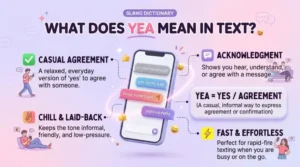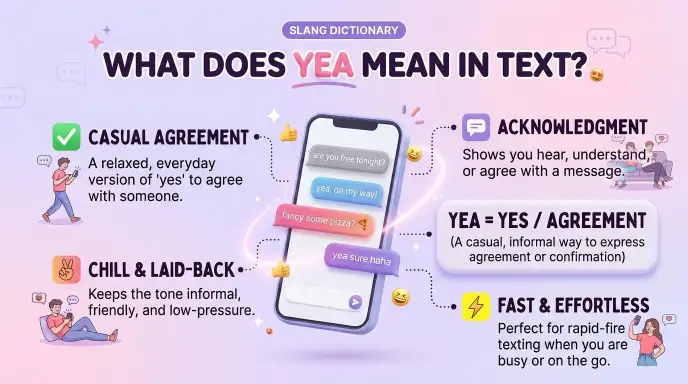
When someone writes “yea” in a text message, they usually mean “yes” or “sure.” It is a casual way to agree, answer a question, or show that they accept something. You may see it in everyday conversations on TikTok, Snapchat, Instagram, WhatsApp, and SMS.
Although “yea” looks similar to “yeah,” both words can have slightly different uses. Understanding the difference can help you know exactly what someone means when they send it.
Yea Meaning in Text
In texting, “yea” generally means “yes.” People use it to agree with someone, confirm information, or respond positively to a question. It is a short and informal expression that makes conversations feel quick and natural.
For example, if a friend asks, “Are you coming to the party tonight?” you might reply, “Yea!” This simply means that you are coming.
The word is not an acronym or an abbreviation. It is an actual English word that has been used for a long time. However, in modern digital conversations, people often use it as a casual alternative to “yes.”
Here are some common meanings of yea in everyday messages:
- Yes: Giving a positive answer to a question.
- Sure: Showing that you agree with a suggestion.
- I agree: Supporting someone’s opinion or idea.
- Okay: Accepting a plan or arrangement.
- Absolutely: Showing strong agreement, depending on the context.
The exact meaning depends on the conversation. A simple “yea” can sound friendly, neutral, or slightly uninterested depending on how the other person uses it.
Is Yea the Same as Yeah?
Not exactly. Although people sometimes use these words interchangeably in casual messages, they have different traditional meanings.
Yea is a standard English word meaning yes or expressing an affirmative vote. It is also used in formal voting contexts.
Yeah is a more conversational way of saying yes. It is especially common in everyday speech, texting, and online conversations.
For example:
- Yea, I agree with your decision.
- Yeah, I will call you later.
Both can communicate agreement, but “yeah” is generally more common in casual digital conversations.
Where Do People Use Yea?
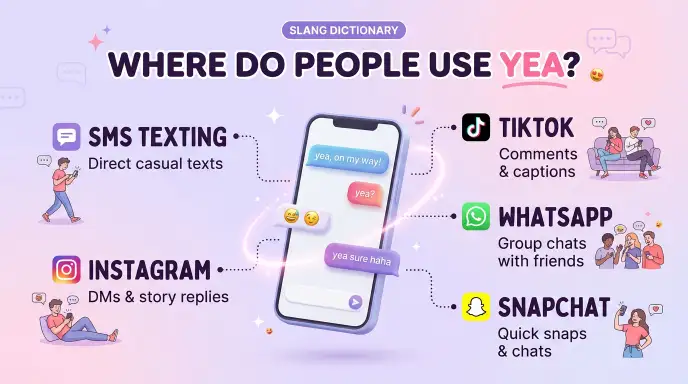
People use “yea” in different types of digital communication. It is not connected to one particular social media platform. Instead, it appears in ordinary conversations whenever someone wants to give a positive response.
Here is how people may use it on popular platforms.
Yea on TikTok
On TikTok, people may use “yea” in comments, direct messages, and conversations about videos.
For example, if someone asks if you enjoyed a funny video, you could comment:
“Yea, this is hilarious!”
It can also appear when users agree with an opinion, support a creator, or respond to a question.
Yea on Snapchat
Snapchat conversations are often quick and informal. Friends may use “yea” when replying to snaps or answering questions.
Example:
Friend: Are we meeting after school?
You: Yea, sounds good.
Here, the word confirms that you agree with the plan.
Yea on Instagram
On Instagram, people may use “yea” in direct messages, story replies, and comment sections.
For example:
A: Do you like this picture?
B: Yea, it looks amazing!
It helps users express agreement without writing a long response.
Yea on WhatsApp
WhatsApp is commonly used for personal conversations, family groups, and everyday planning.
Someone might send:
“Yea, I will be there in 10 minutes.”
In this situation, the word confirms that the person understands the plan and agrees with it.
Yea in SMS Text Messages
Traditional SMS conversations also include short responses like “yea.”
For example:
A: Did you finish your homework?
B: Yea, just finished.
It is a simple way to answer without typing a complete sentence.
10 Real Chat Examples of Yea
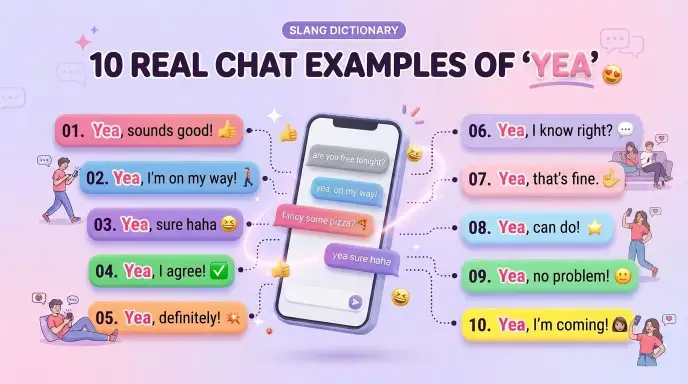
The easiest way to understand an internet expression is to see how people actually use it in conversations.
Below are 10 realistic examples showing different situations where someone might write “yea.”
Example 1: Agreeing With a Friend
A: Do you want to watch a movie tonight?
B: Yeah, that sounds fun.
Meaning: The person agrees with the movie plan.
Example 2: Confirming a Meeting
A: Are you coming to the cafe tomorrow?
B: Yea, around 5 PM.
Meaning: The person confirms that they will attend.
Example 3: Answering a Simple Question
A: Did you see my message?
B: Yea, I just read it.
Meaning: The person confirms that they received and read the message.
Example 4: Supporting an Opinion
A: I think this song is better than the original.
B: Yea, I totally agree.
Meaning: The person shares the same opinion.
Example 5: Accepting an Invitation
A: Want to come over this weekend?
B: Yea, I would love to!
Meaning: The person happily accepts the invitation.
Example 6: Confirming Information
A: Your exam starts at 9 AM, right?
B: Yea, that’s correct.
Meaning: The person confirms that the information is accurate.
Example 7: Making Plans
A: Should we order pizza?
B: Yea, let’s do that.
Meaning: The person agrees with the suggestion.
Example 8: Responding to Good News
A: I finally passed my driving test!
B: Yea! Congratulations!
Meaning: The person shows happiness and excitement.
Example 9: Giving a Quick Answer
A: Are you free right now?
B: Yea, what’s up?
Meaning: The person is available and wants to know what the other person needs.
Example 10: Casual Confirmation
A: I’ll send you the pictures later.
B: Yea, no problem.
Meaning: The person understands and accepts the arrangement.
These examples show that “yea” usually communicates agreement, confirmation, or a positive response. However, the tone can change depending on the surrounding words.
How to Reply When Someone Says Yea?
When someone sends you “yea,” your response depends on what you were discussing. Sometimes you do not need to reply at all. In other situations, you can continue the conversation with a friendly or funny message.
Here are a few natural replies.
Funny Replies
If you are chatting with a close friend, a little humor can make the conversation more interesting.
- “That’s the energy I wanted!”
- “Finally, we agree!”
- “I knew you would say yes!”
- “Yea squad!”
- “Great minds think alike!”
Casual Replies
These responses work well in everyday conversations.
- “Okay, cool.”
- “Sounds good.”
- “Alright, let’s do it.”
- “Perfect!”
- “Got it.”
Friendly Replies
Use these when you want to sound warm and positive.
- “Awesome, can’t wait!”
- “Great, see you soon!”
- “That makes me happy.”
- “Thanks for agreeing!”
- “Looking forward to it!”
Neutral Replies
Sometimes a simple answer is enough.
- “Okay.”
- “Understood.”
- “Alright.”
- “Sure.”
- “Thanks for confirming.”
Helpful tip: You do not have to create a long reply to a short message. Choose a response that matches the conversation and your relationship with the person.
Is Yea Rude or Offensive?
No, “yea” is generally not rude, offensive, or inappropriate. It is a normal English word that people use to express agreement or give a positive answer.
However, the way it sounds can depend on the situation.
For example, if a friend asks if you want to go shopping and you reply, “Yea!” it sounds perfectly friendly.
But if someone shares an important personal problem and you only respond with “yea,” they might think you are not paying attention.
The problem is not the word itself. It is the context and tone of the conversation.
Is Yea Safe to Use?
Yes. You can safely use it in most everyday conversations with friends, classmates, and family members.
It does not contain an insulting or offensive meaning by itself.
Is Yea Appropriate at School?
In casual conversations with classmates, using “yea” is completely normal.
However, when writing school assignments, essays, or formal answers, it is better to use “yes.”
Is Yea Appropriate at Work?
In informal workplace chats, “yea” may be acceptable when talking with colleagues you know well.
For professional emails, official messages, or conversations with clients, “yes” is usually a better choice because it sounds more polished.
Who Uses This Term?
The word “yea” is not limited to one age group. People of different ages use it in spoken English, written communication, and online conversations.
Its simple meaning makes it easy for almost anyone to understand.
Teenagers and Young Adults
Teenagers and young adults may use “yea” when chatting with friends, making plans, or responding to questions.
They often prefer short messages because they make conversations faster.
Gen Z Usage
Gen Z commonly uses informal expressions in digital communication. Words such as “yeah,” “yep,” “nah,” and “yea” can appear in everyday conversations.
For example:
A: Are you watching the game tonight?
B: Yeah, definitely.
Here, the response shows agreement and interest.
However, “yea” is not exclusive to Gen Z. It is a regular English word that people from different generations understand.
Adults and Older Users
Adults may also use “yea” when replying to family members, friends, or colleagues.
Its meaning does not change based on the person’s age.
Common Platforms
You may encounter the word in:
- TikTok: Comments and direct messages.
- Snapchat: Quick replies between friends.
- Instagram: Story replies and private chats.
- WhatsApp: Personal and group conversations.
- SMS: Regular text messages.
There is no reliable reason to treat it as a platformifspecific trend. It is simply an everyday expression that can appear across different communication channels.
Origin of the Term Yea
Unlike many modern internet slang expressions, “yea” did not originate on TikTok, Instagram, or another social media platform.
It has a much older history in the English language.
The word comes from Old English “gēa,” which was used to express agreement or affirmation. Over time, its spelling and pronunciation developed into the modern form “yea.”
Historically, the word has appeared in written English, speeches, religious texts, and voting situations.
For example, in parliamentary or formal voting contexts, people may say “yea” to indicate an affirmative vote.
How Did Yea Become Common in Texting?
As digital communication became more popular, people started using familiar spoken expressions in written messages.
Short words such as “yes,” “yeah,” “yep,” and “yea” became convenient ways to respond quickly.
Although the word itself is old, its use in modern messaging fits naturally with the informal style of online communication.
Is Yea an Internet Slang Word?
Not originally.
“Yea” is a traditional English word, not a newly invented internet abbreviation. However, its casual use in text messages can make it feel like modern slang.
This is why people sometimes search for its meaning when they see it in a conversation.
Yea vs. IDK, IDC, IMO, and BRB
Not every short expression in texting has the same purpose. Some show agreement, while others communicate uncertainty, opinions, or temporary absence.
The following table explains the differences.
| Term | Meaning | Type | Usage | Popularity |
| Yea | Yes or agreement | English word | Confirming or agreeing | Common |
| IDK | I Don’t Know | Abbreviation | Showing uncertainty | Very common |
| IDC | I Don’t Care | Abbreviation | Showing indifference | Common |
| IMO | In My Opinion | Abbreviation | Sharing an opinion | Common |
| BRB | Be Right Back | Abbreviation | Temporarily leaving a chat | Common |
Understanding the Differences
Yea: Used when you agree with someone or answer positively.
IDK: Used when you do not know something.
IDC: Used when something does not matter to you. Depending on the context, it may sound dismissive.
IMO: Used before sharing a personal opinion.
BRB: Used when you need to leave a conversation temporarily.
For example, if a friend asks if you like a new movie, you could answer “Yea” to show agreement with a positive statement. If you are unsure, you might say “IDK.”
Understanding these differences makes online conversations easier to follow.
Realif: World Usage Example of Yea
Imagine that two friends are planning to meet after school.
One friend sends a message asking:
Friend 1: Are you coming to the park this afternoon?
Friend 2: Yea, I’ll be there around 4.
In this situation, the second friend uses “yea” to confirm the plan.
There is no hidden meaning or complicated slang involved. The word simply communicates a positive answer.
Now imagine another situation at work.
Manager: Can you send me the updated document today?
Employee: Yea, I’ll send it before lunch.
This is understandable in a casual workplace conversation. However, in a more formal email, writing “Yes, I’ll send it before lunch” would sound more professional.
These situations show why context matters. The word stays the same, but the level of formality changes depending on the people and circumstances.
Common Mistakes People Make About Yea
Even though the word is simple, people sometimes misunderstand it because it looks similar to other English expressions.
Here are a few common mistakes worth avoiding.
1. Thinking Yea and Yeah Are Always Identical
Both words can express agreement, but their traditional uses are different.
Yea is a standard affirmative word, while yeah is a conversational form of yes.
2. Assuming Yea Is an Acronym
Some people think it is a shortened internet expression made from several words.
That is incorrect. Yea is a complete English word, not an acronym.
3. Thinking It Always Shows Excitement
A person can write “yea” without being excited.
For example:
A: Did you receive the package?
B: Yea.
The answer simply confirms receipt. It does not necessarily show happiness.
4. Using It in Every Professional Situation
Although it is understandable, “yea” may sound too casual in formal communication.
For important emails, reports, and official messages, choose “yes” instead.
5. Confusing It With Yay
The words “yea” and “yay” have different meanings.
- Yea: Means yes or agreement.
- Yay: Expresses happiness, excitement, or celebration.
For example:
“Yea, I agree with you.”
“Yay! We won the match!”
Knowing this difference helps prevent confusion.
Frequently Asked Questions
1. What Does Yea Mean in Text Messages?
Yea means yes, sure, or I agree. People use it to answer questions, confirm plans, and show agreement in everyday messages.
2. What Does Yea Mean on TikTok?
On TikTok, yea usually means yes or agreement. People may use it in comments, captions, or direct messages when responding positively.
3. Is Yea Slang?
Not exactly. Yea is a traditional English word, but people also use it casually in modern texting and online conversations.
4. Is Yea Rude or Offensive?
No. Yea is generally a polite and harmless expression. However, a very short reply may sometimes sound uninterested depending on the conversation.
5. How Should You Reply to Yea?
You can reply with “Okay,” “Sounds good,” “Perfect,” or “Great!” Choose a response that matches the topic and tone of the conversation.
Conclusion
The word “yea” means “yes” or “I agree” in most text conversations. People use it to confirm information, accept invitations, answer questions, and respond positively.
You may see it on TikTok, Snapchat, Instagram, WhatsApp, and regular SMS messages. Although it is often used casually, it is an established English word rather than a modern internet abbreviation.
Remember that “yea” is generally friendly and harmless, but “yes” is a better choice for formal situations. Once you understand its meaning and context, you can easily recognize and use it in everyday conversations.

I’m Dylan Foster, a slang and internet culture writer passionate about exploring how people communicate online and in everyday conversations. I write about texting abbreviations, social media expressions, and modern slang to help readers understand meanings, origins, and real-world usage in a simple way.