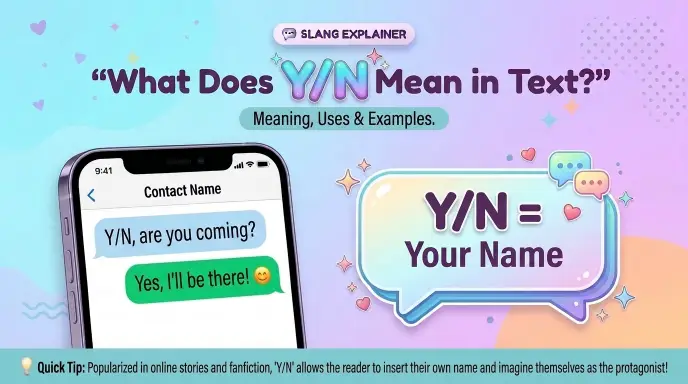
Y/N in text usually means “Yes or No.” People use it when asking someone a question that needs a simple yesiforifno answer. However, in fanfiction and online stories, Y/N can also mean “Your Name.”
You may see Y/N in text messages, TikTok comments, Instagram posts, Snapchat conversations, and online stories. Its meaning depends on the situation and the words around it.
Many people search for this abbreviation because they see it in a message or social media post and are unsure what the sender means. Understanding the context makes it much easier to know which meaning is correct.
In this guide, you will learn what Y/N means, how people use it on different platforms, and how to reply naturally when someone sends it to you.
What Does Y/N Mean in Text?
The most common meaning of Y/N in everyday texting is “Yes or No.” It is a short way to ask someone to give a direct answer instead of explaining everything.
For example:
Friend A: Are you coming to the party? Y/N?
Friend B: Yes!
Here, the sender wants a simple answer. They are not asking for a long explanation. They just want to know if the other person is coming or not.
Y/N is an abbreviation, not a traditional slang word. It combines the first letters of two words:
- Y = Yes
- N = No
Together, Y/N = Yes or No.
Another Meaning: Your Name
There is another popular meaning of Y/N, especially in online stories and fanfiction.
In this context, Y/N means “Your Name.” Writers use it as a placeholder so readers can imagine themselves as the main character in a story.
For example:
“Harry looked at Y/N and smiled.”
The reader can imagine their own name in place of Y/N.
This usage is especially common in fanfiction, romantic stories, and readerifinsert content on social media.
How Do You Know Which Meaning Is Correct?
The surrounding conversation usually tells you what the abbreviation means.
| Context | Meaning |
| Text messages | Yes or No |
| Questions and polls | Yes or No |
| Fanfiction stories | Your Name |
| Romantic readerifinsert posts | Your Name |
| Online conversations | Depends on context |
Remember: If someone asks you a question and adds Y/N, they probably mean Yes or No. If you see it inside a fictional story, it most likely means Your Name.
Where Do People Use Y/N Online?
Y/N appears in different online spaces. Its meaning can change depending on the platform and type of conversation.
Let’s look at how people use it on popular social media platforms.
Y/N on TikTok
On TikTok, Y/N can appear in comments, captions, questions, and fanfictionifstyle videos.
People may use it when asking viewers to choose between two options or answer a direct question.
For example:
“Would you date your best friend? Y/N?”
Here, the creator wants viewers to answer yes or no.
TikTok also has a large community of fanfiction and POV creators. In those videos, Y/N often stands for Your Name.
For example:
“POV: Your favorite celebrity falls in love with Y/N.”
In this situation, Y/N represents the viewer as a character in the story.
Y/N on Snapchat
On Snapchat, people may use Y/N in quick messages when they want a straightforward answer.
For example:
“Are you free tonight? Y/N.”
It saves time and makes the question easy to understand.
Friends might also use it when planning something, checking availability, or asking for a quick decision.
Y/N on Instagram
Instagram users may use Y/N in comments, Stories, captions, and direct messages.
For example:
“Should I buy this dress? Y/N?”
The sender wants followers or friends to give a simple answer.
Instagram also has fan pages that share fictional stories. In those posts, Y/N can mean Your Name, allowing readers to imagine themselves in the story.
Y/N on WhatsApp
WhatsApp conversations are usually personal and direct, so Y/N can be useful when someone needs a quick response.
For example:
“Can you pick me up at 6? Y/N?”
The sender is asking for confirmation.
It can also appear in group chats when someone wants everyone to respond to a simple question.
Y/N in SMS Text Messages
Traditional SMS messages often have limited space, so people sometimes use abbreviations to communicate faster.
For example:
“Meeting tomorrow at 10. Can you attend? Y/N.”
The abbreviation keeps the message short and clear.
However, it is not necessary to use Y/N in every message. Writing “yes or no” is also perfectly fine, especially when communicating with someone who may not understand texting abbreviations.
10 Real Chat Examples of Y/N in Text Messages
The easiest way to understand an abbreviation is to see how people use it in everyday conversations.
Here are ten realistic examples showing different situations.
Example 1: Making Weekend Plans
A: Are you coming to the mall tomorrow? Y/N?
B: Yes, I’ll be there around 2.
A: Great! I’ll meet you outside.
Meaning: The sender wants to know if their friend is coming.
Example 2: Asking About Homework
A: Did you finish the assignment? Y/N?
B: Yes, I finished it last night.
A: Can you send me the notes?
Meaning: Y/N asks for a simple confirmation.
Example 3: Inviting a Friend
A: We are having a small party tonight. Are you coming? Y/N?
B: Yes! What time does it start?
A: Around 8 PM.
Meaning: The sender wants a direct answer about attending the party.
Example 4: Checking Availability
A: Are you free this evening? Y/N?
B: No, I have some work to finish.
A: No problem. Maybe tomorrow.
Meaning: The sender is checking if the other person is available.
Example 5: Asking for Permission
A: Can I borrow your headphones tomorrow? Y/N?
B: Sure, you can take them.
A: Thank you!
Meaning: Y/N is used to request a quick yesiforifno response.
Example 6: Talking About Food
A: Should we order pizza tonight? Y/N?
B: YES! I’m hungry.
A: Haha, I’ll place the order.
Meaning: The sender wants to know if the other person agrees.
Example 7: Asking About a Movie
A: Have you watched the new movie? Y/N?
B: No, not yet.
A: Let’s watch it together this weekend.
Meaning: The question asks for a simple yesiforifno answer.
Example 8: Making Travel Plans
A: Are you joining us for the trip next week? Y/N?
B: Yes, I’m definitely coming.
A: Awesome! It’s going to be fun.
Meaning: The sender wants confirmation about the trip.
Example 9: Asking About a Social Media Post
A: Should I upload this picture? Y/N?
B: Yes! It looks amazing.
A: Thanks for helping me decide.
Meaning: The sender wants an opinion in the form of a yesiforifno answer.
Example 10: Fanfiction Conversation
A: I found a new Harry Potter story.
B: Does it use Y/N?
A: Yes, the main character is written as Y/N.
B: That’s fun! I like readerifinsert stories.
Meaning: In this example, Y/N means Your Name, not Yes or No.
How to Reply When Someone Says Y/N?
Your reply depends on the question and the situation. If someone uses Y/N to ask if you agree, are available, or want to do something, you can simply answer yes or no.
Here are some natural replies.
Funny Replies
If you are chatting with a close friend, a funny answer can make the conversation more entertaining.
- “Y, obviously! 😂”
- “N, unless there’s free pizza!”
- “Why are you making me choose? 😂”
- “Yes, but only if you pay!”
- “N… just kidding, Y!”
Casual Replies
These replies are simple and suitable for everyday conversations.
- “Yeah, sure.”
- “No, not today.”
- “Yep, I’m in.”
- “Maybe, let me check.”
- “Yeah, that works for me.”
Friendly Replies
When talking to friends or family, you can use warm and positive responses.
- “Yes! Sounds like fun.”
- “Of course, I’d love to.”
- “Sure, count me in!”
- “No worries, maybe next time.”
- “Absolutely! See you there.”
Neutral Replies
For situations where you want to sound clear and respectful, these responses work well.
- “Yes, I can.”
- “No, I won’t be available.”
- “Yes, that’s fine.”
- “No, thank you.”
- “I haven’t decided yet.”
Helpful tip: You do not always have to answer with only Y or N. If the question needs more explanation, a complete sentence is perfectly acceptable.
Is Y/N Rude or Offensive?
No. Y/N is not generally rude, offensive, or inappropriate. It is a simple abbreviation used to make questions shorter.
Most people understand it as a convenient way to ask for a yesiforifno answer.
However, the tone of a message matters.
For example:
“Are you coming? Y/N?”
This is usually a normal question.
But sending repeated messages like:
“ANSWER ME. Y/N NOW!”
can sound impatient or demanding.
Is It Safe to Use With Friends?
Yes. You can comfortably use Y/N with friends who understand common texting abbreviations.
It is useful when making plans, asking for opinions, or checking if someone agrees with something.
Is It Appropriate at School?
It is generally fine in casual conversations with classmates and friends.
However, when writing school assignments, essays, or formal messages to teachers, it is better to write “Yes or No” instead.
Is It Appropriate at Work?
Y/N can be acceptable in informal workplace chats, especially when colleagues already understand the abbreviation.
For professional emails, business reports, or formal communication, writing the complete words is a better choice.
The important thing is to consider your audience and the situation before using abbreviations.
Who Uses Y/N in Online Conversations?
Y/N is not limited to one age group. People with different communication styles may use it when sending short messages or asking direct questions.
Its popularity also depends on which meaning is being used.
Teenagers and Young Adults
Teenagers and young adults often encounter abbreviations through social media, group chats, and online communities.
They may use Y/N to ask quick questions or respond to polls.
Gen Z Users
Gen Z users are familiar with many short internet expressions. Y/N can fit naturally into quick conversations, particularly when someone wants a simple response.
For example:
“Are we going out later? Y/N 👀”
This makes the question short and casual.
Fanfiction Readers and Writers
The Your Name meaning is especially recognizable among fanfiction readers and writers.
It is commonly used in readerifinsert stories where the audience becomes part of the fictional experience.
Readers can imagine themselves interacting with their favorite fictional characters or celebrities.
Common Online Platforms
People may encounter Y/N on:
- TikTok videos and comments
- Instagram Stories and captions
- Snapchat messages
- WhatsApp group chats
- Online fanfiction communities
- Text messages and discussion forums
How Popular Is It?
Y/N is a recognizable abbreviation, but it is not used as frequently as everyday expressions such as LOL, IDK, or BRB.
Its appearance depends on the context. The Yes/No meaning is useful in short questions, while the Your Name meaning is more closely connected to fanfiction and readerifinsert content.
Origin of Y/N: Where Did It Come From?
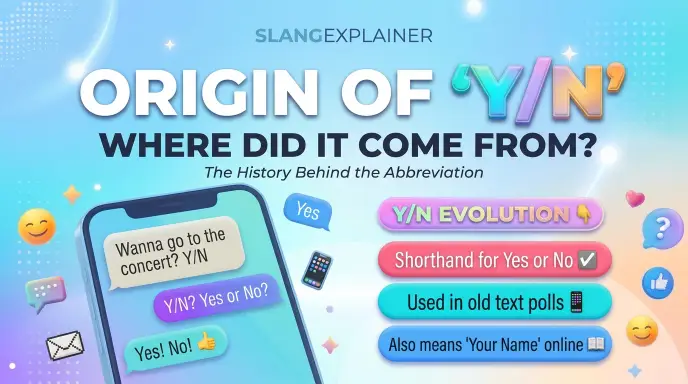
The abbreviation Y/N does not have one universally confirmed origin.
Its development is connected to the broader habit of shortening words in written communication.
The Yes or No Meaning
The Yes/No meaning comes from the first letters of two common English words.
People have used shortened forms and initials in notes, forms, questionnaires, and digital communication for a long time.
As online messaging became more popular, short abbreviations became a convenient way to ask direct questions.
Y/N fits naturally into this style because it communicates a complete question using just three characters, including the slash.
The Your Name Meaning
The Your Name meaning developed within readerifinsert storytelling and online fan communities.
Writers needed a simple way to let readers imagine themselves as characters in fictional stories.
Instead of choosing a specific name, writers used Y/N as a placeholder.
For example:
“Y/N walked into the room and smiled at him.”
Readers can replace those letters with their own names while imagining the scene.
The Influence of Internet Culture
Social media helped make both meanings easier to recognize.
Short captions, interactive questions, fanfiction posts, and POV videos gave the abbreviation more visibility.
Today, Y/N can have different meanings depending on if someone is asking a question or sharing a fictional story.
Its exact first use is uncertain, but its meanings are connected to simple abbreviations and online storytelling.
Y/N vs. IDK, IDC, IMO, and BRB
Y/N belongs to the wider group of internet abbreviations that make online conversations quicker.
However, each expression has a different purpose.
Here is a simple comparison.
| Term | Meaning | Type | Usage | Popularity |
| Y/N | Yes or No / Your Name | Abbreviation | Questions and fanfiction | Contextifdependent |
| IDK | I Don’t Know | Abbreviation | Expressing uncertainty | Very common |
| IDC | I Don’t Care | Abbreviation | Showing indifference | Very common |
| IMO | In My Opinion | Abbreviation | Sharing an opinion | Common |
| BRB | Be Right Back | Abbreviation | Temporary absence | Common |
Y/N
Y/N means Yes or No in ordinary questions. In fanfiction, it can mean Your Name.
IDK
IDK means “I Don’t Know.” People use it when they are unsure about something.
Example: “IDK what time the movie starts.”
IDC
IDC means “I Don’t Care.” It expresses that someone does not have a strong preference or interest.
Example: “IDC which restaurant we choose.”
Depending on the conversation, it can sometimes sound dismissive.
IMO
IMO means “In My Opinion.” It is used when someone wants to share a personal view.
Example: “IMO, this is the best song on the album.”
BRB
BRB means “Be Right Back.” People use it when they are temporarily leaving a conversation.
Example: “BRB, I need to answer the door.”
The main difference is that Y/N asks for a decision or represents a name, while the other abbreviations communicate feelings, opinions, or actions.
Real: World Usage Example: When Might Someone Use Y/N?
Imagine that two friends are planning to go shopping on Saturday.
One friend sends a WhatsApp message:
Friend A: “Hey, we’re going shopping tomorrow. Are you joining us? Y/N?”
The other friend sees the message while studying.
Friend B: “Y! I’ll finish my work by noon.”
Friend A: “Perfect! We’ll meet at the shopping center at 1 PM.”
In this situation, Y/N makes the question short and easy to answer.
Now imagine a different situation.
Someone is reading a romantic fanfiction story on their phone. The story says:
“Y/N looked into his eyes and smiled.”
Here, the letters represent the reader’s name. The writer wants the reader to imagine being the main character.
These examples show why context is important. The same abbreviation can communicate two completely different ideas.
Common Mistakes People Make About Y/N
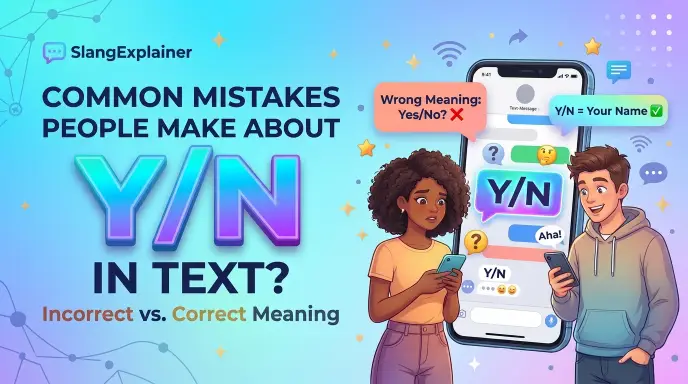
Although Y/N is simple, people sometimes misunderstand it because it has more than one meaning.
Here are some common mistakes to avoid.
1. Thinking It Always Means Yes or No
Many people assume Y/N has only one meaning.
However, it can also mean Your Name in readerifinsert stories.
2. Confusing It With Regular Slang
Y/N is better described as an abbreviation or initialism rather than a traditional slang word.
It is a shortened form of existing words.
3. Ignoring the Conversation Context
If you see Y/N in a question, it probably means Yes or No.
If you see it in a fictional story, it probably means Your Name.
Looking at the surrounding sentence helps you understand the intended meaning.
4. Using It in Every Conversation
Not everyone knows internet abbreviations.
Using Y/N with someone unfamiliar with texting language may create confusion.
When clarity matters, simply write the full words.
Frequently Asked Questions
1. What does Y/N mean in text messages?
Y/N usually means “Yes or No” in text messages. It is used when someone wants a direct answer to a question.
2. What does Y/N mean on TikTok?
On TikTok, Y/N can mean “Yes or No” in questions and comments. In POV and fanfiction videos, it can mean “Your Name.”
3. Is Y/N slang?
Y/N is mainly an abbreviation, not traditional slang. It is used in online conversations and digital storytelling.
4. Is Y/N rude or offensive?
No. Y/N is generally harmless and not offensive. However, the tone of the message can make a question sound demanding.
5. How should you reply to Y/N?
You can reply with “Yes,” “No,” “Yep,” or “Not sure.” Your answer should match the question and situation.
Conclusion
Understanding Y/N is easy once you know the context. In everyday text messages, Y/N usually means “Yes or No” and helps people ask questions that need a quick answer.
On TikTok, Instagram, Snapchat, WhatsApp, and other platforms, it can appear in questions, comments, captions, and online conversations. In fanfiction and POV stories, however, Y/N means “Your Name,” allowing readers to imagine themselves as the main character.
The abbreviation is generally safe and friendly to use with people who understand it. For formal school or workplace communication, writing the complete words is usually clearer.
The best way to understand Y/N is to look at the conversation around it. Once you recognize the context, you can easily understand what the sender means and respond naturally.

I’m Dylan Foster, a slang and internet culture writer passionate about exploring how people communicate online and in everyday conversations. I write about texting abbreviations, social media expressions, and modern slang to help readers understand meanings, origins, and real-world usage in a simple way.