Featured Snippet:
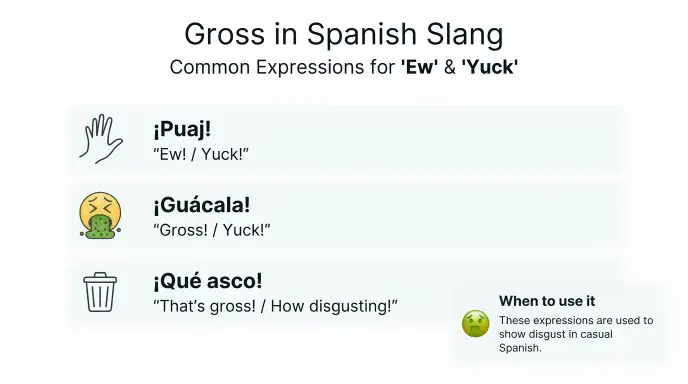
“Gross” in Spanish slang can be ¡puaj!, ¡guácala!, or ¡qué asco!, depending on the country and situation. These casual expressions show disgust, similar to “ew,” “yuck,” or “gross” in English. ¡Guácala! is especially associated with Latin American Spanish, while ¡puaj! is a common conversational reaction to something unpleasant.
If you want to say gross in Spanish slang, you have several natural choices. The best one depends on if you are reacting to something disgusting, describing something as disgusting, or talking about a person or situation.
For a quick reaction like “Ew!” or “Gross!”, Spanish speakers may say ¡puaj!, ¡guácala!, or ¡qué asco!. For example, if you see spoiled food, you could say, “¡Puaj!,” meaning “Gross!” or “Yuck!” ¡Guácala! is another casual expression used in Latin America to show disgust.
If you want to describe something as gross, asqueroso or asquerosa is more direct. Cambridge defines asqueroso as something that causes disgust or feels revolting.
The important point is that there is no single Spanish slang word that fits every use of English “gross.” Your choice changes with the sentence, country, and tone.
Quick Answer gross in spanish slang
| Question | Answer |
| Meaning | Disgusting, unpleasant, or “ew/yuck” |
| Common slang reaction | ¡Puaj! |
| Latin American slang | ¡Guácala! |
| Common phrase | ¡Qué asco! |
| Describing something gross | Asqueroso / asquerosa |
| Tone | Casual and informal |
| Offensive? | Usually no, but it can sound rude when aimed at a person |
A useful distinction is the difference between a reaction and a description. You might shout “¡Puaj!” when you see something disgusting, but you would normally use “asqueroso” to describe the thing itself. That small difference makes your Spanish sound much more natural.
What Does “Gross” Mean in Spanish Slang?
When English speakers say “Gross!”, they often mean that something is disgusting, dirty, unpleasant, or makes them feel uncomfortable.
Spanish has several casual ways to express that feeling.
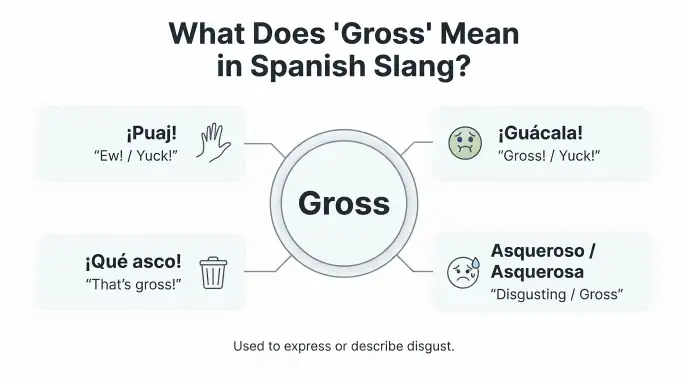
The most useful options are:
- ¡Puaj! “Gross!” / “Yuck!” / “Ew!”
- ¡Guácala! “Gross!” / “Yuck!”
- ¡Qué asco! “How disgusting!” / “That’s gross!”
- ¡Qué asqueroso! “How gross!” / “How disgusting!”
- Asqueroso / asquerosa “gross,” “disgusting”
The first three are especially useful when you are reacting to something. Asqueroso is usually used as an adjective to describe something.
For example:
¡Puaj! Ese olor es horrible.
“Gross! That smell is awful.”
¡Qué asco! Hay comida podrida aquí.
“That’s gross! There is rotten food here.”
Ese baño es asqueroso.
“That bathroom is gross.”
Cambridge lists asqueroso, repugnante, and basto among translations for the “disgusting” sense of gross.
The Most Natural Slang Words for “Gross”
Not every Spanish expression has the same feel. Here is a simple comparison.
| Spanish expression | English meaning | Main use | Tone |
| ¡Puaj! | Ew! / Yuck! / Gross! | Reaction | Casual |
| ¡Guácala! | Gross! / Yuck! | Reaction | Casual, Latin American |
| ¡Qué asco! | That’s gross! | Reaction or judgment | Casual |
| Asqueroso/a | Gross / disgusting | Description | Casual to neutral |
| Repugnante | Repulsive / disgusting | Description | Stronger, more formal |
| Grosero/a | Rude / vulgar | Behavior or language | Different meaning |
That last word is important. Grosero looks somewhat similar to the English word “gross,” but it usually means rude, impolite, or vulgar, not “disgusting.” Cambridge gives grosero as “rude” and “coarse.
So saying “grosero” when you mean “gross” can create confusion.
Puaj! : A Simple Way to Say “Gross!”
Puaj! is one of the easiest Spanish reactions to learn.
It works much like:
- Ew!
- Yuck!
- Gross!
- Ugh!
SpanishDictionary lists ¡puaj! as a colloquial interjection used to express disgust.
Examples
¡Puaj! Ese queso huele terrible.
“Gross! That cheese smells terrible.”
¡Puaj! ¿Qué hay en esa bolsa?
“Ew! What’s in that bag?”
¡Puaj! No quiero tocar eso.
“Yuck! I don’t want to touch that.”
The expression is useful because you do not need a full sentence. If you see something unpleasant, simply say “¡Puaj!” can communicate your reaction.
Guácala! : Latin American Slang for “Gross”
¡Guácala! is a very useful Latin American expression for disgust.
SpanishDictionary describes it as a colloquial interjection used to express disgust and identifies it as a regional expression in Latin America. It also notes the spelling huácala as a variant.
Examples
¡Guácala! Esa comida está podrida.
“Gross! That food is rotten.”
¡Guácala! Hay un pelo en mi comida.
“Ew! There’s a hair in my food.”
¡Guácala! Huele muy mal.
“Yuck! It smells really bad.”
You may hear or see ¡guácala! more in Latin American contexts than in Spain. Because slang and interjections vary by region, it is better not to assume that every Spanishifspeaking country uses the same expression equally.
¡Qué Asco! Means “That’s Gross!”
¡Qué asco! literally relates to disgust and is commonly used as a reaction.
It can translate naturally as:
- “Gross!”
- “That’s disgusting!”
- “How disgusting!”
- “Yuck!”
SpanishDictionary gives examples where ¡Qué asco! corresponds directly to “Gross!” and “That’s gross!”
Example
La comida tiene moho. ¡Qué asco!
“The food has mold. Gross!”
It can also be used when you dislike something strongly:
¡Qué asco ese olor!
“That smell is disgusting!”
This expression is especially helpful because it sounds natural in many everyday situations.
Asqueroso Means “Gross” or “Disgusting”
If you are not making a quick reaction but actually describing something, use asqueroso or asquerosa.
The ending changes according to the noun:
- asqueroso masculine
- asquerosa feminine
For example:
El baño está asqueroso.
“The bathroom is gross.”
La comida está asquerosa.
“The food is disgusting.”
Cambridge defines asqueroso as something that causes disgust or an unpleasant feeling.
It can describe:
- food
- smells
- dirty places
- unpleasant objects
- disgusting behavior
- something that makes you feel disgust
It is stronger than simply saying that something is “not nice.”
Gross in Spanish Texting and Social Media
When people text or comment online, short expressions are often more natural than full sentences.
| English | Spanish casual version |
| Gross! | ¡Puaj! |
| Ew! | ¡Puaj! |
| Yuck! | ¡Guácala! |
| That’s gross! | ¡Qué asco! |
| So gross! | ¡Qué asco! / ¡Qué asqueroso! |
| That is disgusting | Eso es asqueroso |
You may also see repeated letters or punctuation online for extra emotion, such as:
¡Puajjj! 🤢
or
¡Guácala! 🤢
These are informal online styles rather than fixed Spanish grammar rules.
The emoji 🤢 is a natural match when someone wants to make the disgust clear.
Where “Gross” Expressions Are Used
The meaning stays close across platforms, so there is no need to learn a different translation for every social network.
| Platform | Typical use | Example |
| TikTok | Reaction to a video | ¡Guácala! 🤢 |
| Comment or caption | ¡Qué asco! | |
| Snapchat | Quick reaction | ¡Puaj! |
| Texting friends | ¡Puaj, qué asco! | |
| Discord | Casual chat | ¡Guácala! |
| Commenting on unpleasant content | Qué asco |
The exact expression depends more on the speaker and region than on the platform.
Is “Gross” in Spanish rude or offensive?
Usually, expressions such as ¡puaj!, ¡guácala!, and ¡qué asco! are not swear words.
Still, context matters.
If you react to rotten food, saying “¡Qué asco!” is simply a statement of disgust.
If you say “Eres asqueroso” directly to someone, the meaning becomes much more personal. It can sound insulting because you are calling the person disgusting.
Compare:
| Phrase | Meaning | Social effect |
| ¡Puaj! | Ew! | Usually harmless |
| ¡Qué asco! | That’s gross! | Usually casual |
| Es asqueroso. | It is disgusting. | Strong criticism |
| Eres asqueroso. | You are disgusting. | Insulting |
So the word itself is not automatically offensive. Who or what you are describing makes a big difference.
Gross vs. Rude in Spanish
English “gross” has several meanings, which can cause translation mistakes.
If “gross” means disgusting, use words such as:
asqueroso, ¡puaj!, ¡guácala!, ¡qué asco!
If “gross” means rude or vulgar, grosero may be appropriate.
Example
That smell is gross.
→ Ese olor es asqueroso.
His comments were gross.
→ Depending on the meaning, this could refer to disgusting content or rude/vulgar comments.
He is rude.
→ Él es grosero.
This distinction is important because grosero does not normally mean “disgusting” in the same way as asqueroso.
Gross in Spain vs. Latin America
Spanish is spoken across many countries, so casual expressions can vary.
¡Guácala! is specifically documented as a Latin American regionalism and is not listed as a Spainifwide expression in the cited dictionary entry.
¡Puaj! and ¡qué asco! are useful expressions for expressing disgust, while asqueroso/asquerosa directly describes something as disgusting.
If you are unsure which regional expression to choose, ¡qué asco! or asqueroso/a can often communicate the basic idea clearly, while ¡guácala! gives a more distinctly Latin American flavor.
How to Pronounce These Spanish Expressions
Here is a simple guide:
| Spanish | Approximate pronunciation |
| ¡Puaj! | “pwah” |
| ¡Guácala! | “gwahifkahiflah” |
| ¡Qué asco! | “keh ahsifkoh” |
| Asqueroso | “ahsifkehifROHifsoh” |
| Asquerosa | “ahsifkehifROHifsah” |
SpanishDictionary gives ¡puaj! as “pwahh” and ¡guácala! as “gwahifkahiflah.”
Real : Life Examples
Text Message
Nora: I opened the fridge.
Mateo: What happened?
Nora: There’s something green growing on the leftovers.
Mateo: ¡Puaj! Qué asco.
Here, ¡puaj! gives the immediate “ew” reaction, while qué asco adds stronger disgust.
TikTok Comment
“¡Guácala! ¿Por qué tocaría eso? 🤢”
This sounds like a quick, emotional reaction to something unpleasant.
Everyday Conversation
Luis: ¿Quieres probar esta salsa?
Carla: No, gracias. Huele raro.
Luis: ¿En serio?
Carla: Sí. ¡Qué asco!
Here, qué asco means “That’s gross” rather than simply describing the sauce with an adjective.
Describing Something
El restaurante estaba muy sucio. El baño era asqueroso.
“The restaurant was very dirty. The bathroom was gross.”
In this sentence, asqueroso is better than puaj because the speaker is describing the bathroom rather than simply reacting to it.
Common Mistakes
1. Using “grosero” for every meaning of “gross”
This is one of the easiest mistakes to make.
Grosero usually relates to being rude, vulgar, or impolite. It is not the normal choice for something that makes you feel physically disgusted.
2. Treating “¡puaj!” like an adjective
¡Puaj! is an interjection. You use it as a reaction.
Natural:
¡Puaj! Eso huele mal.
Not:
La comida es puaj.
For the second idea, use asquerosa or another adjective.
3. Assuming “guácala” is universal Spanish
Spanish varies by region. ¡Guácala! is strongly associated with Latin American usage.
4. Calling a person “asqueroso” without considering tone
Eres asqueroso can be a direct insult.
If you only mean that an object or situation is unpleasant, describe the object or situation instead.
5. Confusing “gross” with “gross income”
English gross also has financial meanings. For example, “gross income” translates with ingresos brutos, not asqueroso. Cambridge distinguishes these meanings clearly.
Similar Spanish Slang and Expressions
| Expression | English equivalent | Best use |
| ¡Puaj! | Ew! / Yuck! | Quick reaction |
| ¡Guácala! | Gross! / Yuck! | Latin American reaction |
| ¡Qué asco! | That’s gross! | Strong reaction |
| Asqueroso/a | Gross / disgusting | Description |
| Repugnante | Repulsive | Strong description |
| ¡Ugh! | Ugh! | Disgust or annoyance |
SpanishDictionary and Cambridge both support ¡puaj! as a disgust reaction, while ¡qué asco! directly corresponds to “Gross!” in conversational examples.
Key Takeaways
- ¡Puaj! is a natural Spanish reaction meaning “Ew!” or “Gross!”
- ¡Guácala! is a casual Latin American expression for disgust.
- ¡Qué asco! means “That’s gross!” or “How disgusting!”
- Asqueroso/asquerosa describes something as gross or disgusting.
- Grosero/a usually means rude or vulgar, so it is not a direct replacement for every use of “gross.”
- Choose the expression based on the situation and Spanishifspeaking region.
FAQs
Q1. What is the slang word for “gross” in Spanish?
Common slang expressions are ¡puaj!, ¡guácala!, and ¡qué asco!. They can mean “Ew!”, “Yuck!”, or “Gross!” depending on the situation.
Q2. What does “gross” mean in Spanish?
For the meaning “disgusting,” common Spanish choices include asqueroso/asquerosa, ¡qué asco!, and ¡puaj!. The best choice depends on whether you are describing something or reacting to it.
Q3. How do Mexicans say “gross”?
In Mexican Spanish, ¡guácala! is a common casual expression for disgust. You may also hear ¡qué asco! or ¡puaj!, depending on the speaker and situation.
Q4. How do you say “yuck” in Spanish slang?
You can say ¡puaj! or ¡guácala! for “Yuck!” Both are casual expressions of disgust. ¡Qué asco! is another natural choice when you mean “That’s gross!”
Q5. What is “nasty” in Spanish slang?
Depending on the meaning, asqueroso/a can mean “nasty” when something is disgusting. Sucio/a can mean “dirty,” while grosero/a can mean “rude” or “vulgar.” The right word depends on the context.
Q6. What is “yucky” in Spanish?
Yucky can be translated as asqueroso/asquerosa when something is disgusting. In a casual reaction, you can also say ¡puaj!, ¡guácala!, or ¡qué asco!.
Conclusion
There is more than one natural way to say gross in Spanish slang. The best choice depends on what you are trying to say.
For a quick “Ew!” reaction, ¡puaj! works well. ¡Guácala! is another casual choice, especially in Latin American Spanish. If you want to say “That’s gross!” or “How disgusting!”, ¡qué asco! is a useful everyday expression. When you want to describe something directly as gross or disgusting, use asqueroso or asquerosa.
One important trap is grosero. Although it looks similar to “gross,” it usually means rude or vulgar, not disgusting.
Learning these small differences helps you sound more natural and avoid awkward translations. The safest approach is to match the expression to the situation, your audience, and the Spanishifspeaking region.

I’m Dylan Foster, a slang and internet culture writer passionate about exploring how people communicate online and in everyday conversations. I write about texting abbreviations, social media expressions, and modern slang to help readers understand meanings, origins, and real-world usage in a simple way.