If you have heard a word like “gat,” “piece,” or “strap” in a song, movie, socialifmedia post, or online conversation, you may wonder what it means. The search for a slang word for gun is often about understanding language rather than the object itself.
Slang can be confusing because informal words do not always have one fixed meaning. A term may be common in one generation but unfamiliar to another. Some expressions are associated with American English, while others appear mainly in music, movies, fiction, gaming, or internet conversations.
This guide explains common gunifrelated slang in simple English and focuses on how these words are actually used in conversation and popular culture. It also points out when a term is oldiffashioned, informal, or strongly dependent on context.
Remember that slang is not the same as standard English. A word such as “iron” or “strap” can have completely different meanings in an ordinary sentence. Looking at the surrounding words is therefore important when trying to understand what someone means.
Quick Answer
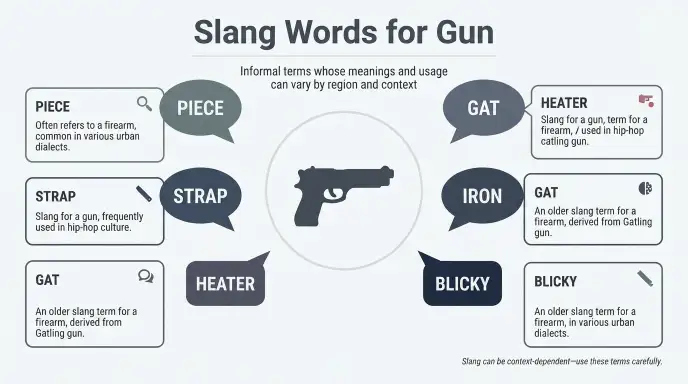
Common slang terms include “gat,” “piece,” “heater,” “iron,” and “strap.” Their meaning depends on context, region, generation, and popular culture.
Common Slang Words for Gun
Several informal terms have been used to refer to a gun in different periods and communities. Some are still recognizable today, while others are mostly found in older movies, songs, books, or fictional dialogue.
| Slang Word | General Meaning | Typical Context |
| Gat | Gun | American slang, music, movies |
| Piece | Gun | Informal speech, fiction |
| Heater | Gun | Older slang, movies, fiction |
| Iron | Gun | Historical slang, fiction |
| Strap | Gun | Contemporary slang, music |
| Roscoe | Gun | Older American slang |
| Shooter | A person or thing related to shooting | Informal speech, gaming |
| Blaster | Fictional gun or weapon | Science fiction, gaming |
These terms should not be treated as exact replacements for the word gun in every sentence. Their tone and meaning can change according to the speaker and situation.
What Does “Gat” Mean in Slang?
“Gat” is an informal slang word for a gun.
The term is strongly associated with American slang and has appeared in music, movies, television, and fictional crime stories. Someone who encounters “gat” today may recognize it because of popular culture even if they never use the word themselves.
The age of the expression is also important. Some slang becomes less common in everyday conversation while remaining familiar through entertainment.
For example, a fictional character in an American crime story might use “gat” as an informal reference to a gun. The expression can give dialogue a particular cultural or historical tone.
However, slang should not automatically be assumed to describe realiflife behavior. Writers often use such expressions simply to create a character, setting, or fictional atmosphere.
What Does “Piece” Mean in Slang?
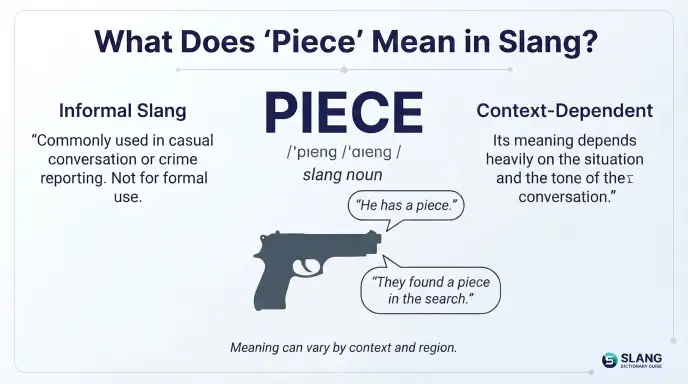
“Piece” can be used informally to mean a gun.
This is one of the more interesting examples because “piece” has many ordinary meanings in English. It can mean a part of something, an artwork, an item, a chess piece, or a portion of something.
The slang meaning only becomes clear from context.
For example, if a fictional character uses “piece” while discussing a weapon, the reader can understand that the word has its slang meaning. In another sentence, the same word may have nothing to do with weapons at all.
This is why translating slang wordifforifword can sometimes produce an incorrect interpretation.
What Does “Heater” Mean in Slang?
“Heater” is an older slang term that can refer to a gun.
The normal English meaning of “heater” is something that produces heat. A heater may refer to a heating device or, informally, something associated with warmth.
In older American slang and fictional dialogue, however, the word has also been used for a gun.
Today, “heater” may sound oldiffashioned or stylized when used with this meaning. Younger speakers may recognize it primarily because they have heard it in movies, books, television shows, or older music.
The meaning therefore depends heavily on the surrounding sentence.
What Does “Iron” Mean in Slang?
“Iron” has been used as informal slang for a gun, particularly in older American English.
The ordinary meaning of “iron” refers to a metal or an object made from iron. Because the word has several literal meanings, readers should not automatically interpret it as gun slang.
The slang meaning is more likely to appear in historical writing, crime fiction, movies, or cultural references.
For example, an oldiffashioned character in a novel may use “iron” in a way that clearly refers to a weapon. The same word in a sentence about construction or metal obviously has a different meaning.
What Does “Strap” Mean in Slang?
“Strap” can refer to a gun in some modern slang contexts.
The term is especially recognizable in contemporary music and informal speech. However, “strap” has several completely ordinary meanings.
A strap can be a strip of material used to carry, hold, or secure something. It can also appear in everyday expressions unrelated to weapons.
Because of this, the word “strap” by itself does not necessarily mean a gun. The surrounding conversation is essential.
Social media has also helped slang spread quickly between different communities. As a result, people may encounter a term online that originated in a different region, generation, or cultural setting.
Slang vs. Standard Words
Not every informal reference is technically slang, and some words are better suited to formal writing than others.
For example, firearm is generally a neutral or formal word rather than slang. It is commonly used in news reporting, legal writing, official documents, and educational material.
By contrast, terms such as “gat” and “piece” are much more informal.
| Term | Language Style | Where You May See It |
| Gun | Neutral | Everyday English |
| Firearm | Formal/neutral | News, legal, academic writing |
| Gat | Slang | Music, movies, informal speech |
| Piece | Slang/informal | Fiction, music, informal speech |
| Heater | Historical slang | Older fiction and movies |
| Iron | Historical/informal | Older slang and fiction |
| Strap | Modern informal slang | Music, online discussions |
Knowing the difference is useful because slang is not appropriate for every situation.
Why Context Matters When Understanding Slang
One of the biggest problems with slang is that a single word can have several meanings.
Take “piece” as an example. In a normal conversation, it could refer to a piece of food, a piece of paper, a piece of art, or part of an object. In a particular slang context, it can refer to a gun.
The same issue occurs with “strap” and “iron.”
When you see an unfamiliar slang word, ask yourself:
- What is the complete sentence?
- Who is using the word?
- Is the conversation serious or fictional?
- Is it from a song, movie, game, or socialifmedia post?
- Does the speaker appear to be using American, British, or another variety of English?
- Could the word have a normal meaning in this sentence?
These questions can make slang much easier to understand.
Where GunifRelated Slang Appears
Gunifrelated slang can occur in several areas of popular culture and informal communication.
Music
Music, particularly American popular music, has introduced many slang expressions to international audiences. Listeners may encounter unfamiliar terms while reading lyrics or discussing songs online.
A slang reference in a song does not necessarily represent literal realifworld behavior. Music can use storytelling, fictional characters, metaphor, exaggeration, or cultural references.
Movies and Television
Crime dramas, action movies, westerns, and television series frequently use slang to make dialogue sound natural for a particular character or setting.
Writers may choose an older slang term to make a character sound like they belong to a particular time period.
Books
Novels can preserve slang that is no longer common in everyday English. Historical fiction and crime fiction are especially likely to contain older informal expressions.
Gaming
Gaming communities use their own vocabulary. Terms such as “shooter” can sometimes refer to a person, a game genre, or fictional gameplay rather than a realifworld weapon.
Social Media
TikTok, Reddit, Instagram, Discord, and messaging platforms allow slang to spread rapidly. However, meanings can differ from one online community to another.
Key Takeaway So Far
The most recognizable slang terms for a gun include gat, piece, heater, iron, and strap. Their meanings are strongly influenced by context, generation, region, music, movies, and online culture.
The safest way to understand an unfamiliar slang term is to look at the complete sentence instead of assuming that one word always has one meaning.
More Slang Terms for Gun
Along with “gat,” “piece,” “heater,” “iron,” and “strap,” you may come across several other expressions in books, movies, music, and online conversations. Some are older terms, while others are mainly used in fictional or cultural contexts.
“Roscoe” Meaning in Slang
“Roscoe” is an older American slang term for a gun.
It is not as common in everyday modern English as words such as “gun” or “firearm.” You are more likely to see it in older crime stories, historical writing, movies, or discussions about American slang.
Because slang changes over time, a person reading an older novel may encounter “Roscoe” and need context to understand it.
“Rod” Meaning in Slang
“Rod” can have several meanings in English, including a long, narrow object or bar. In some informal contexts, it has also been used as slang for a gun.
However, this meaning is highly contextifdependent. A reader should not assume that “rod” refers to a gun simply because it appears in informal dialogue.
“Blaster” in Fiction and Gaming
“Blaster” is commonly associated with fictional weapons, especially in scienceiffiction movies, books, and video games.
Unlike many traditional slang terms, “blaster” is often more strongly connected to fictional worlds than ordinary realiflife conversation.
Gaming communities may also use the word casually when discussing fictional gameplay.
Gun Slang by Context
The same slang term can feel very different depending on where you encounter it.
| Context | Terms You May Encounter | Typical Tone |
| Older American slang | Heater, iron, Roscoe | Historical or oldiffashioned |
| Modern music | Strap, gat, piece | Informal and cultural |
| Crime fiction | Piece, gat, iron | Characterifdriven |
| Movies & TV | Gat, heater, piece | Dramatic or fictional |
| Science fiction | Blaster | Fictional |
| Gaming | Blaster, shooter | Gameifspecific |
| Formal writing | Firearm, gun | Neutral/formal |
This table shows why there is no single “best” slang word. The right interpretation depends on the source and audience.
Why Do People Use Slang Instead of “Gun”?
People use slang for many reasons. Language is not only about communicating basic information; it can also express identity, humor, history, attitude, and cultural belonging.
In music and fiction, slang can make dialogue sound more natural for a particular character. A writer may choose a specific expression because it reflects the character’s age, location, or social environment.
Slang can also create a particular tone. A historical term may make a scene feel like it belongs to an earlier period, while a modern expression can make dialogue sound contemporary.
Online, slang spreads because people communicate quickly and creatively. A term can move from music or television into socialifmedia conversations and then develop new meanings.
Modern vs. Older Gun Slang
Not every slang expression has the same level of popularity today.
Some words remain widely recognizable, while others are mainly understood because of popular culture.
| Slang Term | General Era/Popularity | Modern Recognition |
| Gat | Older but still recognizable | High |
| Piece | Longifstanding slang | High |
| Heater | More historical | Moderate |
| Iron | Historical/informal | Moderate |
| Strap | More contemporary | High |
| Roscoe | Older slang | Low to moderate |
| Blaster | Mainly fictional | High in gaming/sciiffi |
“Recognition” does not necessarily mean that people commonly use the term. Someone may understand a word because they have heard it in a movie without ever using it in everyday speech.
Common Mistakes When Interpreting Gun Slang
Assuming Every “Strap” Means a Gun
“Strap” has several normal meanings. It can refer to a physical strap, a beltiflike object, or something used to secure an item.
Always read the complete sentence before deciding what it means.
Assuming “Iron” Always Means Gun
“Iron” normally refers to a metal or something made from it. Its gunifrelated meaning is a slang or historical usage.
Treating Movie Dialogue as Everyday Speech
Movies and television often use dramatic or stylized language. A word may sound common because you hear it repeatedly in entertainment even though ordinary speakers rarely use it.
Ignoring the Speaker’s Age
Older slang may be familiar to one generation and strange to another.
Assuming Online Slang Is Universal
Internet communities frequently develop their own vocabulary. A term used on one platform may not have the same popularity or meaning elsewhere.
How to Tell If a Word Refers to a Gun
Context is the most useful clue.
Look at the words surrounding the slang term. If the sentence clearly discusses weapons, crime fiction, an action scene, or a fictional character, the intended meaning may become obvious.
You should also consider the source.
A word appearing in:
- a historical novel,
- a rap song,
- an action movie,
- a gaming conversation,
- a socialifmedia post,
may carry a different tone even when the basic slang meaning is similar.
The safest approach is to interpret the entire sentence rather than translating one slang word in isolation.
Examples of GunifRelated Slang in Context
The following examples are designed to demonstrate language meaning and context, not weapon use.
Example 1: “Gat”
“The movie character called it a gat.”
Here, “gat” is being used as an informal reference to a gun.
Example 2: “Piece”
“The crime novel used the word piece several times.”
In this fictional context, “piece” can be understood as gunifrelated slang.
Example 3: “Heater”
“The old detective story used heater as slang.”
Here, the word has a historical slang meaning rather than its ordinary meaning of a heating device.
Example 4: “Iron”
“The western used iron in its oldiffashioned dialogue.”
The setting helps indicate that “iron” is being used as historical slang.
Example 5: “Strap”
“The song contains the slang term strap.”
The surrounding lyrics and context would be needed to determine its exact meaning.
Are Gun Slang Words Appropriate in Formal Writing?
Usually, no.
If you are writing an essay, news article, academic paper, report, or professional document, gun or firearm is generally clearer and more appropriate.
Slang is better suited to situations where informal language is actually being discussed, such as:
- slang dictionaries,
- language research,
- cultural analysis,
- literary analysis,
- dialogue explanation,
- music interpretation,
- movie or television discussions.
Using slang simply because it sounds more interesting can make formal writing less precise.
Why Slang Meanings Change
Slang is constantly evolving.
A word can become popular through music, television, movies, sports, online communities, or regional speech. Later, another generation may stop using it.
Some terms disappear almost completely. Others survive because they are repeatedly used in popular entertainment.
This explains why older expressions such as “Roscoe” or “heater” may still be recognizable even though they are not everyday vocabulary for many modern speakers.
The internet has accelerated this process. Social media allows expressions to cross geographical and cultural boundaries much faster than in the past.
Frequently Asked Questions
Q1. What is another word for gun in slang?
Common slang examples include gat, piece, heater, iron, strap, and Roscoe. Their popularity varies by time and context.
Q2. What does “gat” mean?
“Gat” is an informal American slang term for a gun. It is frequently recognizable from music, movies, and fictional dialogue.
Q3. Is “piece” a slang word?
Yes. “Piece” can be used as slang for a gun, although the word has many other ordinary meanings.
Q4. Is “strap” always slang for a gun?
No. “Strap” has many literal meanings. Its gunifrelated meaning depends on context.
Q5. What does “heater” mean in slang?
“Heater” has been used as older American slang for a gun. It can also have its ordinary meaning related to heating.
Q6. What is the difference between gun slang and formal terminology?
Gun slang is informal and often culturally specific. Terms such as “gun” and “firearm” are more neutral and suitable for general or formal communication.
Q7. Why is context important with slang?
Many slang words have multiple meanings. Context helps determine if the speaker is using the word literally, figuratively, historically, or as slang.
Conclusion
Understanding a slang word for gun is mainly about understanding how informal English changes across cultures, generations, and forms of entertainment. Words such as “gat,” “piece,” “heater,” “iron,” and “strap” can appear in music, movies, books, gaming conversations, and online discussions, but they do not all have the same history or tone.
Some expressions are modern, while others are strongly associated with older American slang. Others, such as “blaster,” are more commonly connected with fictional worlds.
The most important lesson is simple: context matters. A word such as “piece,” “iron,” or “strap” can have an ordinary meaning in one sentence and a slang meaning in another.
For formal communication, neutral words such as “gun” or “firearm” are generally clearer. For understanding songs, movies, fiction, and internet conversations, however, knowing these slang expressions can make unfamiliar language much easier to interpret.

I’m Dylan Foster, a slang and internet culture writer passionate about exploring how people communicate online and in everyday conversations. I write about texting abbreviations, social media expressions, and modern slang to help readers understand meanings, origins, and real-world usage in a simple way.