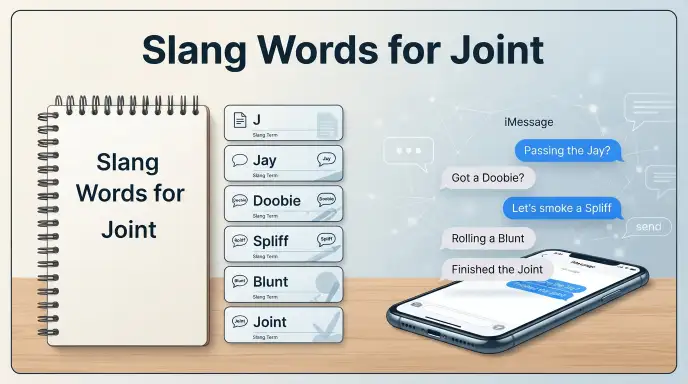
Slang words for joint can be confusing, especially when you come across terms like “J,” “jay,” “doobie,” or “spliff” in a text, comment, meme, or online conversation. If you are unfamiliar with cannabisifrelated slang, it can be difficult to understand what someone actually means.
These expressions are mostly informal and can vary depending on location, age group, and online community. Some words are used as direct alternatives for “joint,” while others describe similar but technically different rolled cannabis products.
Understanding the difference can help you interpret messages without guessing. It is also important to remember that slang is flexible, so the same word may not mean exactly the same thing everywhere.
Quick Answer:Slang Words for Joint:
Common slang words for a joint include J, jay, doobie, spliff, and sometimes blunt. However, terms such as “spliff” and “blunt” can describe different types of rolled cannabis products depending on regional usage.
What Does “Slang Words for Joint” Mean in Text?
When people search for slang words for joints, they are usually trying to understand informal language used to describe a cannabis joint.
In texting, people often shorten words because casual conversations do not require formal language. For example, someone might write:
“He brought a J.”
In this context, J is short for joint.
Another person might say:
“They were talking about a doobie.”
Here, doobie is an informal term commonly used for a cannabis joint.
These expressions can appear in private messages, social media comments, online discussions, memes, musicifrelated conversations, and other informal settings.
The important point is that not every slang word is a perfect synonym. Joint, spliff, and blunt can have different traditional meanings, even though people sometimes use them loosely.
Common Slang Words for a Joint
There are several terms you may encounter when reading informal conversations.
| Slang Word | General Meaning | Typical Usage |
| J | Short form of joint | Texting and casual chats |
| Jay | Spoken or written form of “J” | Informal conversation |
| Doobie | Slang for a joint | Casual American English |
| Spliff | Traditionally a cannabisifandiftobacco roll | British, Caribbean, and international usage |
| Blunt | Traditionally a cannabis roll associated with cigarifstyle wrapping | American slang |
| Cone | A coneifshaped rolled cannabis product | Informal cannabis vocabulary |
| Preifroll | A readyifmade rolled cannabis product | Modern and retail contexts |
| Joint | Common informal term itself | General usage |
The exact meaning can change depending on the speaker and location. That is why context is especially important when interpreting slang.
J Meaning in Slang
J is one of the simplest slang terms for a joint. It is essentially an abbreviation of the word “joint.”
You may see it written in texts like:
“He mentioned bringing a J.”
Or:
“What does J mean in this message?”
When the conversation is clearly about cannabis, the intended meaning is usually easy to understand.
However, J does not always mean joint. It can refer to a person’s name, an initial, a letter, a grade, or another abbreviation. You should therefore avoid interpreting it automatically without looking at the surrounding conversation.
Jay vs. J
Jay is often simply the spoken version of the letter J.
For example:
“He called it a jay.”
This can mean the same thing as saying “J” in an informal cannabisifrelated conversation.
Because slang is constantly changing, spelling and pronunciation may differ from one person to another.
Doobie Meaning in Slang
Doobie is a familiar informal word for a cannabis joint.
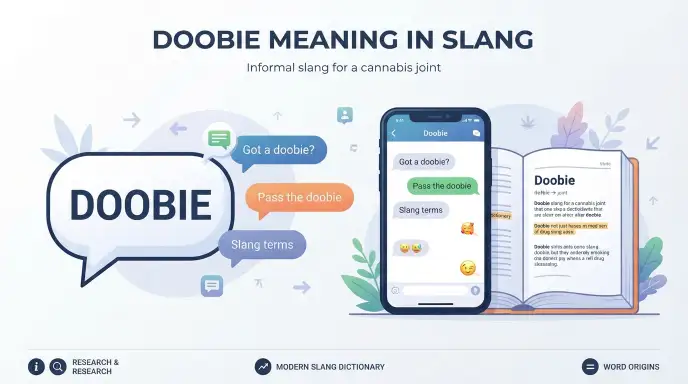
The term has a playful, casual tone and has appeared in American popular culture for decades. You may encounter it in jokes, entertainment, social media posts, or informal conversations.
For example:
“I heard someone use the word doobie in a movie.”
The word is generally casual rather than formal. It would be unusual in professional writing where precise, neutral terminology is expected.
The popularity of “doobie” also varies by generation. Some speakers may recognize it immediately, while younger internet users may prefer shorter or newer expressions.
Spliff Meaning in Slang
Spliff is closely related to “joint,” but the two terms are not always interchangeable.
Traditionally, a spliff refers to a rolled product containing cannabis mixed with tobacco. However, regional usage can differ, and some speakers use “spliff” more broadly.
This is one reason slang dictionaries should provide context rather than presenting every slang term as having one universal definition.
For example:
“He called it a spliff, but his friend called it a joint.”
The disagreement may simply reflect different regional or personal vocabulary.
Blunt vs. Joint
Blunt is another word that people sometimes use as if it means the same thing as “joint.”
Traditionally, however, the terms describe different styles of rolled cannabis products.
A joint is generally associated with rolling paper, while a blunt is traditionally associated with cigar or cigarilloifstyle wrapping.
Online conversations can blur this distinction, so you may see people using the terms loosely.
| Term | Traditional distinction |
| Joint | Cannabis rolled in paper |
| Spliff | Traditionally cannabis mixed with tobacco |
| Blunt | Traditionally associated with cigarifstyle wrapping |
| Preifroll | A readyifmade rolled cannabis product |
These distinctions are useful when interpreting slang, but they should not be treated as universal because language and regional usage change.
Where Are These Slang Terms Commonly Used?
Slang related to joints is most likely to appear in informal communication.
Text Messages
Texting encourages short expressions. A person may use J instead of writing the full word because the intended audience already understands it.
Social Media
Terms such as J, doobie, and blunt can appear in captions, comments, memes, and casual discussions on social platforms.
Reddit contains many communities with specialized vocabulary. A word may have a particular meaning within one community while being less familiar elsewhere.
Discord
Discord slang varies greatly between servers. A gaming or social server may use informal expressions that outsiders do not immediately understand.
Music and Entertainment
Cannabisifrelated slang has also been spread through music, movies, television, and internet culture. This is one reason people may recognize words such as “doobie” even if they rarely use them themselves.
RealifLife Examples of Usage
Understanding the tone of a slang term is just as important as understanding its definition.
Friendly Example
“He called it a J when he was joking with his friends.”
Here, J is being used casually between people who understand the reference.
Casual Example
“I saw the word doobie in a comment and had to look it up.”
This is a simple example of someone encountering unfamiliar slang online.
Social Media Example
“Why does everyone keep saying ‘jay’ in these comments?”
The word “jay” is being discussed as internet or conversational slang.
Educational Example
“The article explains how joint, spliff, and blunt are used differently.”
Here, the words are being discussed as vocabulary rather than used as instructions.
Why Do People Use Slang for a Joint?
People use slang for several ordinary linguistic reasons.
Shorter communication: A single letter such as “J” is faster to type than a longer phrase.
Social connection: Shared vocabulary can signal that people belong to the same social group or community.
Casual tone: Informal words often make a conversation sound relaxed and conversational.
Popular culture: Music, movies, memes, and social media can make certain expressions widely recognizable.
Indirect wording: Some people prefer slang because it sounds less direct than a literal description.
The meaning is therefore not just about the word itself. The speaker’s relationship with the audience and the overall conversation also matter.
Is This Slang Rude, Offensive, or Neutral?
Most common slang words for a joint are informal rather than inherently offensive.
Words such as J, jay, doobie, and joint are generally casual terms. However, their appropriateness depends on the situation.
For example, using slang in a conversation with friends may sound natural, while using it in a formal report may appear unprofessional.
If your goal is maximum clarity, a neutral expression such as “cannabis joint” is usually easier for a broad audience to understand.
Key Takeaway
The most common informal terms include J, jay, doobie, joint, spliff, and blunt. While some are used interchangeably in casual speech, they can have different traditional meanings.
When you see one of these terms in a text, always consider the context, location, and surrounding words before deciding exactly what the speaker means.
Slang Words for Joint Meaning in Text: Common Terms, Uses & Examples
Origin and Background of Joint Slang
The slang surrounding cannabis joints has developed over many decades through everyday speech, music, entertainment, regional vocabulary, and changing social attitudes.
The word joint itself is not exclusively related to cannabis. In English, “joint” has many meanings, including a place where two things connect and an informal term for a place or establishment. Its association with a rolled cannabis product developed as part of broader slang usage.
The shortened term J is much simpler. It works as an abbreviation of “joint,” particularly in informal conversations and text messages.
Doobie is another wellifknown American slang term. It became widely recognizable through popular culture, although its exact linguistic origin is not completely certain.
Spliff has a different history and is strongly associated with Caribbean and British usage. Traditionally, it refers to a roll containing cannabis and tobacco, although people in different regions may use the word differently.
Blunt also developed its own cultural meaning, traditionally referring to cannabis rolled using cigar or cigarilloifstyle wrapping.
Because these words have traveled between countries and generations, their meanings are not always fixed.
What Is the Difference Between J, Doobie, Spliff, and Blunt?
These words can all appear in conversations about cannabis, but they are not necessarily identical.
| Term | General meaning | Key difference |
| J | Short form of joint | Abbreviation |
| Jay | Spoken form of J | Informal variation |
| Doobie | Slang for a joint | Casual/playful expression |
| Joint | Cannabis rolled in paper | General term |
| Spliff | Traditionally cannabis mixed with tobacco | Composition can differ |
| Blunt | Traditionally associated with cigarifstyle wrapping | Wrapping differs |
| Preifroll | Readyifmade rolled cannabis product | Describes preparation rather than slang alone |
The easiest way to remember the distinction is that J and doobie are mainly alternative names, while spliff and blunt traditionally describe particular types of rolled products.
Still, everyday speakers may not follow these distinctions strictly.
When Should You Avoid Using Joint Slang?
Slang is not automatically inappropriate, but there are situations where it can create confusion or sound unprofessional.
Avoid relying on slang when writing:
- Academic assignments
- Business emails
- Workplace documents
- Legal or official documents
- Medical or professional communications
- Content intended for a general international audience
For example, writing “doobie” in a formal report may sound overly casual.
A neutral phrase can communicate the idea more clearly when precision matters.
It is also wise to avoid assuming that everyone understands regional slang. A term that is familiar to one audience may be unfamiliar to another.
Polite and Neutral Alternatives
If you need to discuss the subject without using slang, neutral wording is usually better.
Depending on the context, alternatives may include:
- Cannabis joint
- Rolled cannabis
- Cannabis cigarette
- Preifrolled cannabis product
- Rolled cannabis product
These phrases are more descriptive and easier for a broad audience to understand.
There is not necessarily a “ruder” or “politer” version of every slang word. The main difference is usually formal versus informal language.
Why Context Matters With Slang
One of the biggest problems with internet slang is that a single word can have multiple meanings.
Take J, for example. In one conversation, it might mean “joint.” In another, it could refer to someone’s initial.
Similarly, blunt can be used as an adjective meaning direct or straightforward:
“She gave me a blunt answer.”
That sentence has nothing to do with cannabis.
Likewise, joint can mean a connection between two things:
“The joint between the pipes was loose.”
Therefore, you should never interpret slang based on one word alone.
Look at:
- The surrounding sentence
- The topic of the conversation
- The platform where it appears
- The speaker’s location or background
- Other slang used nearby
These clues can make the intended meaning much easier to identify.
Joint Slang in Social Media
Social media has helped slang spread rapidly between different communities.
A term that was once strongly associated with one region can now be recognized internationally because of videos, memes, music, comments, and online conversations.
On platforms such as TikTok, Instagram, Reddit, Snapchat, and Discord, you may encounter words like J, jay, doobie, blunt, or spliff.
However, not every appearance has the same meaning.
For example, a person might use a term as part of a joke, while another person may be discussing language itself.
This is why context is especially important when reading short socialifmedia posts.
Examples With Different Tones
Friendly Tone
“He used the word ‘doobie’ as a joke.”
The word sounds playful and informal in this example.
Casual Tone
“What does J mean in this text?”
Here, the person is simply asking about slang.
Educational Tone
“A joint and a spliff are not always defined in exactly the same way.”
This is neutral and informational.
Argumentative Tone
“I said ‘joint,’ not ‘blunt.’”
The speaker is correcting someone about terminology.
Social Media Tone
“I keep seeing ‘jay’ in the comments. What does it mean?”
The context makes it clear that the person is asking about online slang.
Regional Context
“People here use ‘spliff’ differently.”
This shows why geographic context can matter.
Common Mistakes When Understanding Joint Slang
Mistake 1: Assuming Every Term Means Exactly the Same Thing
A joint, spliff, and blunt may overlap in casual conversation, but traditional definitions can distinguish them.
Mistake 2: Assuming “J” Always Means Joint
The letter J has countless meanings. You need the surrounding context.
Mistake 3: Treating American Slang as Universal
American internet culture has spread many slang words internationally, but regional differences still exist.
Mistake 4: Ignoring Age and Generation
Older speakers may recognize terms such as doobie, while younger users may prefer abbreviations or newer internet expressions.
Mistake 5: Using Slang in Formal Writing
Even if a word is widely understood, it may not be suitable for a professional or academic setting.
Is Joint Slang Safe for Social Media?
The words themselves are primarily language expressions, but social platforms have their own rules regarding drugifrelated content.
A person discussing the meaning of a slang word is different from someone using social media to promote or encourage illegal drug activity.
If you are creating educational content, it is best to make the purpose clear.
For example:
“The term ‘J’ is commonly used as slang for a cannabis joint.”
This makes the linguistic purpose obvious.
Socialifmedia audiences are also international, so adding a short explanation can prevent misunderstandings.
How to Understand “Joint” Slang in a Text
If you receive a message containing unfamiliar slang, use the surrounding context.
For example:
“He said he brought a J.”
If the conversation is about cannabis, J likely means joint.
But if someone writes:
“J sent me the file.”
then J is much more likely to be a person’s initial or nickname.
The same principle applies to other words.
A Simple Context Checklist
Ask yourself:
- What are they talking about?
- Is the conversation casual or formal?
- Are other cannabisifrelated words present?
- Is the speaker using regional slang?
- Could the word have another ordinary meaning?
This approach is more reliable than memorizing a single definition.
Final Takeaway
Slang words for joint can include J, jay, doobie, spliff, and blunt, but understanding their differences requires attention to context.
If someone writes “J” in a cannabisifrelated conversation, it most likely means “joint.” Doobie is another informal term, while spliff and blunt traditionally describe products with different characteristics.
The biggest lesson is that slang is flexible. Regional differences, generations, online communities, and personal preferences can all influence how these words are used.
For casual conversations, these expressions may be easy to understand among people who share the same vocabulary. For professional, academic, or international communication, however, neutral language is usually clearer.
When you encounter an unfamiliar slang term in a text, don’t rely on the word alone. Read the entire sentence and consider the surrounding conversation. Context is often the key to understanding slang correctly.
Origin and Background of Joint Slang
The slang surrounding cannabis joints has developed over many decades through everyday speech, music, entertainment, regional vocabulary, and changing social attitudes.
The word joint itself is not exclusively related to cannabis. In English, “joint” has many meanings, including a place where two things connect and an informal term for a place or establishment. Its association with a rolled cannabis product developed as part of broader slang usage.
The shortened term J is much simpler. It works as an abbreviation of “joint,” particularly in informal conversations and text messages.
Doobie is another wellifknown American slang term. It became widely recognizable through popular culture, although its exact linguistic origin is not completely certain.
Spliff has a different history and is strongly associated with Caribbean and British usage. Traditionally, it refers to a roll containing cannabis and tobacco, although people in different regions may use the word differently.
Blunt also developed its own cultural meaning, traditionally referring to cannabis rolled using cigar or cigarilloifstyle wrapping.
Because these words have traveled between countries and generations, their meanings are not always fixed.
What Is the Difference Between J, Doobie, Spliff, and Blunt?
These words can all appear in conversations about cannabis, but they are not necessarily identical.
| Term | General meaning | Key difference |
| J | Short form of joint | Abbreviation |
| Jay | Spoken form of J | Informal variation |
| Doobie | Slang for a joint | Casual/playful expression |
| Joint | Cannabis rolled in paper | General term |
| Spliff | Traditionally cannabis mixed with tobacco | Composition can differ |
| Blunt | Traditionally associated with cigarifstyle wrapping | Wrapping differs |
| Preifroll | Readyifmade rolled cannabis product | Describes preparation rather than slang alone |
The easiest way to remember the distinction is that J and doobie are mainly alternative names, while spliff and blunt traditionally describe particular types of rolled products.
Still, everyday speakers may not follow these distinctions strictly.
When Should You Avoid Using Joint Slang?
Slang is not automatically inappropriate, but there are situations where it can create confusion or sound unprofessional.
Avoid relying on slang when writing:
- Academic assignments
- Business emails
- Workplace documents
- Legal or official documents
- Medical or professional communications
- Content intended for a general international audience
For example, writing “doobie” in a formal report may sound overly casual.
A neutral phrase can communicate the idea more clearly when precision matters.
It is also wise to avoid assuming that everyone understands regional slang. A term that is familiar to one audience may be unfamiliar to another.
Polite and Neutral Alternatives
If you need to discuss the subject without using slang, neutral wording is usually better.
Depending on the context, alternatives may include:
- Cannabis joint
- Rolled cannabis
- Cannabis cigarette
- Preifrolled cannabis product
- Rolled cannabis product
These phrases are more descriptive and easier for a broad audience to understand.
There is not necessarily a “ruder” or “politer” version of every slang word. The main difference is usually formal versus informal language.
Why Context Matters With Slang
One of the biggest problems with internet slang is that a single word can have multiple meanings.
Take J, for example. In one conversation, it might mean “joint.” In another, it could refer to someone’s initial.
Similarly, blunt can be used as an adjective meaning direct or straightforward:
“She gave me a blunt answer.”
That sentence has nothing to do with cannabis.
Likewise, joint can mean a connection between two things:
“The joint between the pipes was loose.”
Therefore, you should never interpret slang based on one word alone.
Look at:
- The surrounding sentence
- The topic of the conversation
- The platform where it appears
- The speaker’s location or background
- Other slang used nearby
These clues can make the intended meaning much easier to identify.
Joint Slang in Social Media
Social media has helped slang spread rapidly between different communities.
A term that was once strongly associated with one region can now be recognized internationally because of videos, memes, music, comments, and online conversations.
On platforms such as TikTok, Instagram, Reddit, Snapchat, and Discord, you may encounter words like J, jay, doobie, blunt, or spliff.
However, not every appearance has the same meaning.
For example, a person might use a term as part of a joke, while another person may be discussing language itself.
This is why context is especially important when reading short socialifmedia posts.
Examples With Different Tones
Friendly Tone
“He used the word ‘doobie’ as a joke.”
The word sounds playful and informal in this example.
Casual Tone
“What does J mean in this text?”
Here, the person is simply asking about slang.
Educational Tone
“A joint and a spliff are not always defined in exactly the same way.”
This is neutral and informational.
Argumentative Tone
“I said ‘joint,’ not ‘blunt.’”
The speaker is correcting someone about terminology.
Social Media Tone
“I keep seeing ‘jay’ in the comments. What does it mean?”
The context makes it clear that the person is asking about online slang.
Regional Context
“People here use ‘spliff’ differently.”
This shows why geographic context can matter.
Common Mistakes When Understanding Joint Slang
Mistake 1: Assuming Every Term Means Exactly the Same Thing
A joint, spliff, and blunt may overlap in casual conversation, but traditional definitions can distinguish them.
Mistake 2: Assuming “J” Always Means Joint
The letter J has countless meanings. You need the surrounding context.
Mistake 3: Treating American Slang as Universal
American internet culture has spread many slang words internationally, but regional differences still exist.
Mistake 4: Ignoring Age and Generation
Older speakers may recognize terms such as doobie, while younger users may prefer abbreviations or newer internet expressions.
Mistake 5: Using Slang in Formal Writing
Even if a word is widely understood, it may not be suitable for a professional or academic setting.
Is Joint Slang Safe for Social Media?
The words themselves are primarily language expressions, but social platforms have their own rules regarding drugifrelated content.
A person discussing the meaning of a slang word is different from someone using social media to promote or encourage illegal drug activity.
If you are creating educational content, it is best to make the purpose clear.
For example:
“The term ‘J’ is commonly used as slang for a cannabis joint.”
This makes the linguistic purpose obvious.
Socialifmedia audiences are also international, so adding a short explanation can prevent misunderstandings.
How to Understand “Joint” Slang in a Text
If you receive a message containing unfamiliar slang, use the surrounding context.
For example:
“He said he brought a J.”
If the conversation is about cannabis, J likely means joint.
But if someone writes:
“J sent me the file.”
then J is much more likely to be a person’s initial or nickname.
The same principle applies to other words.
A Simple Context Checklist
Ask yourself:
- What are they talking about?
- Is the conversation casual or formal?
- Are other cannabisifrelated words present?
- Is the speaker using regional slang?
- Could the word have another ordinary meaning?
This approach is more reliable than memorizing a single definition.
Frequently Asked Questions
Q1. What are common slang words for a joint?
Common terms include J, jay, doobie, joint, spliff, and blunt. However, spliff and blunt can refer to different types of rolled cannabis products.
Q2. What does “J” mean in text slang?
In a cannabisifrelated conversation, J commonly means joint. In other contexts, it can have completely different meanings.
Q3. Is “doobie” still used?
Yes. “Doobie” remains recognizable as informal slang, although how frequently people use it varies by age, location, and social group.
Q4. Is “spliff” another word for joint?
Sometimes, but not always. Traditionally, a spliff contains cannabis mixed with tobacco, while a joint generally refers to cannabis rolled in paper.
Q5. Is “blunt” a slang word for joint?
It can be used loosely as an alternative term, but traditionally a blunt refers to a cannabis roll associated with cigar or cigarilloifstyle wrapping.
Q6. Why are there so many slang words for a joint?
Slang develops through regional speech, social groups, popular culture, music, and online communities. Different generations can also create or popularize their own terms.
Final Takeaway
Slang words for joint can include J, jay, doobie, spliff, and blunt, but understanding their differences requires attention to context.
If someone writes “J” in a cannabisifrelated conversation, it most likely means “joint.” Doobie is another informal term, while spliff and blunt traditionally describe products with different characteristics.
The biggest lesson is that slang is flexible. Regional differences, online communities, and personal preferences can all influence how these words are used.
For casual conversations, these expressions may be easy to understand among people who share the same vocabulary. For professional, academic, or international communication, however, neutral language is usually clearer.
When you encounter an unfamiliar slang term in a text, don’t rely on the word alone. Read the entire sentence and consider the surrounding conversation. Context is often the key to understanding slang correctly.
Conclusion
Slang words for joint include terms such as J, jay, doobie, spliff, and blunt, but their meanings can vary depending on region and context. While some people use these words interchangeably, terms like “spliff” and “blunt” can have more specific traditional meanings.
Understanding the context helps you interpret these expressions correctly, especially when they appear in texts, social media posts, or casual conversations.
For formal or professional writing, neutral terms such as cannabis joint are usually clearer. Ultimately, slang is flexible and constantly changing, so paying attention to the conversation, tone, and audience is the best way to understand what a particular term means.
Keep Learning!

I’m Dylan Foster, a slang and internet culture writer passionate about exploring how people communicate online and in everyday conversations. I write about texting abbreviations, social media expressions, and modern slang to help readers understand meanings, origins, and real-world usage in a simple way.