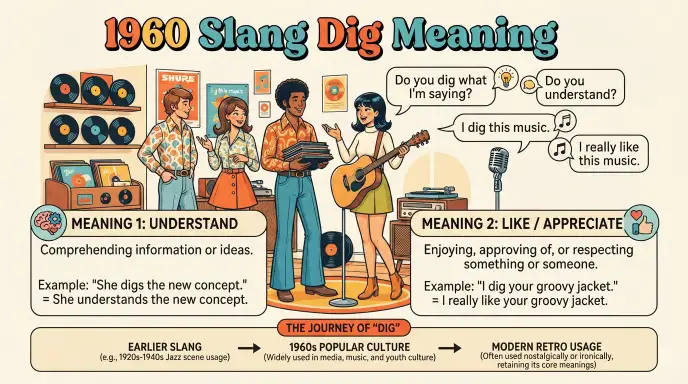
1960 slang dig usually means “understand,” “like,” “appreciate,” or “be into something.” The expression was especially associated with American jazz, beat, and 1960s counterculture speech.
If you have heard someone say “Can you dig it?”, they probably were not talking about digging a hole. In this slang sense, dig could mean “Do you understand?” or “Do you appreciate it?” Likewise, “I dig this song” could mean “I really like this song.”
The slang use of dig actually existed before the 1960s, so it was not invented during that decade. However, the 1960s helped make the expression widely recognizable through music, youth culture, movies, and informal conversation.
Quick Answer: 1960 Slang Dig
In 1960s slang, dig could mean “understand,” “like,” or “appreciate.” For example, “I dig it” means “I like it,” while “Can you dig it?” can mean “Do you understand?”The exact meaning depends on the sentence and situation.
Quick Examples
- “I dig this music.” → I really like this music.
- “I dig your style.” → I like or admire your style.
- “Do you dig what I’m saying?” → Do you understand what I’m saying?
- “Can you dig it?” → Can you understand or appreciate it?
What Does 1960 Slang Dig Mean?
The 1960 slang dig has two main meanings: to understand something and to like or appreciate something.
These meanings are closely connected, but they are not exactly the same. Looking at the sentence around the word usually makes the intended meaning clear.
Dig Meaning “Understand”
When dig meant “understand,” speakers used it to ask if someone followed an idea or message.
For example:
“You dig what I’m saying?”
A modern speaker would probably say:
“Do you understand what I’m saying?”
Another example is:
“You dig?”
This can simply mean:
“Do you understand?”
This use was common in informal speech and is strongly connected with older American slang.
Dig Meaning “Like or Appreciate”
Dig could also mean that someone liked, enjoyed, admired, or appreciated something.
For example:
“I dig this record.”
means:
“I really like this record.”
Similarly:
“I dig your jacket.”
means:
“I really like your jacket.”
This meaning was particularly useful when talking about music, fashion, art, people, or ideas.
What Does “Can You Dig It?” Mean?
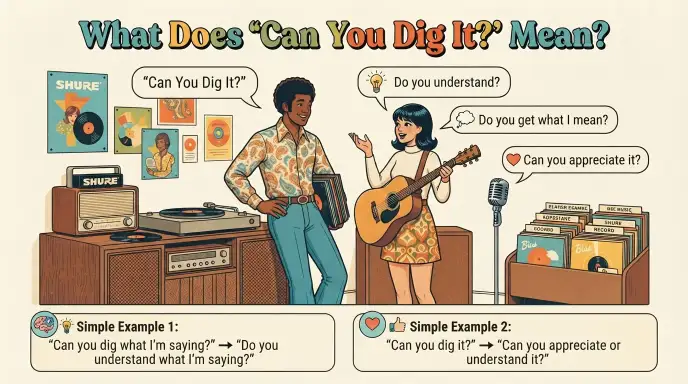
“Can you dig it?” is one of the bestifknown expressions connected with this slang usage.
Depending on context, it can mean:
- “Do you understand?”
- “Do you get what I mean?”
- “Can you appreciate it?”
- “Are you into it?”
For example:
“We’re trying something completely different. Can you dig it?”
Here, the speaker may be asking:
“Can you understand or appreciate what we’re doing?”
The phrase is strongly associated with older American popular culture and can sound distinctly retro to many modern English speakers.
Is “Dig” the Same as “Like”?
Sometimes, but not always.
When someone said:
“I dig this song.”
the closest modern translation is:
“I like this song.”
But when someone said:
“Do you dig what I’m saying?”
the meaning is closer to:
“Do you understand what I’m saying?”
This distinction is important because dig does not have one fixed slang definition.
| Expression | Likely meaning |
| I dig it. | I like it. |
| I dig your style. | I like your style. |
| I dig this music. | I really like this music. |
| Do you dig me? | Do you understand me? |
| Can you dig it? | Do you understand/appreciate it? |
| You dig? | Do you understand? |
Where Did the Slang “Dig” Come From?
The slang meaning of dig did not originate in the 1960s. Earlier examples of the word used in this way can be found in American slang and cultural speech before that decade.
Historical references connect the slang sense with African American English and jazz culture, where dig could carry meanings related to understanding, appreciating, or being aware of something.
The expression later became more widely associated with beat culture, jazz, youth culture, and the counterculture of the 1960s.
This is why it is more accurate to say that the 1960s popularized and strengthened the cultural association of the expression rather than invented it.
Why Was “Dig” Popular in the 1960s?
The word worked well because it could express both understanding and appreciation.
Someone could say:
“I dig that.”
and communicate that they liked or appreciated something.
Or they could ask:
“You dig?”
to check if someone understood.
It was especially useful in conversations about:
- Music
- Art
- Fashion
- New ideas
- Youth culture
- Social experiences
- Jazz
- Rock music
- Counterculture
The word also had a relaxed, informal quality that fit the conversational style associated with the period.
1960 Slang Dig in Music
Music was one of the settings where dig became especially recognizable.
A person talking about a new record might say:
“I really dig this sound.”
That simply means:
“I really like this sound.”
A musician or listener might also ask:
“Can you dig this?”
meaning:
“Can you understand or appreciate this?”
The expression worked naturally because music often involves personal taste and emotional connection.
Instead of simply saying “I like it,” saying “I dig it” gave the statement a more relaxed and culturally distinctive feel.
Real :Life Examples of 1960 Slang Dig
Friendly Conversation
“I dig your new jacket.”
Meaning: I really like your new jacket.
Tone: Friendly and positive.
Talking About Music
“Man, I dig this record.”
Meaning: I really enjoy this record.
Tone: Enthusiastic and informal.
Asking for Understanding
“You dig what I’m saying?”
Meaning: Do you understand what I’m saying?
Tone: Casual and conversational.
Discussing an Idea
“I dig your idea.”
Meaning: I like and understand your idea.
Tone: Supportive.
Asking for Appreciation
“Can you dig it?”
Meaning: Can you understand or appreciate it?
Tone: Informal and expressive.
Is 1960 Slang Dig Positive or Negative?
The slang meaning of dig was generally positive or neutral.
When someone said:
“I dig it.”
they were normally expressing approval.
For example:
“I dig your new song.”
would be a compliment.
Likewise:
“I dig your idea.”
would normally show support.
Of course, tone can change any expression. Someone could use the phrase sarcastically, but sarcasm is not the normal historical meaning of the word.
Is “Dig” Still Used Today?
Yes, but its slang use is much less common than it was during the 1960s.
You may still hear:
“I dig it.”
meaning:
“I like it.”
However, “Can you dig it?” can sound oldiffashioned or retro when used by a modern speaker.
Today, the word may appear in:
- Vintageifthemed conversations
- Old movies and television
- Discussions about 1960s culture
- Music conversations
- Retro fashion content
- Nostalgic socialifmedia posts
- Period fiction
A modern speaker might also deliberately use “I dig it” because they want their language to sound relaxed or oldifschool.
1960 Slang Dig vs. Modern English
| 1960s slang | Modern English |
| I dig it. | I like it. |
| I dig your style. | I like your style. |
| Can you dig it? | Do you understand? |
| You dig what I’m saying? | Do you get what I’m saying? |
| I dig this music. | I really like this music. |
The modern alternatives are usually clearer for everyday communication.
Dig adds a vintage or informal flavor that words like like and understand do not have.
Where Is “Dig” Commonly Used?
The 1960s slang dig was mainly used in informal American speech, especially in conversations connected with music, youth culture, jazz, and counterculture. It was not a formal English term, so people were more likely to say it with friends or in relaxed social settings.
You may also find the expression in older books, films, songs, interviews, and television programs that reflect the language of the period.
Dig in Music Conversations
Music was an especially natural setting for this slang.
For example:
“I really dig this new band.”
This means:
“I really like this new band.”
The word could show more than simple approval. It could suggest that the listener understood the style and genuinely appreciated what they were hearing.
Dig in Everyday Conversation
Someone might also use dig when talking about an idea or opinion:
“I dig what you’re saying.”
This could mean:
“I understand what you’re saying.”
Or it could suggest:
“I understand and appreciate your point.”
The exact meaning depends on the conversation.
Was “Dig” Used by Hippies?
Yes, the word became associated with hippie and counterculture language, but it did not originate with hippies.
This distinction is important.
The slang use of dig existed before the 1960s and had connections with earlier American slang, including African American speech and jazz culture. During the 1960s, it became part of the wider vocabulary associated with youth and counterculture.
That means calling dig a “hippie word” is understandable, but saying hippies invented it would be inaccurate.
Why It Fit Counterculture Speech
The word worked well with conversations about:
- Music
- Art
- Freedom
- New ideas
- Alternative lifestyles
- Social change
- Personal expression
A person could say:
“I dig what you’re doing.”
and communicate approval in a relaxed way.
Origin and History of 1960 Slang Dig
The history of dig is older than the decade named in the search term.
The ordinary English verb dig has existed for centuries, but its informal meaning connected with understanding or appreciating something developed separately.
Historical slang records show that the nonifliteral use was already established before the 1960s. The expression then became more widely recognized through American popular culture.
Earlier American Usage
The slang sense is associated with African American English and jazz communities before it entered broader mainstream speech.
Jazz musicians and listeners used dig in ways connected with understanding, knowing, or appreciating something.
That history is important because many explanations of 1960s slang make the mistake of treating every popular expression of the era as something created during the decade itself.
The 1960s Made It More Visible
During the 1960s, the word appeared alongside other expressions associated with youth and counterculture.
As music, television, movies, and youth culture reached larger audiences, expressions such as:
- Dig it
- Can you dig it?
- I dig it
- You dig?
became recognizable to people outside the communities where they had earlier been used.
So the 1960s were an important period in the popularization of the slang, even though the word itself was older.
Is “Dig” Still Common Slang Today?
The expression is still understandable, but it is not as common as it was during its peak popularity.
The meaning “like” or “appreciate” can still appear in modern English.
For example:
“I dig your new design.”
Most English speakers can understand that as:
“I like your new design.”
But the phrase can sound slightly retro depending on the speaker and setting.
The meaning “understand” is more likely to sound dated.
For example:
“Do you dig what I’m saying?”
is understandable, but a modern speaker would more naturally say:
“Do you get what I’m saying?”
Is “I Dig It” Outdated?
Not completely.
“I dig it” can still be used naturally, especially when someone wants to sound relaxed, playful, or expressive.
However, it is much less common than:
- “I like it.”
- “I love it.”
- “I’m into it.”
- “I get it.”
This makes dig a good example of slang that has survived but has become less central to everyday speech.
1960 Slang Dig on Social Media
The phrase dig is not modern internet slang in the same way as LOL, IDK, TBH, or BRB.
You are unlikely to see people regularly using dig as a standard abbreviation on TikTok, Snapchat, Instagram, Reddit, or Discord.
However, social media can bring the expression back in certain situations.
Vintage or Retro Posts
Someone creating a 1960sifthemed post might write:
“I dig this vintage look.”
Here, dig means:
“I really like this vintage look.”
The person may be using the word because it gives the caption a retro feel.
Music Content
A music fan might write:
“Still dig this album after all these years.”
This is a modern use of an older slang meaning.
It does not necessarily mean the person is trying to imitate the 1960s. They may simply like the expression.
Is “Dig” Appropriate at Work?
The slang meaning of dig is usually too informal for formal workplace writing.
It is not offensive, but it may sound oldiffashioned or casual.
For example:
“I dig your proposal.”
A coworker would probably understand it, but a more professional version would be:
“I really like your proposal.”
Or:
“I think your proposal is excellent.”
In Workplace Chat
A casual workplace such as a creative team may tolerate informal language more easily than a formal business setting.
Still, if you are unsure, choose the clearer phrase.
| Situation | Better choice |
| Texting a friend | “I dig it.” |
| Casual team chat | “I like it.” |
| Business email | “I like your proposal.” |
| Academic writing | “I appreciate this approach.” |
| Formal presentation | “I agree with this idea.” |
The problem with dig is not that it is inappropriate in every workplace. The issue is that it can sound informal and dated.
When Should You Avoid Using 1960 Slang Dig?
You should avoid dig when your audience may not understand the intended meaning or when formal language is expected.
Consider using a modern alternative in:
- Academic papers
- Job applications
- Formal emails
- Business reports
- Official documents
- Professional presentations
- Important instructions
For example, instead of:
“Can you dig what I’m saying?”
write:
“Do you understand what I mean?”
Instead of:
“I dig your proposal.”
write:
“I like your proposal.”
The modern versions are easier for a wider audience to understand.
What Is the Difference Between “Dig” and “Get It”?
Dig and get it can both mean “understand,” but they have different tones.
Compare:
“Do you dig what I’m saying?”
and:
“Do you get what I’m saying?”
Both mean roughly the same thing.
The difference is that dig has a more oldiffashioned or culturally specific feel, while get it is common modern English.
Quick Comparison
| Expression | Meaning | Modern feel |
| Do you dig it? | Do you understand/appreciate it? | Retro |
| Do you get it? | Do you understand? | Very common |
| Do you understand? | Do you understand? | Neutral/formal |
| Are you with me? | Do you understand/follow? | Casual |
What Is the Difference Between “Dig” and “Be Into”?
When dig means “like,” a close modern expression is be into.
For example:
“I dig jazz.”
and:
“I’m really into jazz.”
Both indicate that the speaker likes jazz.
But the tone is different.
“I dig jazz” can sound vintage or oldifschool.
“I’m into jazz” sounds much more natural in presentifday casual English.
This is one reason the slang word remains recognizable even though it is not as popular as it once was.
Similar 1960s Slang Words
If you are learning 1960 slang, several expressions are useful to understand alongside dig.
| Slang | General meaning |
| Groovy | Excellent, enjoyable, or fashionable |
| Far out | Amazing, unusual, or impressive |
| Cool | Good or impressive |
| Hip | Fashionable or aware of current culture |
| Square | Conventional or unfashionable person |
| Bummer | Disappointing experience |
| Out of sight | Excellent or impressive |
| Dig it | Understand, like, or appreciate |
These expressions are associated with the period, although their exact origins and periods of popularity are not identical.
That is another reason to be careful when labeling a word simply as “1960s slang.” Some terms were older, some became popular during the decade, and some continued into later decades.
Common Misunderstandings About 1960 Slang Dig
1. “Dig” Does Not Always Mean “Understand”
If someone says:
“I dig this song.”
they are probably saying:
“I like this song.”
But:
“Do you dig what I’m saying?”
is more likely to mean:
“Do you understand what I’m saying?”
Always look at the surrounding words.
2. It Was Not Invented in 1960
The slang meaning predates the decade.
The 1960s are important because the expression became strongly connected with popular culture during that period.
3. It Is Not Modern Internet Slang
Although someone may use “I dig it” in an Instagram caption or text today, the expression itself is not a modern internet invention.
It is an older slang expression that has survived into modern English.
4. It Is Not Offensive
The historical slang meaning of dig is generally harmless.
Its main issue today is not offensiveness but tone. It can sound oldiffashioned, informal, or deliberately retro.
Why Do People Still Use “Dig”?
People may still use dig because it has personality.
Compare:
“I like this.”
with:
“I dig this.”
The second sentence has a more relaxed, expressive sound.
Someone might choose it because:
- They like vintage language.
- They are talking about old music.
- They want a casual tone.
- They enjoy retro expressions.
- They want to sound playful.
- The phrase fits their personal speaking style.
In other words, people do not always use slang because they need a shorter word. Sometimes they use it because of the feeling and style it creates.
FAQs About 1960 Slang Dig
Q1.What does “dig” mean in 1960s slang?
It can mean “understand,” “like,” or “appreciate.” The meaning depends on the context.
Q2. What does “I dig it” mean?
“I dig it” usually means “I like it” or “I appreciate it.”
Q3. What does “Can you dig it?” mean? mean?
It can mean “Do you understand?” or “Can you appreciate or accept it?”
Q4. Was “dig” invented in the 1960s?
No. The slang use existed before the 1960s. The decade helped make it widely associated with American youth and counterculture.
Q5. Is “dig” still used today?
Yes, especially in the sense of “like” or “appreciate,” although it can sound informal or retro.
Q6. Is “dig” appropriate for formal writing?
Usually no. In formal writing, words such as understand, like, appreciate, or agree are clearer choices.
Conclusion
The 1960 slang dig is a classic American expression that could mean “understand,” “like,” or “appreciate,” depending on the context. Phrases such as “I dig it” usually expressed approval, while “Do you dig what I’m saying?” asked if someone understood the message. Although the slang became strongly associated with 1960s music, youth culture, and counterculture, the usage existed before the decade.
Today, dig is still understood, but it can sound informal, vintage, or oldiffashioned. If you use it in modern conversation, pay attention to your audience and the situation. For formal writing, clearer words such as like, understand, or appreciate are usually better choices.
Related Articles!
- Loud Meaning Slang: Meaning in Text & Examples
- Slang Test: Meaning, Quiz Types, and Examples
- Burner Slang Meaning in Text: Definition & Examples

I’m Dylan Foster, a slang and internet culture writer passionate about exploring how people communicate online and in everyday conversations. I write about texting abbreviations, social media expressions, and modern slang to help readers understand meanings, origins, and real-world usage in a simple way.