Have you ever heard someone say, “They live back in the holler,” and wondered what a holler actually is? If you are unfamiliar with Appalachian English, the word can sound like slang for shouting. In many Appalachian conversations, though, it refers to a place rather than an action.
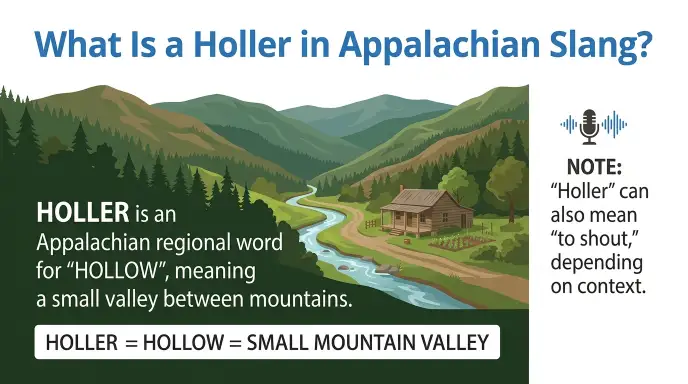
A holler is generally a small, sheltered valley between hills or mountain ridges. It is closely connected to the word hollow, and Appalachian English resources document holler as a regional pronunciation of that word. The term is more than a dictionary definition.
In real Appalachian speech, a holler can describe a particular mountain community, road, creek area, or secluded place where people live. This article explains what “holler.
means in Appalachian slang, where the word comes from, how people use it, and why it remains an important part of Appalachian English.
Quick Answer what is a holler in appalachian slang
In Appalachian English, “holler” usually means a small, sheltered valley between hills or mountains. It is a regional pronunciation and spelling of “hollow.” You may hear phrases such as “up in the holler” or “back in the holler” when someone is talking about a rural mountain valley or community. However, holler has another common meaning in American English: to shout, call loudly, or yell. The context tells you which meaning is intended.
What Does “Holler” Mean in Appalachian Slang?
In Appalachian English, holler means a small, sheltered valley or open area between ridges or mountains. The University of South Carolina’s Southern Appalachian English resource defines a hollow as a small, sheltered valley that usually, though not always, has a watercourse. It also documents holler as the regional pronunciation associated with this word. The American Heritage Dictionary similarly describes holler as a chiefly Upper Southern U.S. variant of hollow and notes that, in Appalachia, the noun can specifically refer to a small valley between mountains.So, if an Appalachian speaker says:
“They live up in the holler.”
they are most likely talking about where someone lives, not saying that someone is yelling.
Simple Meaning
Holler = a small mountain valley or sheltered area between hills or ridges.
It can be helpful to think of it this way:
Hollow → regional Appalachian pronunciation → Holler
The spelling holler reflects a pronunciation pattern found in Appalachian English. The Encyclopedia of Appalachia specifically identifies holler as a pronunciation of hollow.
Why Do Appalachian People Say “Holler”?
The word is connected to a broader feature of Appalachian pronunciation.
Appalachian English is not simply one uniform accent. It includes different varieties of English spoken across a large mountain and valley region of the eastern United States. The University of South Carolina describes Appalachian English as an umbrella term covering varieties spoken across areas including West Virginia, eastern Kentucky and Tennessee, western Virginia and North Carolina, northern Georgia and Alabama, and northwestern South Carolina. One documented pronunciation pattern involves words ending in an unstressed “ifo” sound. In Appalachian speech, that sound may become an “ifer” sound. The Encyclopedia of Appalachia gives examples such as:
- hollow → holler
- window → winder
- tobacco → tobaccer
These spellings attempt to represent regional pronunciation.This means holler is not simply a random slang word. It reflects a recognizable regional speech pattern.
Holler vs. Hollow: Are They the Same?
For the geographic meaning, holler and hollow are closely related.
In standard American English, hollow can refer to a small valley between hills or mountains. American Heritage defines this geographic sense as a small valley between hills or mountains. In Appalachian English, holler is a common regional form of that word.
| Word | Meaning | Usage |
| Hollow | Small valley between hills or mountains | General English |
| Holler | Small sheltered valley | Appalachian/Upper Southern English |
| Valley | Low area between hills or mountains | General English |
| Gully | Narrow channel or eroded depression | General English |
The difference is therefore mainly regional usage and pronunciation, rather than two completely unrelated geographic features.
What Does “Back in the Holler” Mean?
One of the most recognizable phrases is “back in the holler.”
This usually means in a secluded or rural mountain valley.
For example:
“My grandparents lived back in the holler.”
The speaker is likely describing a home located in a small mountain valley, perhaps away from a larger town or major road.
Other common expressions include:
- up in the holler
- down in the holler
- back in the holler
- over in the holler
- the road through the holler
The exact direction word can vary depending on the location and speaker. The important idea is that the person is referring to a specific mountain valley or community.
The Southern Appalachian English dictionary gives historical examples of holler being used for these kinds of mountain settings and notes that hollows frequently appear in informal place names.
What Is a Holler Like?
A holler is generally associated with the landscape of the Appalachian Mountains.
Imagine two wooded ridges rising on either side of a relatively narrow low area. A road may run through the bottom, and a creek or small stream may pass through it. Homes can be scattered along the road or around the available flatter land.
That type of landscape can be described as a holler.
However, not every holler looks exactly the same. Some may be narrow and steep, while others can be wider and more open. The University of South Carolina notes that a hollow is usually a small sheltered valley and may or may not have a watercourse.So you should not think of a holler as having one fixed shape.
A Simple Visual Picture
Think of:
Mountain ridge → sheltered low area → mountain ridge
That low, protected area may be called a holler in Appalachian speech.
Is “Holler” Actually Slang?
Calling holler slang is understandable, especially when searching for its meaning online, but regional or dialectal word is often more precise for its Appalachian geographic meaning.
The term is part of Appalachian English and has been documented in linguistic resources and regional dictionaries. The University of South Carolina’s Southern Appalachian English project includes holler and hollow in its vocabulary resources.Unlike modern internet slang, the Appalachian use of holler is not something that was recently created on TikTok, Reddit, Discord, or Instagram.
It is a regional word connected to Appalachian speech and geography.
That distinction matters because many people use the word slang broadly to describe any unfamiliar regional expression.
Where Is “Holler” Commonly Used?
The geographic meaning of holler is especially associated with Appalachia and the Upper South.
Appalachian English covers a broad region rather than a single state. The University of South Carolina describes it as encompassing areas across parts of West Virginia, Kentucky, Tennessee, Virginia, North Carolina, Georgia, Alabama, and South Carolina.The word can also appear outside the Appalachian mountains because speakers move, families relocate, and regional vocabulary travels with communities.
The Encyclopedia of Appalachia notes that Appalachian speech features can persist among migrant communities outside the mountains, including in the Midwest. So hearing holler does not necessarily mean the speaker currently lives in the mountains.
How Is “Holler” Used in Everyday Speech?
The geographic meaning is easiest to recognize when holler appears alongside words describing location.
For example:
“The house is up in the holler.”
Here, holler refers to a place.
“We drove down the holler to visit them.”
Again, it refers to a mountain valley or local area.
“There was a little church in the holler.”
The word describes the surrounding geographic community.
| Example | What “Holler” Means |
| “They live up in the holler.” | Mountain valley |
| “The road goes through the holler.” | Mountain valley |
| “There is a creek down in the holler.” | Sheltered valley |
| “She grew up in a holler.” | Appalachian mountain community |
| “We visited the people in the holler.” | Local valley/community |
These examples show why context is so important when interpreting regional vocabulary.
Holler Can Also Mean “Shout”
There is another meaning of holler that has nothing specifically to do with Appalachia.
As a verb, to holler can mean to shout, yell, or call loudly. MerriamifWebster defines the verb as crying out or shouting and also lists “complain” as another informal sense. For example:
“Holler if you need help.”
Here, holler means call out or shout.
Another example:
“He hollered across the field.”
This means he shouted across the field.
The American Heritage Dictionary also lists holler as a verb meaning to yell or shout and as a noun meaning a yell or shout. This gives the word two important meanings:
| Meaning | Example |
| Mountain valley | “They live in the holler.” |
| Shout/call loudly | “Holler if you need me.” |
Once you understand the context, the difference is usually easy to recognize.
How Can You Tell Which Meaning Is Intended?
Look at the words surrounding holler.
If the sentence talks about:
- mountains
- hills
- roads
- creeks
- homes
- rural communities
- Appalachia
- valleys
then holler probably means a small valley.
If the sentence talks about:
- calling
- yelling
- hearing
- speaking loudly
- getting someone’s attention
then holler probably means shout or call.
Compare These Two Sentences
“Their cabin is deep in the holler.”
→ The word refers to a mountain valley.
“Holler when you get home.”
→ The word means call or let someone know.
Context solves the confusion.
Is “Holler” Only Used by Older Appalachian Speakers?
No. Appalachian English is spoken by people of different ages, and regional vocabulary can continue across generations.
At the same time, Appalachian speech is not frozen in the past. The Encyclopedia of Appalachia emphasizes that Appalachian language is changing and diverse, challenging the idea that mountain speech is simply an unchanged form of old English.The word holler can therefore appear in modern conversations, local writing, music, storytelling, place names, and discussions of Appalachian culture.
Its continued use is part of the broader story of how regional dialects survive and change.
Why Does “Holler” Matter in Appalachian Culture?
Words often carry information about place and community, not just literal definitions.
In Appalachia, a holler can be more than a physical valley. It can also describe a local community connected by geography, family relationships, roads, churches, schools, creeks, and shared history.
The Southern Appalachian English resource even notes historical descriptions of residents of a particular hollow developing a strong sense of belonging and community. That is one reason the word appears so often when people describe Appalachian life.
When someone says:
“I grew up in the holler.”
they may be communicating both where they lived and something about their regional background.
Common Misunderstandings About “Holler”
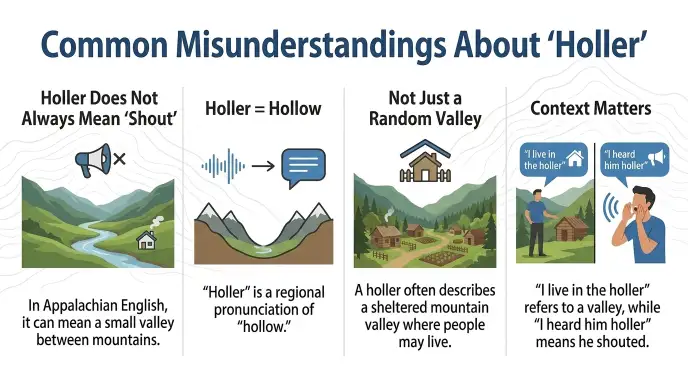
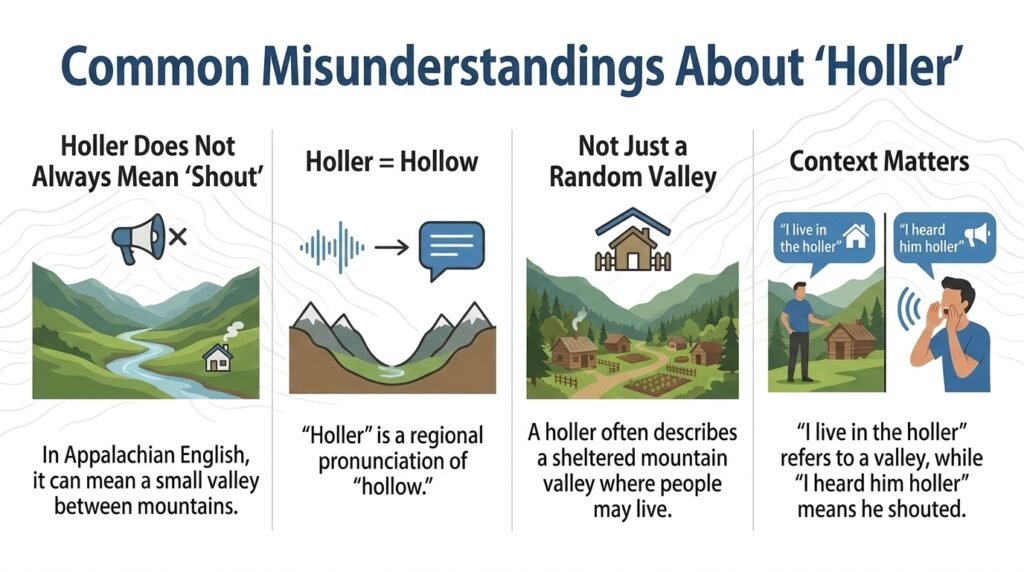
Holler Always Means “Yell”
Not always.
While holler commonly means “shout” as a verb, the Appalachian noun can mean a small mountain valley. Holler Is Just Incorrect English
This is also misleading.
Regional dialects have their own established pronunciation and vocabulary. Appalachian English resources specifically document holler as a regional form of hollow.Every Holler Is Completely Remote
Not necessarily.
A holler is primarily a geographic term for a small sheltered valley. Some may be quite isolated, while others may be close to towns or more developed areas.
Holler and Hollow Are Unrelated
They are closely connected.
In the Appalachian geographic sense, holler is a regional pronunciation and spelling of hollow. Holler Is Modern Internet Slang
No.
Although people may discuss the word on social media today, its Appalachian geographic meaning predates platforms such as TikTok, Reddit, Instagram, and Discord by a very long time.
Key Takeaway
“Holler” in Appalachian English usually means a small, sheltered mountain valley. It is closely related to “hollow” and reflects a documented Appalachian pronunciation pattern. But remember that holler also means to shout or call loudly in informal American English.
The easiest way to understand it is to check the context:
“up in the holler” → mountain valley
“holler if you need me” → shout or call
That simple distinction makes the word much easier to understand.
The Origin of “Holler” in Appalachian English
The Appalachian use of holler comes from the word hollow. A hollow is a low or sheltered area between hills, ridges, or mountains. Over time, regional pronunciation patterns caused hollow to sound more like holler in many Appalachian communities.
This type of pronunciation is part of regional dialect development. English changes naturally depending on geography, community, migration, and local speech traditions.
That is why holler should not simply be treated as “wrong English.” It is better understood as a regional form of a standard English word.
In Appalachian speech, the term became strongly connected with mountain geography because many families historically lived in narrow valleys between ridges.
A phrase such as:
“We lived back in the holler.”
therefore developed a clear regional meaning connected to both place and community.
Holler vs. Cove vs. Valley
Appalachian geography includes several words that can sound similar but do not always mean exactly the same thing.
A holler is usually a relatively small, sheltered valley between hills or mountain ridges.
A valley is a broader geographic term. Valleys can be large or small and may exist in many types of landscapes around the world.
A cove, particularly in Appalachian geography, can refer to a sheltered valley or basin surrounded by mountains.
Here is a simple comparison:
| Term | Basic Meaning | Typical Usage |
| Holler | Small sheltered mountain valley | Appalachian regional speech |
| Hollow | Small low area between hills | General and regional English |
| Valley | Low land between hills or mountains | General geographic term |
| Cove | Sheltered valley or basin | Common in some Appalachian areas |
These words can overlap, but local speakers may choose one term based on the shape of the land, regional tradition, or everyday habit.
Does Every Holler Have a Creek?
No. A holler does not always need to have a creek, although streams are common in Appalachian valleys.
Mountain water naturally flows toward lower areas, so many hollers contain:
- small creeks
- streams
- drainage channels
- springs
- wet lowland areas
This is one reason roads and homes were often built near valley bottoms.
However, the main meaning of holler is based on the shape and location of the land rather than the presence of water.
You can therefore have a holler without a noticeable creek.
Can People Live in a Holler?
Yes. In fact, the word often refers not only to the land but also to the community living within that valley.
A holler may contain:
- homes
- farms
- churches
- family cemeteries
- small roads
- creeks
- wooded hillsides
- local gathering places
Historically, Appalachian terrain influenced where people could build homes and roads. Flatter land was often easier to find along valley floors.
As a result, families could live near one another within the same holler.
This helped make the word meaningful beyond geography.
Someone saying:
“Everybody in the holler knew each other.”
may be talking about the people living in that valley community, not just the physical land.
Why Is the Word “Holler” Connected With Community?
A holler can create a natural geographic boundary.
Mountain ridges may surround the valley on several sides, while a road or creek may run through the center. Because families sometimes lived close together in these areas, the name of a holler could also become a way of identifying a local community.
For example, someone might describe where another person is from by referring to a particular holler.
This gives the word two closely connected ideas:
Holler as geography: a small mountain valley.
Holler as community: the people or homes located within that valley.
The meaning depends on the sentence.
For example:
“The holler is narrow.”
This describes geography.
“The whole holler came to the gathering.”
This refers more naturally to the community.
Is “Holler” Offensive?
Generally, holler itself is not an offensive word.
It is a regional term associated with Appalachian English and geography.
However, context matters.
Using regional vocabulary respectfully is different from exaggerating an Appalachian accent or using stereotypes to mock people from the region.
For example, saying:
“My grandfather grew up in a holler in eastern Kentucky.”
is a normal geographic or cultural description.
Using holler as part of a caricature intended to make Appalachian speakers appear uneducated can be disrespectful.
The safest approach is to treat the word as genuine regional vocabulary rather than as a joke.
Is Saying “Holler” Grammatically Wrong?
No. Regional dialect words are not automatically grammatical mistakes.
English has many regional varieties, and speakers often use words that are uncommon elsewhere.
Examples include regional differences involving:
- pronunciation
- vocabulary
- expressions
- sentence patterns
- names for local geography
In formal academic writing, you might use hollow, small valley, or mountain valley if the audience is unfamiliar with Appalachian English.
But when describing Appalachian speech, culture, geography, or dialogue, holler may be the most accurate word.
How Is “Holler” Used in Modern English?
The word remains useful today.
You may hear it in:
- everyday Appalachian conversations
- regional storytelling
- country and folk music
- documentaries
- interviews
- novels
- local history
- Appalachian social media content
It may also appear on TikTok, Reddit, YouTube, or Instagram when people discuss Appalachian culture or explain regional vocabulary.
However, holler is not primarily internet slang.
Its regional meaning existed long before modern social media.
Online platforms simply give people another place to use and explain the word.
Holler in Social Media and Online Conversations
When holler appears online, context remains important.
Someone might write:
“I grew up in a holler in West Virginia.”
Here, they mean a mountain valley or community.
Another person might write:
“Holler at me when you’re free.”
Here, the word means contact me, call me, or let me know.
These meanings are related only by spelling and pronunciation in modern usage.
The first is connected to Appalachian geography.
The second comes from the verb meaning to call or shout.
What Does “Holler at Me” Mean?
The phrase “holler at me” usually does not refer to Appalachia.
In casual American English, it means something like:
contact me, talk to me, let me know, or get in touch with me.
For example:
“Holler at me when you get home.”
This means:
“Let me know when you get home.”
Or:
“Holler at me if you need anything.”
This means:
“Contact me if you need anything.”
This usage developed from the idea of calling out to someone.
It should not be confused with the Appalachian geographic meaning of holler.
Holler as a Noun vs. Holler as a Verb
Understanding the word’s grammatical role can make its meaning much clearer.
| Form | Meaning | Example |
| Holler noun | Mountain valley | “They live in the holler.” |
| Holler noun | A loud shout | “I heard a holler outside.” |
| Holler verb | To shout | “He hollered across the yard.” |
| Holler at someone | Contact or call someone | “Holler at me later.” |
When holler follows words such as in, up, down, back, or through, it may refer to a place.
When it describes an action, it usually means shouting or calling.
Appalachian Holler Examples in Sentences
Here are some natural examples that show the Appalachian meaning:
“Her family has lived in that holler for generations.”
This means her family has lived in that mountain valley for a long time.
“A narrow road runs through the holler.”
Here, holler describes the valley.
“We crossed the creek and drove farther into the holler.”
The speaker is describing movement through a mountain valley.
“The old church sits at the end of the holler.”
The church is located within or near the end of the valley.
“He grew up with several cousins in the same holler.”
This describes both a geographic area and a local community.
“Fog stayed low in the holler that morning.”
Here, the term clearly refers to a low valley.
When Should You Use the Word “Holler”?
Use holler when the context makes its regional meaning clear.
It works especially well when discussing:
- Appalachian geography
- Appalachian culture
- regional speech
- family history
- local communities
- mountain life
- fictional Appalachian dialogue
If you are writing for an international or general audience, you may want to explain the term the first time you use it.
For example:
“They lived in a holler, a small valley between mountain ridges.”
After that explanation, readers can understand later uses more easily.
When Should You Use “Hollow” Instead?
Hollow may be better when you want a more widely recognized geographic term.
For example:
“The cabin stands in a wooded hollow.”
This sounds natural in general English.
Use holler when the regional Appalachian character of the language matters.
For example:
“My grandmother always called it the holler.”
Neither choice is automatically better. The correct word depends on audience, tone, and context.
Why Do People Get Confused About “Holler”?
Confusion happens because holler has more than one familiar meaning.
A person who knows only the verb may assume it always means “shout.”
Someone familiar with Appalachian English may immediately recognize the valley meaning.
There is also confusion because the words holler and hollow look similar but are pronounced differently in standard speech.
The easiest memory trick is:
If people live “in” it, it probably means a valley.
If someone does it loudly, it probably means shouting.
For example:
“They live in the holler.”
= valley
“He hollered loudly.”
= shouted
Why Both Meanings Still Exist
English frequently contains words that have several unrelated or partly related meanings.
The same spelling may develop different meanings through regional speech, history, and everyday usage.
With holler, the two major meanings remain common because they serve different purposes.
The geographic meaning identifies a type of Appalachian landscape.
The verb describes shouting or calling.
Context keeps them separate.
This is why native speakers rarely become confused when they hear the complete sentence.
Cultural Respect When Using Appalachian Words
When learning Appalachian vocabulary, it is useful to avoid treating every regional expression as strange, humorous, or incorrect.
Regional English varieties develop naturally.
Appalachian speech reflects generations of:
- settlement
- migration
- geography
- family traditions
- local communities
- language change
Using a word like holler accurately shows greater understanding of the region.
It is also worth remembering that Appalachia contains many communities and speech patterns. Not every Appalachian person speaks the same way, and not everyone uses holler with the same frequency.
Regional language is diverse.
Quick Meaning Table
| Phrase | Meaning |
| a holler | Small Appalachian mountain valley |
| in the holler | Inside a mountain valley/community |
| back in the holler | Farther into a rural valley |
| up the holler | Toward or within a valley |
| to holler | To shout or call loudly |
| holler at me | Contact or talk to me |
| a loud holler | A shout or yell |
This table makes it easier to recognize the intended meaning without memorizing complicated definitions.
Frequently Asked Questions
Q1. What is a holler in Appalachian slang?
A holler in Appalachian English is a small, sheltered valley between hills or mountain ridges. It is a regional form of the word hollow.
Q2. Why do Appalachians call a valley a holler?
The term developed from a regional pronunciation of hollow. Over time, holler became strongly associated with Appalachian valleys and communities.
Q3. Is a holler the same thing as a hollow?
In the Appalachian geographic sense, yes, they are closely related. Holler is commonly understood as a regional pronunciation and spelling of hollow.
Q4. Does a holler always have a creek?
No. Many hollers contain creeks because water flows toward low areas, but having a creek is not required for an area to be called a holler.
Q5. What does “living in a holler” mean?
It usually means living in a small valley between hills or mountain ridges, often within an Appalachian community.
Q6. Does “holler” also mean shout?
Yes. To holler can mean to shout, yell, or call loudly. Context separates this meaning from the Appalachian geographic meaning.
Q7. Is “holler” still used today?
Yes. The word still appears in Appalachian conversation, storytelling, writing, music, local history, and online discussions about the region.
Conclusion
A holler in Appalachian slang is a small, sheltered valley between hills or mountain ridges. The word comes from the regional pronunciation of hollow and is deeply connected with Appalachian geography and everyday speech.
A holler can describe more than land. Depending on context, it may also refer to the homes, families, and communities located within that valley.
The word should not be confused with the verb holler, which means to shout or call loudly. A sentence such as “They live back in the holler” refers to a place, while “Holler if you need help” means to call out.
Understanding the context makes the difference simple. More importantly, recognizing holler as genuine regional vocabulary helps readers understand Appalachian language with greater accuracy and respect.

I’m Dylan Foster, a slang and internet culture writer passionate about exploring how people communicate online and in everyday conversations. I write about texting abbreviations, social media expressions, and modern slang to help readers understand meanings, origins, and real-world usage in a simple way.