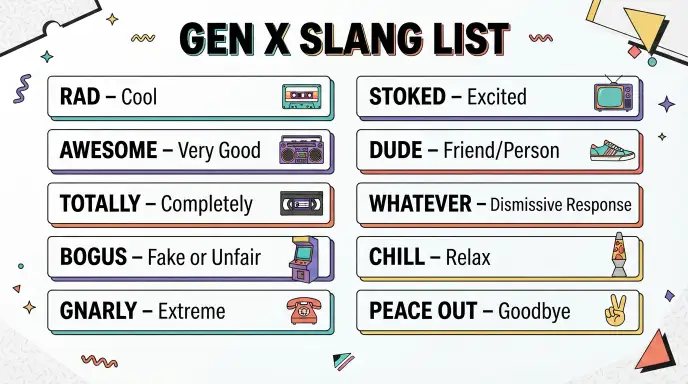
Gen X slang includes the casual words and expressions popular among Generation X, especially during the 1980s and 1990s. From “rad” and “awesome” to “whatever” and “bogus,” these phrases reflect the music, movies, television, and youth culture of the era.
If you are exploring a Gen X slang list, you will find familiar expressions as well as phrases that have largely disappeared from everyday speech. Some are still commonly used today, while others are mainly remembered through nostalgia, movies, memes, and retro culture.
Quick Answer
Some popular Gen X slang words include rad, awesome, totally, whatever, gnarly, bogus, dude, stoked, psyched, chill, my bad, fly, phat, props, peace out, and as if. These expressions were especially common in Gen X youth culture during the 1980s and 1990s.
What Is Gen X Slang?
Gen X slang refers to informal words and phrases associated with Generation X and the culture of their youth.
Generation X is generally considered to include people born from the mid 1960s through around 1980. Many members of this generation grew up during a period when television, music, movies, video games, and youth oriented entertainment had a major influence on language.
Unlike today’s internet slang, Gen X slang did not spread through TikTok, Instagram, Reddit, or Discord. It was more commonly passed between friends, classmates, neighborhoods, music communities, and families.
Some expressions were nationwide, while others were strongly connected to particular regions or subcultures.
The Origin of Gen X Slang
There was no single source for Gen X slang. Instead, it developed from several parts of popular culture.
The 1980s brought a huge expansion of cable television, music videos, blockbuster movies, video arcades, and youth focused entertainment. Young people picked up expressions from the characters, musicians, athletes, and communities they followed.
Music had an especially strong influence. Rock, punk, heavy metal, new wave, hip hop, and alternative music all contributed words and phrases to youth vocabulary.
Skateboarding and surfing culture also introduced or popularized expressions such as “rad,” “gnarly,” “stoked,” and “bodacious.”
By the 1990s, hip hop, television sitcoms, teen movies, and early internet communities continued to influence how Gen X spoke.
Because of these influences, there is no single “official” Gen X vocabulary. Slang varied depending on where someone lived and which cultural groups they followed.
50+ Gen X Slang Words and Phrases
1. Awesome
“Awesome” means extremely good, impressive, or exciting.
Example: “That concert was awesome.”
The word is still widely used today, although it became especially common as casual praise during the Gen X era.
2. Rad
“Rad” is a shortened form of “radical” and means cool, excellent, or exciting.
Example: “That’s a rad skateboard.”
The expression is strongly associated with skateboarding and youth culture.
3. Totally
“Totally” literally means completely, but it was also frequently used as an enthusiastic way to agree.
Example:
“Are you going to the party?”
“Totally!”
4. Whatever
“Whatever” can express indifference, dismissal, disagreement, or sarcasm.
Example: “You can complain all you want. Whatever.”
The dismissive use became strongly associated with Gen X attitudes and youth culture.
5. Gag Me
“Gag me” is an exaggerated expression of disgust.
Example: “You expect me to eat that? Gag me!”
The phrase became particularly recognizable in 1980s youth culture.
6. Grody
“Grody” means disgusting, dirty, gross, or unpleasant.
Example: “That old refrigerator is totally grody.”
7. Psyched
“Psyched” means very excited or enthusiastic.
Example: “I’m psyched about the concert.”
8. Stoked
“Stoked” means extremely excited or happy about something.
Example: “She’s stoked about her new job.”
The word has strong connections with surfing and outdoor culture.
9. Bummed
“Bummed” means disappointed, sad, or upset.
Example: “I’m bummed that the game was canceled.”
10. Chill
“Chill” can mean relaxed, calm, easygoing, or simply to relax.
Example: “Let’s chill at home tonight.”
Unlike many older expressions, “chill” remains very common today.
11. No Way
“No way” expresses disbelief, surprise, or refusal.
Example: “I won two tickets!”
“No way!”
12. For Sure
“For sure” means definitely or certainly.
Example: “Are you coming tonight?”
“For sure.”
13. My Bad
“My bad” is an informal way to admit a mistake.
Example: “I forgot to call you. My bad.”
This expression has continued into modern everyday speech.
14. Dude
“Dude” can refer to a person or friend, or it can simply express surprise or emotion.
Example: “Dude, that was amazing!”
Although “dude” existed before Generation X, it became strongly associated with casual youth culture during this period.
15. Bodacious
“Bodacious” means impressive, excellent, remarkable, or sometimes attractive.
Example: “That was a bodacious wave.”
It is particularly connected with surfing culture.
16. Gnarly
“Gnarly” can describe something extreme, difficult, dangerous, or impressive.
Example: “That was a gnarly skateboarding trick.”
Its meaning depends on the situation.
17. Radical
“Radical” could be used to describe something excellent, exciting, or extreme.
Example: “That’s a radical new bike.”
18. Bogus
“Bogus” means fake, dishonest, unfair, or disappointing.
Example: “They canceled the concert? That’s bogus.”
19. Fresh
“Fresh” could mean stylish, attractive, new, or impressive.
Example: “Those sneakers look fresh.”
20. Fly
“Fly” was used to describe someone or something fashionable or stylish.
Example: “That jacket is fly.”
The expression was particularly noticeable in 1980s and 1990s urban and music culture.
21. Phat
“Phat” was a slang spelling used to describe something excellent, impressive, or attractive.
Example: “That’s a phat beat.”
The term became particularly associated with 1990s hip hop culture.
22. Word
“Word” could mean “I agree,” “I understand,” or “that’s true.”
Example:
“We’ll meet at eight.”
“Word.”
23. As If!
“As if!” is a sarcastic expression meaning something like “I don’t believe that” or “That isn’t going to happen.”
Example:
“You think I’m going to apologize?”
“As if!”
The expression became particularly recognizable through 1990s pop culture.
24. Talk to the Hand
“Talk to the hand” is a humorous way of saying that someone does not want to listen.
Example: “You keep complaining, but talk to the hand.”
The expression became strongly recognizable during the 1990s.
25. Don’t Have a Cow
“Don’t have a cow” means don’t get extremely upset or angry.
Example: “Don’t have a cow. I’ll replace it.”
26. Eat My Shorts
“Eat my shorts” is a humorous and rebellious insult meaning roughly “go away” or “leave me alone.”
Example: “You want me to do your homework? Eat my shorts!”
The phrase became widely known through television culture.
27. Take a Chill Pill
“Take a chill pill” means calm down or relax.
Example: “Take a chill pill. Everything is under control.”
28. What’s Your Damage?
“What’s your damage?” is a sarcastic way to ask why someone is acting strangely or badly.
Example: “What’s your damage? Why are you so angry?”
29. Geek
“Geek” traditionally referred to someone who was highly interested in a particular subject and sometimes socially awkward.
Example: “He’s a computer geek.”
Today, the word can be positive and often describes someone who is highly knowledgeable or passionate.
30. Dork
“Dork” describes someone who is silly, awkward, or uncool.
Example: “You’re such a dork.”
It is often used playfully rather than seriously.
31. Nerd
“Nerd” traditionally described someone who was very interested in academic, technical, or specialized subjects.
Example: “He’s a total computer nerd.”
The word is now often used positively.
32. Hella
“Hella” means very or extremely.
Example: “That movie was hella good.”
It became strongly associated with Northern California speech before spreading more widely.
33. Crib
“Crib” is slang for a person’s home or house.
Example: “Come over to my crib later.”
34. Props
“Props” means respect, praise, or recognition.
Example: “Props to you for finishing the project.”
35. Dip
“Dip” means to leave.
Example: “It’s getting late. I’m going to dip.”
36. Bounce
“Bounce” can also mean to leave.
Example: “Let’s bounce before the store closes.”
37. Peace Out
“Peace out” is an informal way of saying goodbye.
Example: “I’ve got to go. Peace out!”
38. Later
“Later” is a short, casual way to say goodbye.
Example: “See you tomorrow.”
“Later!”
39. Homeboy
“Homeboy” refers to a close male friend in certain regional and urban speech communities.
Example: “He’s my homeboy from school.”
40. Homegirl
“Homegirl” similarly refers to a close female friend in certain speech communities.
Example: “She’s my homegirl from college.”
41. Posse
“Posse” can mean a group of friends or people who spend time together.
Example: “I’m going out with my posse tonight.”
42. Jam
“Jam” can mean a favorite song.
Example: “That’s my jam!”
This meaning remains familiar today.
43. Jammin’
“Jammin’” can mean playing or enjoying music or simply having a good time.
Example: “We were jammin’ all night.”
44. Book It
“Book it” means to move or leave quickly.
Example: “We’re late. Book it!”
45. Hook Up
“Hook up” has several meanings depending on context. It can mean meeting someone, connecting someone with something, getting something arranged, or becoming romantically or sexually involved.
Example: “I’ll hook you up with some tickets.”
Because the expression has multiple meanings, context is important.
46. Wannabe
A “wannabe” is someone who tries to imitate another person, group, style, or identity.
Example: “He’s trying to look like a rock star. He’s a wannabe.”
47. Busted
“Busted” can mean caught doing something wrong, discovered, or broken.
Example: “We got busted sneaking out.”
It can also describe something that no longer works.
48. Crashing
“Crashing” means sleeping somewhere temporarily or staying at another person’s home.
Example: “Can I crash at your place tonight?”
49. Mondo
“Mondo” was used as an intensifier meaning very large, huge, or extreme.
Example: “That’s a mondo problem.”
50. Zonked
“Zonked” means extremely tired or exhausted.
Example: “I’m completely zonked after that long day.”
51. All That
“All that” could describe someone or something as impressive, attractive, or highly regarded.
Example: “He thinks he’s all that.”
It could also be used sarcastical
The word remains part of everyday informal English.
53. Killer
“Killer” could describe something excellent, impressive, or exciting.
Example: “That was a killer performance.”
Here, “killer” has a positive meaning.
54. Def
“Def” was used as an informal way to describe something excellent, cool, or impressive.
Example: “That’s a def track.”
The word is particularly associated with 1980s and 1990s hip hop culture.
55. Loser
“Loser” was commonly used as an insult for someone viewed as unsuccessful, unpopular, or uncool.
Example: “Don’t be such a loser.”
Where Was Gen X Slang Commonly Used?
Gen X slang was mostly spoken in real life social situations.
Young people commonly picked up expressions from:
- Schools and colleges
- Friends and neighborhoods
- Television
- Movies
- Radio
- Music
- Teen magazines
- Skateboarding communities
- Surfing communities
- Sports
- Video arcades
- Shopping malls
- Telephone conversations
The internet eventually became another place where Gen Xers communicated, but most of these expressions became popular before social media existed.
This is one of the biggest differences between Gen X slang and today’s internet slang.
Gen X Slang and 1980s Culture
The 1980s were especially important for Gen X vocabulary.
Cable television and music videos gave young people access to new cultural influences. Movies and television programs also created memorable phrases that spread quickly among teenagers.
Expressions such as “rad,” “gnarly,” “grody,” “gag me,” “totally,” and “awesome” fit the energetic and informal style of 1980s youth culture.
Skateboarding, surfing, rock music, punk, new wave, and other subcultures also contributed to the vocabulary.
Not everyone used the same words, but many of these expressions became recognizable across different parts of the United States.
Gen X Slang and 1990s Culture
The 1990s brought another wave of slang.
Hip hop became an even stronger influence on mainstream language, while television and teen movies popularized expressions such as “as if,” “talk to the hand,” and “whatever.”
Words such as “phat,” “fly,” “props,” “word,” and “homeboy” were connected with different aspects of 1990s youth and music culture.
The decade also introduced early online communication. Gen X was one of the generations that experienced the transition from mostly offline communication to email, chat rooms, forums, and eventually social media.
Gen X Slang vs. Modern Internet Slang
The biggest difference between Gen X slang and modern slang is how quickly language spreads.
Gen X expressions usually spread through:
- Friends
- Television
- Movies
- Music
- Radio
- School
- Local communities
Modern slang can spread through TikTok, Instagram, Reddit, Discord, gaming platforms, memes, and other online communities.
For example:
Gen X style:
“That movie is totally rad.”
Modern style:
“That movie is fire.”
Both expressions communicate approval, but they reflect different cultural periods.
Some words have survived the transition. “Chill,” “awesome,” “dude,” “my bad,” and “that’s my jam” can still be heard today.
Why Is Gen X Slang Still Popular?
Gen X slang remains popular mainly because of nostalgia and pop culture.
People who grew up during the 1980s and 1990s may recognize these expressions immediately. Younger generations may encounter them through classic movies, television shows, memes, social media, or retro themed content.
Older slang can also be useful when creating a particular character or mood.
For example, a writer creating an 1980s teenager might naturally use expressions such as “rad,” “totally,” “dude,” or “awesome” to make the dialogue feel connected to that period.
Some people also use older slang humorously because the expressions now sound deliberately retro.
Are All Gen X Slang Words Actually From Gen X?
No.
This is an important distinction.
Some expressions on a Gen X slang list existed before Generation X was born. Others became popular during Gen X’s childhood or teenage years but continued into later generations.
Slang does not follow strict generational boundaries.
For example, “dude” existed before Gen X, while “awesome” has an even longer history. Their association with Gen X comes from how frequently they were used and how strongly they appeared in youth culture during that period.
Regional differences also matter. A person from California might have used more surfing or skateboarding slang, while someone from another region may have had a completely different vocabulary.
Common Mistakes When Using Gen X Slang
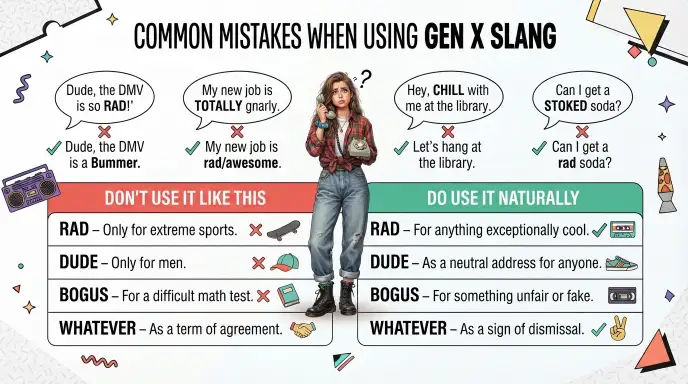
One common mistake is assuming that every Gen Xer used every word on a slang list.
Slang depends on age, location, social group, interests, and cultural background.
Another mistake is assuming that an expression has only one meaning. Words such as “gnarly,” “chill,” “fresh,” and “hook up” can mean different things depending on context.
It is also easy to overuse old slang. If every sentence contains “rad,” “totally,” and “dude,” the conversation can sound like a parody rather than natural speech.
For authentic use, choose expressions that fit the character, situation, and time period.
Gen X Slang in Everyday Examples
Here are some simple examples of how these expressions can work naturally:
Example 7:
“Those sneakers are fresh.”
Example 8:
“I’m going to bounce. Peace out!”
How Gen X Slang Has Changed Over Time
Slang constantly changes.
Some Gen X expressions disappeared from everyday conversation, while others became normal informal English.
For example, “gag me” and “talk to the hand” now often sound nostalgic. On the other hand, “awesome,” “chill,” “dude,” “my bad,” and “for sure” remain widely understood.
Other words changed their social meaning. “Nerd” and “geek,” once commonly used as insults, can now be positive descriptions of people who are passionate and knowledgeable.
This evolution shows that slang does not simply vanish. Sometimes it changes meaning, sometimes it becomes mainstream, and sometimes it returns through nostalgia.
Frequently Asked Questions About Gen X Slang
Q1. What is the most popular Gen X slang?
Some of the best known Gen X expressions are “awesome,” “rad,” “totally,” “whatever,” “dude,” “gnarly,” “bogus,” “stoked,” and “psyched.”
Q2. What slang did Gen X use in the 1980s?
Commonly recognized 1980s expressions include “rad,” “awesome,” “totally,” “grody,” “gag me,” “bodacious,” “gnarly,” “bogus,” and “take a chill pill.”
Q3. What slang did Gen X use in the 1990s?
Popularly recognized 1990s expressions include “as if,” “talk to the hand,” “my bad,” “phat,” “fly,” “word,” “props,” “peace out,” and “whatever.”
Q4. Is “dude” Gen X slang?
“Dude” is older than Generation X, so it is not exclusively Gen X slang. However, it became strongly associated with casual youth culture during the Gen X era.
Q5. Is “whatever” considered Gen X slang?
“Whatever” existed before Gen X, but its sarcastic and dismissive use became strongly associated with Gen X youth culture, particularly during the 1980s and 1990s.
Q6. Do people still use Gen X slang?
Yes. Expressions such as “awesome,” “dude,” “chill,” “my bad,” and “for sure” remain common. Other expressions are now mostly used for nostalgia or humor.
Q7. Why does Gen X slang sound different from Gen Z slang?
Gen X slang developed before smartphones and social media. Television, movies, music, schools, and local communities played major roles in spreading it. Modern slang can spread globally through online platforms within a very short time.
Conclusion
A Gen X slang list provides an interesting look at the language and culture of a generation that grew up during the 1970s, 1980s, and 1990s. Expressions such as “rad,” “awesome,” “totally,” “whatever,” “bogus,” “gnarly,” “stoked,” and “dude” became recognizable parts of youth culture during this period.
However, Gen X slang was never one fixed collection of words. Different regions, communities, music scenes, and age groups developed their own expressions. Some words existed before Generation X, while others became popular during their teenage years and later spread to other generations.
Today, many classic expressions remain part of informal English, while others survive through movies, television, memes, nostalgia, and retro culture.
If you are researching generational language, writing a character from the 1980s or 1990s, or simply wondering what older expressions mean, this Gen X slang list provides a useful starting point for understanding the words and culture behind them.
Related Articles!

I’m Dylan Foster, a slang and internet culture writer passionate about exploring how people communicate online and in everyday conversations. I write about texting abbreviations, social media expressions, and modern slang to help readers understand meanings, origins, and real-world usage in a simple way.