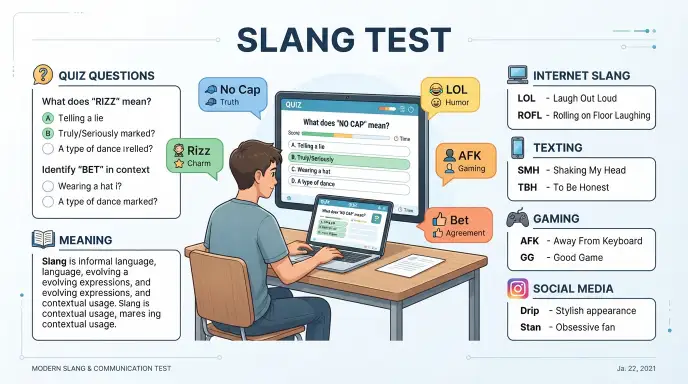
A slang test is a quiz that checks how well you understand informal words, phrases, abbreviations, and expressions used in texting, social media, gaming, and everyday conversations.
People search for a slang test when they want to check their knowledge of modern internet language or understand unfamiliar expressions they see online. A slang test can include Gen Z slang, texting abbreviations, gaming terms, regional phrases, and social media language.
Some quizzes ask you to choose the correct meaning, while others use short conversations to test if you understand a word from its context. Since slang can change between platforms, communities, and generations.
, knowing the context is just as important as knowing the definition. if you are a student, parent, teacher, gamer, or regular social media user, a slang test can be a simple and useful way to learn how informal English is used.
Quick Answer
A slang test is a quiz designed to check your knowledge of informal words, phrases, abbreviations, and expressions. It can test internet slang, texting language, gaming vocabulary, social media terms, or slang connected to particular generations and regions.
For example
What does “no cap” mean?
The correct answer is B. No lie.
A good slang test does more than ask for definitions. It may also test if you understand the tone and context in which an expression is normally used.
What Does a Slang Test Mean?
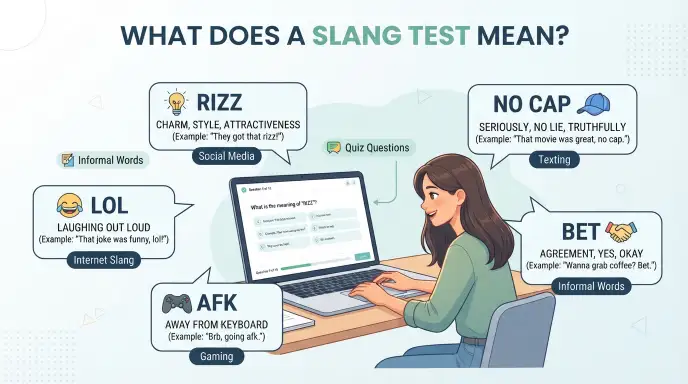
The phrase slang test is made from two ordinary English words. “Slang” refers to informal words and expressions that are often connected with particular groups, communities, regions, or situations. A “test” is an activity used to check someone’s knowledge or understanding. Together, a slang test simply means a test or quiz about slang.
The phrase is not normally slang itself. You may see it on quiz websites, educational pages, social media posts, and languageiflearning resources. A person might also say, “I took a slang test,” meaning that they answered questions designed to measure how familiar they are with informal language.
A slang test can be very simple or quite detailed. One quiz may ask what a single abbreviation means, while another may give you an entire conversation and ask you to work out what a slang expression means from the surrounding words.
What Can a this Slang Include?
A slang test can include many different types of questions. The content depends on the audience and the purpose of the quiz. Some tests focus on general internet slang, while others are designed around texting, gaming, social media, regional English, or a particular generation.
A typical test may ask about words such as rizz, no cap, sus, lowkey, ate, or bet. A textingiffocused test may include abbreviations such as LOL, IDK, TBH, BTW, and BRB. A gaming test may use terms such as AFK, GG, noob, buff, nerf, or clutch.
Questions can also appear in different formats. Multipleifchoice questions are common because they are quick to answer. Matching questions can ask you to connect slang words with their definitions. Fillifiniftheifblank questions test if you understand how an expression fits into a sentence. Context questions are especially useful because they show how slang works in actual communication rather than treating every word as having only one fixed meaning.
Different Types of This Slang
Internet Slang
An internet slang test focuses on expressions that are commonly seen online. These may appear in comments, captions, posts, videos, forums, and online chats. Words such as no cap, sus, rizz, slay, and lowkey may appear in this type of quiz.
Internet slang can change quickly, so a test made several years ago may contain expressions that are less common today. For that reason, it is useful to consider when a slang quiz was created or updated.
Gen Z Slang Test
A Gen Z slang test focuses on expressions strongly associated with younger online culture. Depending on the quiz, it may include words such as rizz, ate, bussin’, delulu, and no cap.
However, it is not accurate to assume that every Gen Z person uses every word on a slang list. Social media allows expressions to spread between age groups very quickly. Older users can learn and use newer slang, while younger users may not know every expression associated with their generation.
Texting Slang
A texting slang test focuses on short forms and abbreviations used in messages. Common examples include LOL for “laughing out loud,” IDK for “I don’t know,” TBH for “to be honest,” BTW for “by the way,” and BRB for “be right back.”
These expressions are usually used to make casual communication shorter and faster. They are much more common in informal messages than in formal writing.
Gaming Slang
A gaming slang test checks vocabulary used by players in online gaming communities. Terms such as AFK, GG, noob, clutch, buff, and nerf may appear.
Gaming slang can sometimes vary by game, so a term that is common in one gaming community may be unfamiliar in another. Context is therefore important when answering these questions.
Regional Slang
A regional slang test focuses on words or phrases connected with a particular country, area, or dialect. British slang, American slang, Australian slang, and other regional varieties can have vocabulary that is unfamiliar to people outside that region.
This is one reason why a person can be fluent in English and still score poorly on a regional slang test. The problem may simply be unfamiliarity with that local vocabulary.
Where Is a Slang Commonly Used?
Slang tests can appear in many places because informal language is now part of everyday online communication. Social media creators may use them as quick challenges, asking followers to identify the meanings of popular expressions. These quizzes can appear on platforms such as TikTok, Instagram, Reddit, and Discord, where users regularly communicate through short and informal messages.
Teachers can also use an ageifappropriate slang test as a classroom activity. For example, students can compare a slang expression with its formal English equivalent and learn when each style is suitable. This can help students understand that knowing slang is different from knowing when it is appropriate to use it.
Parents may also search for a slang test when they encounter unfamiliar expressions online. Instead of guessing what a word means, they can use a quiz or slang dictionary to understand the vocabulary and then consider the context in which it was used.
Gaming communities are another common place for slang tests. New players may encounter terms that experienced players use naturally. Learning these expressions can make online conversations easier to follow and can help beginners feel more comfortable in a gaming community.
Slang vs. Regular English Test
A slang test is different from a standard English vocabulary test. A regular vocabulary test usually focuses on words that are part of standard English, while a slang test focuses on informal expressions that may be strongly connected to a particular group, platform, region, or period.
For example, a regular English test might ask you to define “confident.” A slang test might ask what “rizz” means in an online conversation. Both tests measure language knowledge, but they focus on different types of vocabulary.
This difference is important because failing a slang test does not mean someone has poor English. A person may have excellent grammar, spelling, reading, and writing skills while knowing very little current internet slang. Slang knowledge is only one small part of understanding a language.
Is a Slang Rude, Offensive, or Harmless?
A slang test is normally harmless because it is simply a quiz about informal language. The possible concern comes from the words included in the test. Some slang expressions are friendly and harmless, while others may contain insults, profanity, sexual references, or language that could offend certain people. A responsible slang test should make the meaning and tone clear instead of suggesting that every slang term is suitable for every situation.
If a slang test is created for children or students, it should be checked for mature vocabulary before being shared. A simple internet slang quiz can be completely ageifappropriate, but another quiz may include words that are better suited to adults. Understanding a slang term does not mean that you need to use it.
Rea-Life Slang Examples
A good slang test often uses realistic sentences because slang can be difficult to understand when it is presented without context. For example, a question may ask, “What does ‘no cap’ mean in this sentence?” If someone says, “That was the best concert I’ve ever seen, no cap,” the phrase means that the speaker is being honest and is not exaggerating.
Another common question may be asked about rizz. If a person says, “He has serious rizz,” they are usually talking about the person’s charm or ability to attract someone romantically. The word is generally used in casual online conversations and social media language.
A gaming slang test might ask about AFK. In a sentence such as “I’m AFK for five minutes,” AFK means “away from keyboard.” The person is telling other players that they will temporarily be away from the game or computer.
A social media test might also ask about ate. When someone writes, “She ate with that performance,” they are usually praising the person’s performance and saying that they did extremely well. These examples show why context is important when answering slang questions.
Why Do People Take a Slang ?
People take a slang test for many different reasons. Some people simply enjoy quizzes and want to see how many popular expressions they recognize. Others encounter unfamiliar words on social media and want to understand what people are saying. A parent may see a new expression in a child’s online conversation, while a teacher may want to understand vocabulary students are using.
English learners can also benefit from slang tests because informal English can be very different from textbook English. Someone may understand formal grammar perfectly but still feel confused when they see abbreviations or modern internet expressions. A slang quiz can introduce these terms in a simple way and show how they are used in real conversations.
Slang tests can also be useful for gamers and online communities. Different communities often develop their own vocabulary, and new users may need time to understand it. A quiz can make this learning process more interesting and less confusing.
Origin and History of Slang Tests
There is no single known person or exact date that can be credited with inventing the slang test. The word “slang” has existed for a long time, and people have tested their knowledge of informal language in different ways over the years. Older quizzes often focused on regional expressions, youth language, popular culture, and slang connected to particular generations.
The internet changed the way these quizzes were created and shared. As online forums, chat rooms, social networks, and gaming communities became more popular, slang tests began to focus more on internet vocabulary and abbreviations. Modern quizzes may now include words that spread through social media, gaming, and online communities.
This history also explains why slang tests can look very different depending on when they were created. A quiz from an older period may contain expressions that are now less common, while a newer quiz may focus on terms that became popular through modern social media.
Why Can Slang Tests Become Outdated?
Slang can change quickly, which means a slang test can become outdated faster than a normal vocabulary test. An expression may become popular for a short period, spread across social media, and then become less common. Some words stay popular for years, while others become associated with an older internet trend.
For example, an older internet slang test may contain expressions that were popular during an earlier period of online culture. A newer quiz may focus on terms such as rizz, no cap, ate, or other expressions that became more visible through modern social media.
This does not mean older slang is incorrect. It simply means that language use changes over time. A useful slang test should ideally show its publication or update date so readers know what period its questions represent.
Common Misunderstandings About Slang Tests
One common misunderstanding is that failing a slang test means you have poor English skills. This is not true. Slang knowledge is only one part of language knowledge. Someone can have excellent grammar, vocabulary, reading, and writing skills while being unfamiliar with current internet expressions.
Another misunderstanding is that everyone uses the same slang. Slang can vary by age, location, generation, platform, and online community. A word that is popular on TikTok may not be common in a workplace or gaming group, while a regional expression may be unfamiliar to someone from another country.
It is also wrong to assume that every modern slang word originated with Gen Z. Some expressions have older roots, while others developed within particular cultural, regional, or linguistic communities. A slang test should be careful about claiming where a term came from when its history is uncertain.
When Should You Avoid Using Slang?
You should avoid using slang when you are not sure what it means or how other people may understand it. This is especially important in formal settings such as school assignments, job applications, workplace emails, business documents, and professional communication.
For example, saying “That project was fired” may sound natural when talking to a friend. In a professional email, “That project was excellent” is clearer and more appropriate. The meaning is similar, but the tone is different.
You should also be careful with slang that may be insulting, offensive, sexual, or strongly connected to a specific community. Understanding a term from a slang test does not automatically mean it is appropriate for you to use. When in doubt, choose clear and neutral language.
How Can You Get Better at a Slang ?
The easiest way to improve your slang knowledge is to learn words through context instead of memorizing isolated definitions. When you see an unfamiliar expression, read the whole sentence and look at what the speaker is trying to communicate. The platform can also provide useful clues because a word used in gaming may not have exactly the same use or tone as a word used on social media.
Pay attention to tone as well. Slang can express excitement, humor, approval, sarcasm, friendship, or criticism. Understanding the speaker’s intention can make a difficult question much easier.
It is also helpful to learn if a term is current, old, regional, or communityifspecific. This prevents you from assuming that every word on a slang test is used everywhere. The goal is not to memorize every slang word in English. The goal is to understand informal language well enough to recognize it and use it appropriately when necessary.
Similar Terms to Slang Test
People searching for a slang test may also come across terms such as slang quiz, internet slang quiz, Gen Z slang test, texting slang test, teen slang quiz, gaming slang test, and slang challenge. These phrases are closely related, although each can focus on a different type of vocabulary.
A slang quiz is usually the closest alternative to a slang test because both describe a set of questions about informal language. An internet slang quiz is more specific because it focuses on expressions used online. A texting slang test usually focuses on abbreviations and short forms, while a gaming slang test focuses on vocabulary used by players.
Frequently Asked Questions
Q1. What is a slang test?
A slang test is a quiz that checks your knowledge of informal words, phrases, abbreviations, and expressions used in casual communication.
Q2. Is “slang test” itself slang?
No. Slang test is a normal phrase that describes a quiz or test about slang.
Q3. What words can appear in a slang test?
A slang test may include internet slang, texting abbreviations, gaming terms, social media expressions, regional phrases, and vocabulary associated with different generations.
Q4. Can students take a slang test?
Yes. An ageifappropriate slang test can be used as a fun educational activity to help students understand the difference between formal and informal English.
Q5. Are slang tests only about Gen Z slang?
No. A slang test can focus on any generation, region, community, or period. Some quizzes focus on older slang, British slang, American slang, gaming language, or internet expressions.
Q6. Why do slang tests become outdated?
Slang changes over time. Some expressions become less popular, while new words appear through social media, gaming, music, and online communities.
Q7. Can I use slang at work?
Some mild slang may be acceptable in casual workplace conversations, but professional emails, reports, and client communication are usually better when written in clear and neutral English.
Conclusion
A slang test is more than a simple collection of funny internet words. It is a way to check how well you understand informal language used in texting, gaming, social media, and everyday conversations. Different tests can focus on different generations, regions, platforms, or online communities, so the vocabulary will not always be the same.
The most useful skill is learning to understand slang from context, tone, audience, and situation. A word may be friendly in one conversation but inappropriate in another. Likewise, a term that is popular on one platform may be unfamiliar somewhere else. If you understand these differences, you can do more than pass a slang test if you can understand modern informal communication more confidently and choose the right language for each situation.

I’m Dylan Foster, a slang and internet culture writer passionate about exploring how people communicate online and in everyday conversations. I write about texting abbreviations, social media expressions, and modern slang to help readers understand meanings, origins, and real-world usage in a simple way.