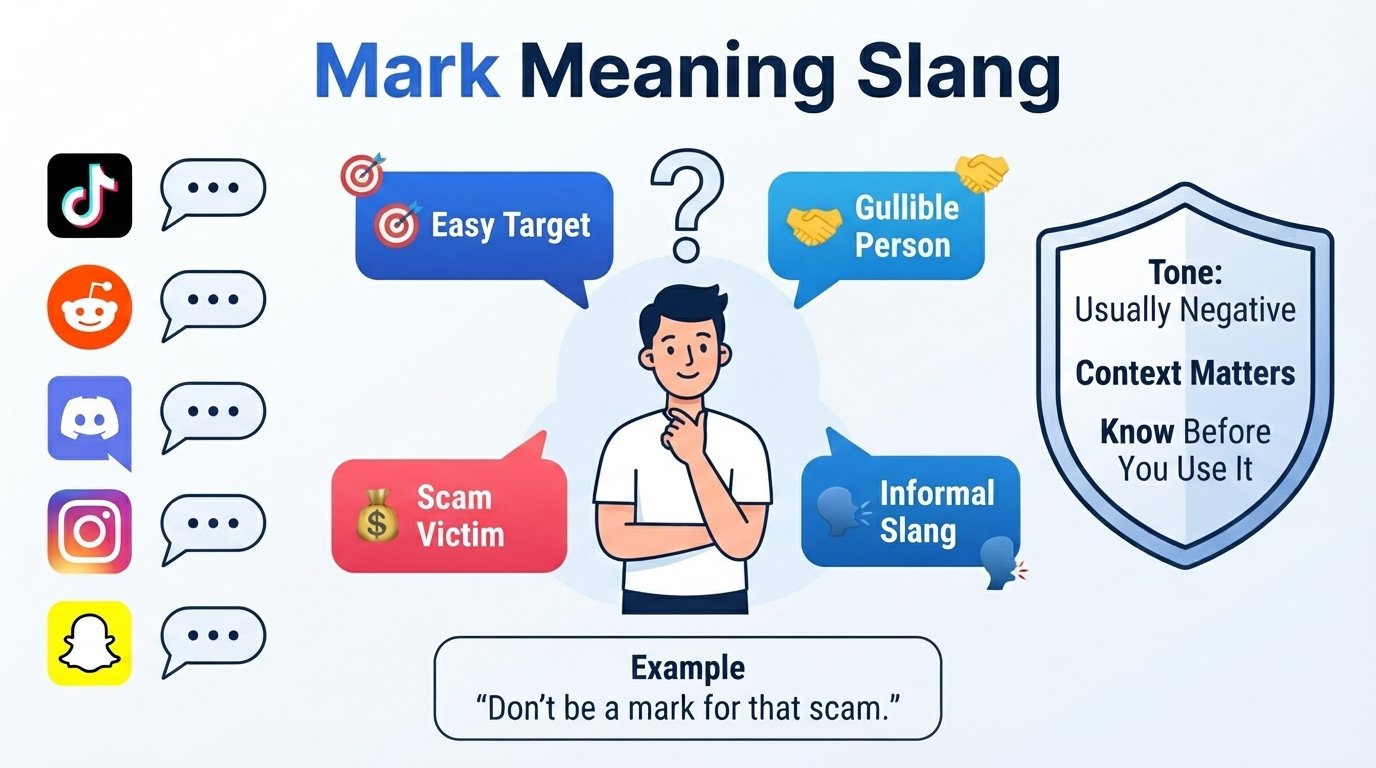
Mark meaning slang refers to a person who is seen as an easy target for deception, manipulation, or scams. In slang, a “mark” is someone that a scammer, con artist, or dishonest person believes can be tricked or taken advantage of
The term has been used for many years and still appears in movies, crime stories, gambling discussions, wrestling, and online conversations.
People search for mark meaning slang after hearing it in TV shows, social media, podcasts, or realiflife conversations. Since the word mark also has several standard English meanings, it can be confusing to know when someone is using it as slang.
In this guide, you’ll learn what mark meaning slang really means, where it is commonly used, if it is offensive, how it originated, and how to recognize it in everyday conversations.
Quick Answer: Mark Meaning Slang
A mark in slang is a person who is considered an easy target for a scam, trick, or manipulation. The term is commonly used in crime stories, gambling, professional wrestling, and sometimes in everyday conversations to describe someone who is easily fooled.
What Does Mark Meaning Slang Mean?
In slang, a mark is someone who becomes the target of another person’s plan, trick, or deception. The word usually suggests that the person has been selected because they appear trusting, inexperienced, or unaware of what is happening.
Unlike its normal dictionary meaning, slang does not use “mark” to describe a sign, grade, or symbol. Instead, it focuses on someone who has been “marked” as a target.
For example:
- A scammer may call a potential victim a mark.
- A con artist may describe someone as an easy mark.
- Crime dramas often use the word before carrying out a scam.
The slang meaning is widely recognized in Englishifspeaking countries and has appeared in books, films, and television for decades.
Full Meaning of Mark in Slang
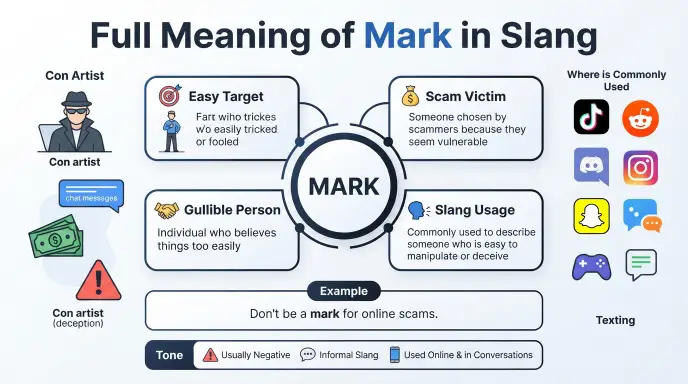
The slang word mark does not stand for another phrase or abbreviation. It is simply a word that developed a special meaning over time.
Its slang definition is:
- Someone chosen as a target
- A person likely to believe a lie
- Someone who can be manipulated
- A victim of a planned scam
Although the meaning sounds negative, it usually describes the situation rather than insulting the person’s intelligence.
Different Meanings of Mark
The word mark has several meanings in English. Understanding the context helps you know which one is being used.
Mark as Slang
This is the informal meaning.
It refers to:
- A target for a scam
- Someone selected for deception
- A person being manipulated
Example:
“The con artist finally found his mark.”
Mark in Everyday English
Outside slang, mark has many standard meanings.
Examples include:
- A school grade
- A visible spot or stain
- A written symbol
- A target in sports
These meanings have nothing to do with slang.
Mark in Professional Wrestling
Professional wrestling has its own special use of the word.
Traditionally, a mark referred to a fan who believed wrestling storylines were completely real.
Today, the meaning has become broader.
It may describe:
- Passionate fans
- New viewers
- Someone deeply invested in wrestling storylines
The tone depends on who is using the term. Some wrestling fans use it jokingly, while others may use it as criticism.
Where Is Mark Meaning Slang Commonly Used?
The slang meaning appears in several different situations.
Crime Stories
Books, TV shows, and movies often use mark when talking about scams.
Example:
“They spent hours choosing the perfect mark.”
Gambling Conversations
Professional gamblers and fictional characters sometimes describe inexperienced players as marks.
Here, the meaning refers to someone who is easier to beat or trick.
Professional Wrestling
Wrestling fans frequently use the word in discussions about matches, promotions, and storylines.
Modern usage often appears in:
- Wrestling podcasts
- Fan forums
- YouTube discussions
- Social media posts
Online Discussions
Although less common than other internet slang, the word sometimes appears in:
- Reddit discussions
- Discord communities
- Online forums
- Social media conversations
The meaning usually stays close to its traditional definition of someone being targeted or easily fooled.
Is Mark Slang Rude, Offensive, or Harmless?
The answer depends on the situation.
Calling someone a mark usually carries a negative meaning because it suggests they were easy to deceive.
However, it is generally not considered profanity or a highly offensive insult.
Neutral Usage
The word is often used while explaining scams, movies, or crime stories without insulting anyone directly.
Example:
“The criminals searched for an easy mark.”
Negative Usage
If someone directly calls another person a mark, it may sound disrespectful because it implies they are gullible or easily manipulated.
Example:
“Don’t be a mark.”
Here, the speaker is warning someone not to be easily fooled.
Real :Life Examples of Mark Meaning Slang
Friendly Conversation
Person A: “Watch out for those online offers.”
Person B: “I don’t want to become someone’s mark.”
Meaning:
The speaker wants to avoid becoming a victim of a scam.
Casual Conversation
Friend: “He almost became the mark in that fake investment scheme.”
Meaning:
The person was nearly tricked into a scam.
Movie Example
“The thief spent the afternoon watching tourists before choosing a mark.”
Meaning:
The criminal selected someone to target.
Wrestling Example
“Some fans proudly call themselves marks because they enjoy the shows.”
Meaning:
In wrestling culture, the word has developed a different meaning than its crimeifrelated usage.
Origin and History of Mark Meaning Slang
The slang meaning of mark has been around for more than a century. It is closely associated with con artists, pickpockets, gamblers, and confidence tricks.
The exact origin is difficult to trace, but historians generally believe the term developed in the late 1800s and early 1900s. Criminals would identify or “mark” a person they believed would be easy to deceive. Over time, the word became part of everyday English and appeared in detective novels, crime films, and television shows.
Today, the slang meaning is still recognized, although it is more commonly heard in entertainment, wrestling culture, and discussions about scams than in ordinary conversation.
Similar Slang and Related Terms
Several slang words have meanings similar to mark, although each has its own context.
| Slang Term | Meaning | Common Usage |
| Mark | Someone targeted for a scam | Crime, gambling, wrestling |
| Victim | Person harmed by deception | General English |
| Sucker | Someone easily fooled | Casual conversations |
| Patsy | Someone blamed or manipulated | Crime and politics |
| Target | Person chosen for an action | General English |
These words are not always interchangeable, but they all describe someone being selected or manipulated in some way.
When Should You Avoid Using Mark as Slang?
Although mark is a recognized slang term, it is not appropriate in every situation.
Avoid using it when:
- Speaking in professional workplaces
- Writing academic papers
- Talking to someone who may misunderstand the slang
- Referring directly to someone in a disrespectful way
Calling someone a “mark” in real life may sound insulting because it suggests they are easy to fool.
Instead, use clearer language like:
- Victim
- Target
- Customer
- Person affected by a scam
The best choice depends on the context.
Polite Alternatives to Mark Slang
If you want to avoid slang, several alternatives work better in formal communication.
| Slang | Polite Alternative |
| Mark | Target |
| Mark | Scam victim |
| Mark | Person affected |
| Mark | Intended victim |
| Mark | Customer (when appropriate) |
These alternatives sound more professional and are easier for a wider audience to understand.
Why Do People Use the Word Mark?
People use mark because it quickly describes someone’s role in a scam or deception.
Instead of saying:
“The person who the scammer planned to deceive…”
People simply say:
“The mark.”
The slang is short, memorable, and widely recognized in crime stories and entertainment.
In professional wrestling, fans also use the word because it has become part of wrestling culture over many decades.
Common Misunderstandings About Mark Meaning Slang
Many people misunderstand the slang because the word has several unrelated meanings.
Confusing It With School Grades
The most common mistake is thinking the slang relates to exam marks or grades.
These meanings are completely different.
Assuming It Is Always an Insult
Not every use of mark is meant to insult someone.
In many books and films, the word simply describes the intended victim of a scam.
Thinking Every Wrestling Fan Is a Mark
In wrestling communities, the word has changed over time.
Some fans proudly describe themselves as marks because they enjoy wrestling, while others use the word critically.
The meaning depends on the conversation and the speaker’s intent.
Can You Use Mark Meaning Slang on Social Media?
Yes, but context matters.
The term sometimes appears on:
- X (formerly Twitter)
- Discord
- YouTube comments
- Wrestling forums
It is usually understood by people familiar with crime stories or wrestling culture.
If your audience may not know the slang, using clearer language is often a better choice.
Mark Meaning Slang Across Different Platforms
Text Messages
The slang is uncommon in everyday texting but may appear when discussing scams or fraud.
Reddit users sometimes use mark when talking about scammers, fraud cases, or professional wrestling.
Discord
Gaming and wrestling communities occasionally use the word, though it is less common than many internet abbreviations.
Workplace Chat
Using mark in professional communication is generally not recommended because some people may misunderstand the meaning.
Frequently Asked Questions About Mark Meaning Slang
Q1: What does mark mean in slang?
In slang, mark refers to a person who is chosen as an easy target for a scam, trick, or manipulation. The term is commonly used in crime stories, gambling, and professional wrestling.
Q2: Is mark a rude slang word?
Not usually. While mark has a negative meaning, it is not considered profanity. However, calling someone a “mark” directly may sound insulting because it suggests they are easy to fool.
Q3: What does mark mean in professional wrestling?
In professional wrestling, a mark traditionally referred to a fan who believed wrestling storylines were real. Today, it can also describe a passionate fan who enjoys the entertainment, depending on the context.
Q4: Is mark used on social media?
Yes. The slang occasionally appears on Reddit, Discord, X (formerly Twitter), YouTube, and wrestling forums. It is most often used in discussions about scams, crime, or wrestling culture.
Q5: Can I use mark in a professional setting?
It is better to avoid using mark in workplaces or formal writing because many people may not understand the slang or may view it as disrespectful. Words like target or victim are usually more appropriate.
Q6: Does mark have more than one meaning?
Yes. Besides its slang meaning, mark can refer to a school grade, a visible spot, a written symbol, a target in sports, or a person’s name. The intended meaning depends entirely on the context.
Conclusion
Mark meaning slang refers to a person who is seen as an easy target for deception, scams, or manipulation. Although the word originated in criminal and gambling circles, it is now widely recognized through movies, television, books, and professionall wrestling.
Because mark has several meanings in English, understanding the surrounding conversation is important. In crimeifrelated discussions, it usually means a target for a scam. In wrestling, it often refers to an enthusiastic fan, and the tone can range from playful to critical.
If you are learning English slang, remember that context is everything. Using the term correctly will help you better understand conversations, entertainment, and online discussions while avoiding misunderstandings in formal situations.

I’m Dylan Foster, a slang and internet culture writer passionate about exploring how people communicate online and in everyday conversations. I write about texting abbreviations, social media expressions, and modern slang to help readers understand meanings, origins, and real-world usage in a simple way.