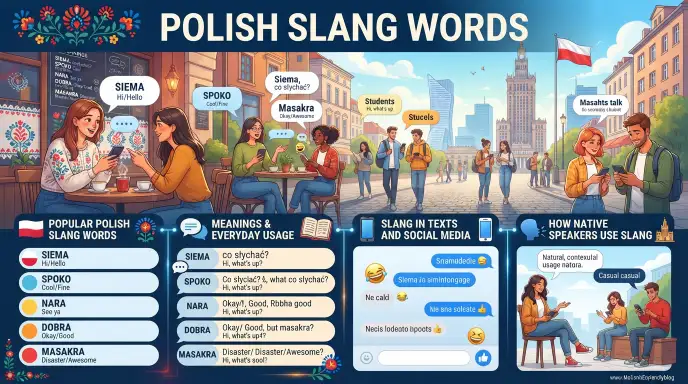
Polish slang words are informal expressions, phrases, and casual words used by people in Poland during everyday conversations. These words often appear in friendly chats, social situations, online.
conversations, and among younger generations. They help speakers sound more natural and connected, but their meanings can change depending on context.
People search for polish slang words because learning textbook Polish is different from understanding how native speakers actually talk. Slang can appear in messages, social media comments, movies, music, and conversations with friends.
This guide explains common Polish slang expressions, their meanings, where they are used, their tone, and when learners should be careful using them. You will learn how Polish slang works in real communication and how to understand informal Polish culture better.
Quick Answer: Polish Slang Words
Polish slang words are informal Polish expressions used in casual conversations, especially among friends, young people, and online communities. They often include shortened words, playful phrases, and expressions that may not appear in traditional language lessons.
What Do Polish Slang Words Mean?
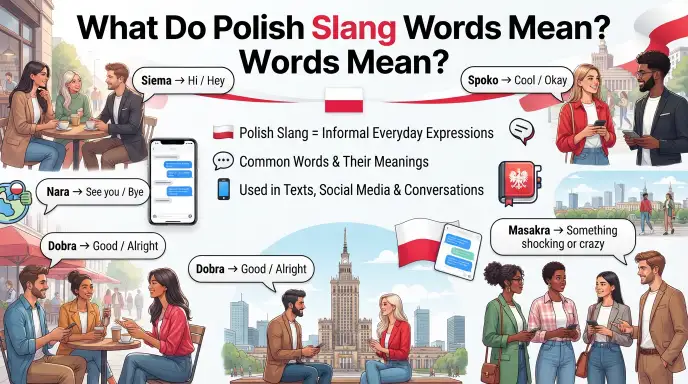
Polish slang words are casual forms of communication used instead of standard Polish vocabulary. Like slang in English and other languages, Polish slang can show friendship, humor, emotions, or belonging to a certain group.
Slang is different from formal Polish because it is usually:
- More relaxed
- More creative
- Used in everyday conversations
- Common among younger speakers
- Connected to specific communities
For example, a person may use slang with friends but choose standard Polish in a job interview or official document.
Polish slang is not one single category. It includes:
- Youth expressions
- Internet slang
- Regional phrases
- Street language
- Gaming terms
- Informal nicknames
Full Meaning and Definition of Polish Slang Words
The phrase “Polish slang words” refers to unofficial vocabulary used by Polish speakers in informal situations.
These words are usually created because people want language to feel:
- Faster
- More expressive
- More personal
- More humorous
Some Polish slang words become popular nationwide, while others remain limited to certain cities, age groups, or online communities.
A slang word can also change meaning over time. A phrase that sounds modern today may become outdated later.
Common Polish Slang Words and Their Meanings
Polish slang includes many expressions used in daily conversations. Below are some popular examples.
| Polish Slang Word | Meaning in English | Tone |
| Siema | Hi / Hey | Friendly and casual |
| Spoko | Okay / No problem / Cool | Relaxed |
| Nara | Bye / See you later | Informal |
| Dobra | Okay / Good / Alright | Casual |
| Kasa | Money | Informal |
| Laska | Girl / Attractive woman | Informal, context matters |
| Ziomek | Friend / Mate / Buddy | Friendly |
| Sztos | Amazing / Awesome | Positive |
| Masakra | /create Extreme / Unbelievable | Emotional |
| Beksa | Crybaby | Teasing |
These words are common examples of how Polish speakers make conversations shorter and more expressive.
Different Types of Polish Slang Words
Polish slang is used in different parts of society. Not every slang expression has the same audience or purpose.
Youth Polish Slang
Young people often create new expressions through friendships, music, social media, and internet culture.
Youth slang may spread through:
- TikTok
- YouTube
- Online communities
- School environments
Some expressions become popular across Poland, while others disappear quickly.
Internet and Social Media Polish Slang
Online communication has created many new Polish slang expressions.
People often shorten words, create funny spellings, or mix Polish with English terms.
Common places where internet slang appears include:
- TikTok comments
- Instagram captions
- Discord chats
- Gaming communities
- Messaging apps
Online slang is usually more playful than formal written Polish.
Gaming Polish Slang
Polish gamers often use borrowed English gaming terms along with Polish expressions.
Examples include:
- GG if good game
- Noob if beginner player
- Nerf if making something weaker in a game
- Buff if making something stronger
These terms are common because gaming communities worldwide share similar vocabulary.
Where Are Polish Slang Words Commonly Used?
Polish slang appears mostly in informal communication.
Polish Slang in Text Messages
Friends often use slang while texting because it makes messages shorter and more natural.
Example:
“Siema, co tam?”
Meaning:
“Hey, what’s up?”
This type of message would sound normal between friends but not in a formal situation.
Polish Slang on Social Media
Platforms like TikTok, Instagram, and Reddit allow slang to spread quickly.
Users may use slang to:
- Show personality
- Join trends
- Make jokes
- Connect with others
A slang expression can become popular online even if it was previously used only by a small group.
Polish Slang in Everyday Conversation
Native Polish speakers often use slang when talking with:
- Friends
- Family members
- Classmates
- Coworkers they know well
However, they usually avoid heavy slang when speaking with strangers or in formal situations.
Is Polish Slang Rude, Offensive, or Harmless?
Polish slang can be harmless, but some expressions may become rude depending on the situation.
The meaning depends on:
- The specific word
- The speaker’s tone
- The relationship between people
- The cultural context
Some slang words are:
- Friendly among friends
- Funny in casual conversations
- Offensive when used toward strangers
For example, a nickname between close friends may sound insulting from someone who does not know the relationship.
Positive and Negative Polish Slang Examples
| Type | Example Situation | Effect |
| Friendly slang | Talking with close friends | Creates connection |
| Funny slang | Online jokes or memes | Adds humor |
| Youth slang | Casual conversations | Shows modern style |
| Offensive slang | Insults or disrespectful comments | Can hurt others |
Understanding tone is just as important as understanding the word itself.
Real :Life Examples of Polish Slang Words
Understanding slang becomes easier when you see how native speakers use it in real situations. The same word can sound friendly, funny, or inappropriate depending on the relationship between speakers.
Friendly Conversation Example
Person A: “Siema! Co tam?”
Person B: “Spoko, wszystko dobrze.”
Meaning:
“Hey! What’s up?”
“Cool, everything is good.”
In this situation, the slang sounds natural and friendly between people who know each other.
Casual Text Message Example
Friend: “Masz kasę na kino?”
Reply: “Tak, spoko.”
Meaning:
“Do you have money for the cinema?”
“Yes, no problem.”
Here, the words are informal but common in everyday conversations.
Social Media Example
Comment: “Ten film to sztos!”
Meaning:
“This video is amazing!”
On platforms like TikTok or Instagram, younger users often use expressions like this to show excitement.
Gaming Example
Player: “GG, dobra gra!”
Meaning:
“Good game.”
Polish gamers often combine Polish phrases with international gaming slang because online games connect players from different countries.
Argument Example
Some slang words can become negative depending on tone.
For example, a word that friends use as a joke may sound offensive when used by someone who is angry.
The meaning of slang is not only in the word itself. The situation and speaker’s intention matter.
Origin and History of Polish Slang Words
Polish slang has developed over many years through different social groups, regions, and generations.
Unlike formal vocabulary, slang usually does not have one exact creator or a single starting point. It develops naturally as people create new ways to express themselves.
Polish slang has been influenced by:
- Local dialects
- Youth culture
- Music
- Movies
- Foreign languages
- Internet communities
In recent years, English has had a strong influence on Polish online language. Many young speakers use English words related to technology, gaming, and social media.
For example, terms from gaming and internet culture often move between languages because online communities communicate globally.
How Polish Slang Changes Over Time
Slang has a short life cycle. Some words remain popular for decades, while others become outdated quickly.
A slang expression may:
- Start in a small group
- Become popular among young people
- Spread through social media
- Become understood by a wider audience
- Eventually become oldiffashioned
This is why older and younger Polish speakers may use completely different slang.
A word that sounds modern to teenagers may sound unusual or outdated to older generations.
Similar Slang and Related Polish Expressions
Many Polish slang words have similar meanings but different levels of formality.
| Polish Expression | Meaning | Usage |
| Siema | Hey | Very casual greeting |
| Cześć | Hi / Hello | Common but less slangiflike |
| Spoko | Cool / Fine | Informal agreement |
| W porządku | Okay / Alright | More neutral |
| Ziomek | Buddy / Friend | Casual friendship term |
| Kolega | Colleague / Friend | More standard Polish |
Choosing the right expression depends on who you are speaking with.
When Should You Avoid Using Polish Slang Words?
Polish slang is useful, but it is not suitable for every situation.
Avoid using slang in:
- Job interviews
- Official emails
- University applications
- Business meetings
- Formal presentations
In these situations, standard Polish is safer because slang may sound too casual or unclear.
Language learners should also be careful because some slang words may have hidden meanings that are not obvious from translation.
Polite Alternatives to Polish Slang Words
If you are learning Polish, using standard words first is usually better.
Examples:
| Slang | More Neutral Alternative |
| Siema | Dzień dobry / Cześć |
| Spoko | Dobrze / W porządku |
| Kasa | Pieniądze |
| Ziomek | Przyjaciel / Kolega |
| Nara | Do widzenia / Na razie |
The formal alternative depends on the situation.
For conversations with friends, slang can make you sound more natural. For professional situations, standard vocabulary is better.
Why Do People Use Polish Slang Words?
People use slang because language is not only about sharing information. It also shows identity and relationships.
Common reasons include:
- Creating a friendly atmosphere
- Showing membership in a group
- Making conversations shorter
- Expressing emotions strongly
- Adding humor
Teenagers and online communities often use slang because it helps them feel connected with others.
Slang can also show cultural knowledge. Understanding common expressions can help visitors and language learners communicate more naturally with native speakers.
Impact of Polish Slang on Communication
Polish slang has both positive and negative effects.
Positive Effects
Slang can:
- Make conversations more relaxed
- Help people connect socially
- Add personality to speech
- Express emotions clearly
Possible Problems
Slang can also:
- Confuse language learners
- Be misunderstood
- Sound inappropriate in formal settings
- Change meaning quickly
Good communication requires knowing when slang fits and when it does not.
Is Polish Slang Safe for Social Media?
Polish slang is generally safe for social media when used respectfully.
Users should consider:
- The audience reading the post
- The meaning of the expression
- if the word could offend someone
- if the platform is public or private
On platforms like TikTok, Instagram, Reddit, and Discord, slang is common because users prefer fast and casual communication.
However, public posts reach many different people, so expressions that seem harmless among friends may be misunderstood by others.
Common Misunderstandings About Polish Slang Words
Many people learning Polish misunderstand slang because they try to translate each word directly. Slang does not always work like standard vocabulary. The meaning often depends on the situation, tone, and relationship between speakers.
Thinking Every Slang Word Is Used Everywhere
A common mistake is assuming that all Polish speakers use the same slang.
In reality, slang can differ between:
- Cities
- Age groups
- Friend groups
- Online communities
- Generations
A word that is popular among teenagers may sound unusual to older speakers.
Believing Slang Is Always Informal or Bad
Some learners think slang is incorrect language. This is not true.
Slang is a normal part of communication. Native speakers use it every day with friends and people they know well.
The important thing is knowing the correct situation for each expression.
Translating Slang WordifforifWord
Direct translation can create confusion because slang often carries cultural meaning.
For example, a Polish slang expression may have:
- A humorous meaning
- An emotional meaning
- A friendly meaning
A simple dictionary translation may not show the real feeling behind the word.
Using Slang Too Early as a Beginner
Language learners often want to sound natural quickly, but using slang without understanding the context can create awkward situations.
A better approach is:
- Learn standard Polish first
- Understand common slang expressions
- Listen to native speakers
- Use slang slowly and naturally
How to Learn Polish Slang Words Naturally
Learning slang is easier when you experience real conversations instead of memorizing lists.
Helpful methods include:
- Watching Polish movies and shows
- Listening to Polish music
- Following Polish creators online
- Talking with native speakers
- Reading social media comments
Pay attention to:
- Who uses the word
- What situation it appears in
- if it sounds friendly or rude
Polish Slang Words for Travelers and Language Learners
Visitors to Poland often learn basic slang because it helps them communicate more naturally.
Some friendly expressions can make conversations easier.
Examples:
| Polish Slang | English Meaning | Situation |
| Siema | Hey | Greeting friends |
| Spoko | Cool / Okay | Casual agreement |
| Nara | See you | Saying goodbye |
| Dzięki | Thanks | Informal appreciation |
| Ziomek | Buddy | Talking about a friend |
Travelers should remember that slang is usually best used after understanding local customs and pronunciation.
Frequently Asked Questions About Polish Slang Words
Q1: What are Polish slang words?
Polish slang words are informal expressions used by Polish speakers in casual conversations. They are common among friends, young people, online communities, and social groups.
Q2: Are Polish slang words difficult to learn?
Polish slang can be challenging because meanings depend on context. Some expressions do not have a direct English translation, so learners need to understand how native speakers use them.
Q3: Is Polish slang rude?
Not all Polish slang is rude. Many slang words are friendly and harmless, but some expressions can become offensive depending on the tone and situation.
Q4: Where are Polish slang words used?
Polish slang is used in texting, social media, everyday conversations, gaming communities, and among friends. It is less common in formal writing and professional situations.
Q5: Can I use Polish slang as a beginner?
Yes, but beginners should learn the meaning and context first. Using slang incorrectly can create misunderstandings, so it is better to listen and practice before using it often.
Q6: Do young Polish people use different slang?
Yes. Young people often create new expressions through social media, music, gaming, and online communities. Some slang changes quickly between generations.
Conclusion
Polish slang words are an important part of everyday communication in Poland. They help people express emotions, build friendships, and communicate in a more relaxed way.
From simple greetings like “Siema” to online expressions used on social media, Polish slang shows how language changes with culture and technology. However, understanding context is essential because the same word can sound friendly in one situation and inappropriate in another.
For learners, the best approach is to first understand standard Polish and then slowly add common slang expressions through real conversations and media.
Polish slang is not just a collection of informal words. It is a reflection of humor, identity, friendship, and modern Polish communication.

I’m Dylan Foster, a slang and internet culture writer passionate about exploring how people communicate online and in everyday conversations. I write about texting abbreviations, social media expressions, and modern slang to help readers understand meanings, origins, and real-world usage in a simple way.