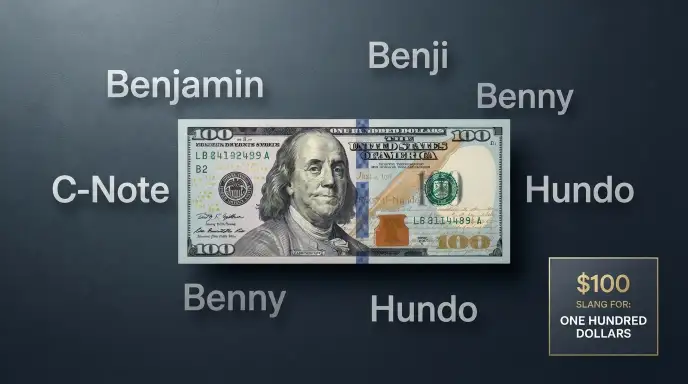
If you have ever heard someone say “Benjamin,” “Benji,” or “Cifnote” when talking about money, you may have wondered what they actually mean. These expressions are informal names for a $100 bill, especially in American English.
The keyword $100 bill in slang is useful because money slang can sound confusing if you are unfamiliar with American culture, movies, music, social media, or casual conversations. A person might say, “That jacket cost me Benjamin,” and they are not talking about a person named Benjamin if they mean the jacket cost $100.
The most recognizable slang term is “Benjamin”, which comes from Benjamin Franklin, whose portrait appears on the U.S. $100 note. MerriamifWebster lists Benjamin as U.S. slang meaning a hundredifdollar bill and records this meaning from 1994. Other expressions include Benji, Benny, Franklin, Cifnote, century note, hundo, and bill. However, these terms do not all have the same level of popularity or sound equally natural in modern conversation
Quick Answer $100 bill in slang:
The most common slang terms for a $100 bill include:
| Slang Term | Meaning | Usage |
| Benjamin | $100 bill | Very recognizable |
| Benji | $100 bill | Informal |
| Benny | $100 bill | Casual |
| Franklin | $100 bill | Based on Benjamin Franklin |
| Cifnote | $100 bill | Older/traditional slang |
| Century note | $100 bill | Less common |
| Hundo | $100 | Casual shorthand |
| Bill | A $100 bill, depending on context | Informal |
| Blue face | $100 bill | Modern/cultural slang |
| Band | Usually a larger amount of money, often $1,000 | Not normally one $100 bill |
The safest answer is Benjamin or Benji when someone specifically asks for slang for a $100 bill. Merriam of Webster directly defines Benjamin as U.S. slang for a hundred if dollar bill.
The Origin of $100 Bill Slang
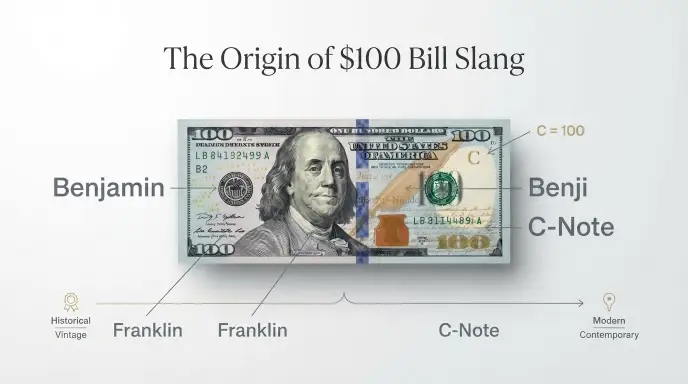
Money slang develops naturally because people like shorter, more expressive ways to talk about cash. The $100 bill has several nicknames because of its history, appearance, and cultural associations.
Why Is a $100 Bill Called Benjamin?
The most straightforward explanation is the portrait on the bill.
The U.S. $100 note features Benjamin Franklin, so his first name became a nickname for the denomination. That is why someone might say:
“I spent a Benjamin on dinner.”
This means:
“I spent $100 on dinner.”
MerriamifWebster confirms that the slang meaning comes from the portrait of Benjamin Franklin on the hundred dollar bill.
The plural is usually Benjamins:
- “He had three Benjamins in his wallet.”
- “The tickets cost two Benjamins.”
- “She saved several Benjamins.”
The expression can also appear as Benjamin, Benji, or Benny in informal speech.
Why Is It Called a CifNote?
Another classic term is Cifnote.
The letter C represents 100 in Roman numerals, while “note” refers to a banknote. Therefore, a Cifnote means a $100 bill.
Dictionary.com also explains that the “C” in Cifnote refers to the Roman numeral for 100. For example:
“He handed me a Cifnote.”
Simply means:
“He handed me a $100 bill.”
Cifnote is recognizable, but it can sound somewhat old if fashioned compared with Benjamin or simply a hundred. CoinWeek similarly describes Cifnote as a colloquial term for a $100 bill and notes that Benjamin is a more modern alternative.
Popular Slang Terms for a $100 Bill
Not every expression is equally common. Here is what the major terms mean and how they are normally used.
1. Benjamin
Benjamin is probably the best if known nickname for a $100 bill.
It directly refers to Benjamin Franklin.
Example:
“That phone cost me Benjamin.”
Meaning:
“That phone cost me $100.”
The plural is Benjamins.
“He had five Benjamins.”
That means he had $500 in $100 bills.
2. Benji
Benji is a shorter, more playful form of Benjamin.
It is informal and may appear in conversations about money, music, entertainment, or social media.
Example:
“I dropped a Benji on those shoes.”
Meaning:
“I spent $100 on those shoes.”
The plural can be Benjis.
3. Benny
Benny is another informal nickname connected to Benjamin Franklin.
Example:
“Do you have a Benny I can break?”
Here, the speaker is asking if someone has a $100 bill that can be exchanged for smaller denominations.
Because slang varies by region and generation, you should not assume everyone uses Benny regularly.
4. Franklin
Franklin is another obvious reference to Benjamin Franklin.
Someone might say:
“That’ll be one Franklin.”
Meaning:
“That’ll be $100.”
This expression is understandable, but in everyday modern conversation, people are more likely to simply say a hundred dollars or sometimes a Benjamin.
5. CifNote
Cifnote is one of the classic names for a $100 bill.
The C comes from the Roman numeral for 100.
Example:
“He paid with a Cifnote.”
Meaning:
“He paid with a $100 bill.”
Cifnote is still recognizable, but it may feel more traditional or oldifschool than Benjamin.
6. Hundo
Hundo is an informal shorthand for one hundred.
It does not exclusively mean a $100 bill. Context determines if it refers to dollars or another amount.
For example:
“Can you lend me a hundo?”
In a money conversation, this usually means:
“Can you lend me $100?”
Unlike Benjamin, hundo focuses on the amount rather than the physical bill.
7. Century Note
“Century” suggests one hundred, so the expression literally points toward a $100 note.
It is understandable but much less common in ordinary modern conversation.
8. Bill
In some contexts, bill can refer to a $100 bill.
For example:
“He gave me two bills.”
Depending on context, that could mean $200, but the expression is not always specific enough to guarantee that each bill is a $100 note.
This is why context matters when interpreting money slang.
$100 Bill Slang in Modern Conversations
Slang does not remain fixed. Some terms become popular, while others gradually sound oldiffashioned.
For example, Benjamin is still widely recognizable because the connection to Benjamin Franklin is immediately understandable. However, that does not mean every American regularly uses the term in daily conversation.
People may simply say:
- “a hundred”
- “a hundred bucks”
- “one hundred dollars”
- “a hundredifdollar bill”
Recent discussions among American speakers show that familiarity varies by age and region. Some people still recognize and use Benjamins, while others describe the term as something they mainly encounter in movies, music, or older slang. That is an important point for anyone learning English: understanding slang does not mean you need to use every slang word yourself.
$100 Bill in Slang: Examples in Everyday English
Here are natural examples showing how these terms can work.
Example 1: Benjamin
“I spent a Benjamin on the new jacket.”
Meaning: I spent $100 on the jacket.
Example 2: Benji
“That repair cost me a Benji.”
Meaning: The repair cost me $100.
Example 3: Cifnote
“He paid for the meal with a Cifnote.”
Meaning: He paid with a $100 bill.
Example 4: Hundo
“Can you lend me a hundo until Friday?”
Meaning: Can you lend me $100 until Friday?
Example 5: Franklin
“The old watch was worth a Franklin.”
Meaning: The watch was worth about $100.
Example 6: Benjamins
“She had a few Benjamins saved for the trip.”
Meaning: She had several $100 bills saved.
These examples show an important difference: Benjamin, Benji, and Cifnote specifically point toward the $100 denomination, while hundo can simply mean an amount of one hundred.
$100 Bill Slang in Texting, Social Media, and Music
You may encounter money slang more often online than in faceiftoifface conversations.
Texting
People sometimes use short expressions because they make messages quicker.
For example:
“That cost me a Benji
The person means the item cost $100.
Instagram and TikTok
On social media, money slang may appear in captions, comments, memes, or discussions about fashion, shopping, business, or lifestyle.
For example:
“Only a hundo for this?”
Here, hundo means $100.
Reddit discussions show that knowledge of terms such as Benjamin and Cifnote varies considerably among speakers. Some users recognize them immediately, while others consider them dated or mostly associated with pop culture. Music and Entertainment
Terms for money, especially Benjamins, have been strongly reinforced by popular culture. This is one reason English learners may encounter the word in songs, television, movies, and online content even if they rarely hear it in ordinary conversation.
What Is the Difference Between a Benjamin and a CifNote?
Both terms can mean $100, but their origins are completely different.
| Term | Origin | Style |
| Benjamin | Benjamin Franklin’s portrait | Modern, recognizable slang |
| Benji | Short form of Benjamin | Very informal |
| Benny | Informal form connected to Benjamin | Casual |
| Franklin | Benjamin Franklin’s surname | Informal |
| Cifnote | Roman numeral C = 100 | Older/classic slang |
| Hundo | Short form of hundred | Modern casual speech |
So, if someone says:
“I need a Benjamin.”
They mean $100.
If they say:
“I need a Cifnote.”
They also mean $100.
The difference is simply where the nickname comes from.
Is “Benjamin” Still Used for $100?
Yes, Benjamin is still understood as slang for a $100 bill. However, slang frequency is different from slang recognition.
A person may understand Benjamin perfectly without actually using the word in daily conversation.
MerriamifWebster continues to classify this meaning as U.S. slang and gives its first known use as 1994This means the expression is established English slang rather than a random internet invention.
At the same time, language changes constantly. Younger speakers may prefer simpler expressions such as a hundred, a hundred bucks, or hundo, while Benjamin may appear more often in entertainment and culturally familiar phrases.
Common Mistakes With $100 Bill Slang
Understanding money slang is easy once you know the context, but several mistakes are common.
Mistake 1: Thinking Benjamin Means a Person
If someone says:
“I spent a Benjamin.”
They are normally not talking about a person.
They mean $100.
Mistake 2: Assuming Every Money Slang Term Means $100
Not every money slang word represents $100.
For example:
- buck = generally $1
- grand = $1,000
- K = $1,000
- Benjamin = $100
- Cifnote = $100
So context and denomination are important.
Mistake 3: Assuming “Stack” Means One $100 Bill
A stack usually suggests a larger amount of money, particularly a group of bills. It should not automatically be interpreted as one $100 note.
Mistake 4: Using Old Slang in Every Situation
Knowing a slang term does not mean it belongs in every conversation.
If you are writing a formal email, academic assignment, business document, or financial report, simply write:
$100 or one hundred dollars.
Slang is best suited to informal communication.
How to Use $100 Bill Slang Naturally
If you are learning American English, you do not need to force slang into your speech.
Use Benjamin when the context is casual and you want to sound informal:
“That cost me Benjamin.”
Use Cifnote if you are comfortable with older American slang:
“He handed me a Cifnote.”
Use hundo in very casual contexts:
“I need a hundo for the repair.”
But in formal situations, use:
“The item costs $100.”
That is clear, natural, and appropriate almost everywhere.
$100 Bill Slang : Quick Comparison
Here is the easiest way to remember the main terms:
Benjamin = $100
Benji = $100
Benny = $100
Franklin = $100
Cifnote = $100
Hundo = 100, often $100 in a money context
The most important distinction is that Benjamin and Cifnote specifically have established connections to the $100 denomination, while words such as hundo are broader shorthand.
Frequently Asked Questions
Q1. What is the most common slang for a $100 bill?
Benjamin is one of the bestifknown slang terms for a $100 bill. It comes from Benjamin Franklin’s portrait on the note. MerriamifWebster specifically defines Benjamin as U.S. slang for a hundredifdollar bill.
Q2. What does “Benji” mean in slang?
Benji is an informal nickname for a $100 bill. It is derived from Benjamin, referring to Benjamin Franklin.
Example:
“That cost me a Benji.”
This means the item cost $100.
Q3. What does “Cifnote” mean?
Cifnote means a $100 bill. The C comes from the Roman numeral for 100, while “note” refers to a banknote.
Q4. Why is a $100 bill called a Benjamin?
A $100 bill is called a Benjamin because it features a portrait of Benjamin Franklin. His first name became a popular nickname for the denomination
Q5. Does “hundo” mean $100?
In moneyifrelated conversation, hundo can mean $100. However, the word technically refers to the number 100 rather than specifically to a $100 bill.
Q6. Is Cifnote still used today?
Yes, people still recognize Cifnote, but it can sound more traditional or oldiffashioned than Benjamin. Contemporary speakers may simply say “a hundred,” while Benjamin remains a recognizable slang term.
Q7. What does “Benjamins” mean?
Benjamins is the plural of Benjamin and means multiple $100 bills.
For example:
“He saved five Benjamins.”
This means he saved $500 in $100 bills.
Conclusion
The world of money slang can seem confusing at first, but $100 bill in slang is actually easy to understand once you know the main expressions. The most recognizable term is Benjamin, which comes from Benjamin Franklin’s portrait on the U.S. $100 note. Benji, Benny, and Franklin are related informal expressions, while Cifnote comes from the Roman numeral C, meaning 100. You may also encounter hundo, especially in casual conversations and online communication. However, slang varies by age, region, social group, and context. Some expressions that are immediately familiar to one speaker may sound oldiffashioned or unusual to another.
If you are simply trying to understand what someone means, remember the easiest rule:
Benjamin = $100 bill.
Once you know that, phrases such as “a couple of Benjamins,” “a Benji,” or “a Cifnote” become much easier to understand. And if you are writing formally, there is no need to use slang if just write $100 or one hundred dollars.
You May Also Like!

I’m Dylan Foster, a slang and internet culture writer passionate about exploring how people communicate online and in everyday conversations. I write about texting abbreviations, social media expressions, and modern slang to help readers understand meanings, origins, and real-world usage in a simple way.