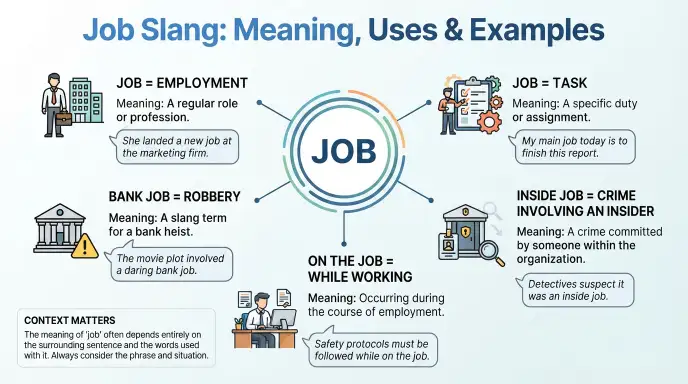
Job slang usually refers to an informal use of the word “job” for a crime, theft, robbery, or planned criminal act. For example, “bank job” can mean a bank robbery. However, “job” is also a normal English word for employment, work, or a task, so context matters.
People searching for job slang may have seen the word in a movie, text, social media post, game, or conversation and wondered what it means. The word can be especially confusing because its everyday meaning is very different from some of its slang uses.
In this guide, you will learn the main job slang meanings, how to recognize them, where the term is used, and how its meaning changes depending on the words around it. You will also see simple examples that make each meaning easy to understand.
Quick Answer:job slang
Job slang can mean a crime, robbery, theft, or planned criminal operation, especially in phrases such as “bank job” or “inside job.” However, “job” is usually an ordinary English word meaning employment, work, or a task, so the surrounding context determines the meaning.
For example:
- “I got a new job.” → employment
- “You did a great job.” → task or work
- “They planned a bank job.” → bank robbery
- “It was an inside job.” → a crime involving someone with inside access
The word itself is not automatically slang. The meaning changes according to the situation.
What Does Job Slang Mean?
Job slang is an informal use of “job” that can refer to a crime or criminal operation. It is particularly associated with planned theft or robbery.
For example:
“The group was preparing for a bank job.”
Here, job does not mean employment. It means a planned robbery.
Another example is:
“The detective thought it was an inside job.”
In this sentence, inside job refers to a crime involving someone who had access to the place, organization, or information involved.
The important point is that job has several meanings in English. You cannot understand its slang meaning by looking at the word alone.
Quick meaning guide
| Phrase | Meaning |
| a job | Work, employment, or a task |
| bank job | Bank robbery |
| inside job | Crime involving someone with inside access |
| pull a job | Carry out a criminal operation |
| do a good job | Perform a task well |
| on the job | Usually while working; can have another slang meaning in some contexts |
Different Meanings of Job Slang
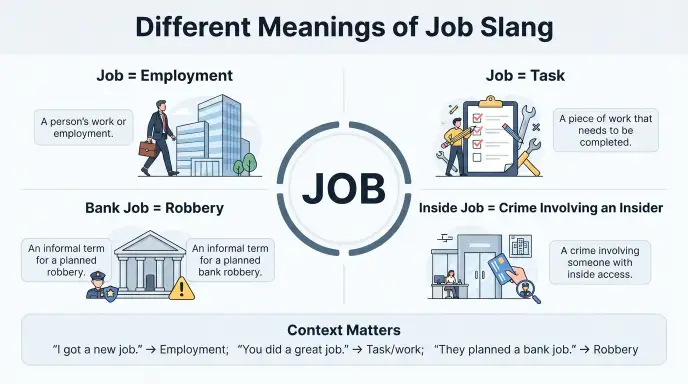
The word job can have several informal meanings. These meanings should be kept separate because they do not all refer to crime.
1. Job Meaning a Crime or Robbery
This is one of the main meanings people are looking for when they search for job slang.
In crimeifrelated language, job can describe a planned criminal act, especially theft or robbery.
You might hear:
- bank job
- inside job
- the job
- pull the job
- plan the job
For example:
“The movie follows a crew planning a bank job.”
The meaning is clear from the phrase bank job: the characters are planning a bank robbery.
This use is especially common in crime movies, television shows, novels, and fictional discussions about criminals.
2. “Inside Job”
Inside job is a particularly common phrase.
It usually means that a crime was committed with help from someone who was already inside the organization, building, company, or other place involved.
For example:
“The stolen files were probably an inside job.”
The sentence suggests that someone with legitimate access may have helped with the theft.
The phrase can also be used more loosely in everyday conversation when people suspect that something was deliberately arranged by someone with internal access.
3. Job Meaning a Task or Piece of Work
Not every informal use of job is slang.
In everyday English, job can simply mean a task or piece of work.
For example:
“You did a great job on the presentation.”
Here, job means the work that someone completed. There is no slang meaning.
Another example:
“Fixing the old computer was a difficult job.”
Again, the word means a task.
This is why context is essential when interpreting job slang.
Job Slang vs. Normal English
One of the easiest ways to understand the word is to compare its normal meaning with its slang meaning.
| Sentence | Meaning of “job” | Slang? |
| “She found a new job.” | Employment | No |
| “He did a great job.” | Task/work | No |
| “I have a job interview.” | Employment | No |
| “They planned a bank job.” | Robbery | Yes, informal |
| “It was an inside job.” | Crime involving inside help | Informal |
| “The team finished the job.” | Task or operation | Depends on context |
This distinction is important for students, parents, teachers, and anyone trying to understand slang in online conversations.
If job appears beside words such as bank, robbery, theft, criminal, crew, police, or heist, the criminal meaning becomes more likely.
If it appears beside words such as work, office, interview, salary, boss, or career, it almost certainly refers to employment.
Where Is Job Slang Commonly Used?
The criminal meaning of job is not limited to one socialifmedia platform. It can appear anywhere people discuss crime, fictional stories, or criminal characters.
Movies and TV Shows
Crime films and television dramas often use expressions such as:
- “The job”
- “The big job”
- “Bank job”
- “Inside job”
- “Pull the job”
For example:
“The crew needs one more person for the job.”
In a crime story, the job may refer to the planned robbery or criminal operation.
Books and Fiction
Crime novels may also use job as a short informal term for a planned crime.
Writers use this kind of language to make dialogue sound natural for criminal characters or groups.
Gaming Communities
In games that include missions, heists, or criminal storylines, players may use job to describe a mission or planned operation.
For example:
“Are we ready for the job?”
The exact meaning depends on the game. It could mean a robbery mission, a difficult task, or simply the next objective.
Social Media
You may encounter job slang on platforms such as TikTok, Reddit, Discord, Instagram, or other online communities when users discuss movies, crime stories, games, or fictional situations.
However, job is not mainly internet slang. Its informal meanings existed long before modern social media.
Is Job Slang Rude, Offensive, or Harmless?
The word “job” itself is not rude or offensive. Its tone depends on the meaning and context.
When job means employment or a task, it is completely normal:
“I need to find a job.”
When it means a robbery or criminal operation, it becomes informal crimeifrelated language:
“They planned the job carefully.”
That does not make the word a swear word or an insult. However, it may be inappropriate in formal writing if a more precise word such as robbery or crime is needed.
What about “on the job”?
The phrase “on the job” normally means while working.
For example:
“He was injured on the job.”
But the phrase can have an additional slang meaning in some British English contexts. Because that meaning can be sexual, it is best to avoid ambiguous uses in professional or formal communication.
Real :Life Examples of Job Slang
Seeing the word in complete sentences makes its meaning much easier to understand.
Crimeifrelated examples
Example 1:
“The detectives believe the robbery was an inside job.”
Meaning: Someone with internal access may have helped with the robbery.
Example 2:
“The movie begins with the crew planning a bank job.”
Meaning: The characters are planning a bank robbery.
Example 3:
“They abandoned the job when the alarm went off.”
Meaning: They stopped the planned criminal operation.
Normal examples
Example 4:
“My brother started a new job last Monday.”
Meaning: He started new employment.
Example 5:
“You did a fantastic job on the project.”
Meaning: You completed the project very well.
These examples show why you should read the entire sentence before deciding if job is slang.
How to Tell Which Meaning Is Intended
When you see job slang, look at the words surrounding it.
Signs that “job” means crime
The criminal meaning is more likely when you see words such as:
- bank
- robbery
- police
- thief
- stolen
- criminal
- heist
- crew
- getaway
- evidence
- inside
For example:
“The police are investigating an inside job.”
The surrounding words make the meaning clear.
Signs that “job” means employment
The normal employment meaning is more likely with words such as:
- salary
- office
- boss
- interview
- career
- workplace
- employee
- hiring
- application
For example:
“She has a job interview tomorrow.”
Here, there is no slang involved.
Simple rule
Look at the context before labeling “job” as slang.
The same word can be completely ordinary in one sentence and informal in another.
Origin and History of Job Slang
The word job has a long history in English, and its slang meanings are not recent inventions from social media.
The ordinary sense connected with a piece or task of work dates back centuries. Historical dictionary sources also record a crimeifrelated slang sense referring to theft or a planned criminal act from the 18th century.
This matters because it is inaccurate to describe job slang as a term that started with TikTok, Gen Z, texting, or modern internet culture.
Over time, job developed several different meanings. Some became standard everyday English, while others remained informal or tied to particular expressions and contexts.
Because historical sources do not always agree on the exact development of every sense, it is better to describe the history carefully rather than claim a single exact origin for all uses of the word.
Key Takeaway
“Job” has both ordinary and slang meanings. In everyday English, it usually refers to employment or a task. In crimeifrelated slang, it can mean a robbery, theft, or planned criminal operation.
The surrounding words are the best clue.
If you see “bank job” or “inside job” in a crimeifrelated conversation, the word is being used informally. If you see “new job,” “job interview,” or “great job,” it normally has its standard English meaning.
Context is the key to understanding job slang.
Similar Slang and Related Terms
Understanding related slang can make job slang easier to recognize. Some words are close in meaning, but they are not always interchangeable.
| Slang or Term | Meaning | Typical Context |
| Heist | A planned robbery or theft | Movies, books, gaming |
| Caper | An informal term for a crime or criminal adventure | Fiction, casual speech |
| Score | Something valuable obtained through a crime | Crime slang |
| Inside job | A crime involving someone with internal access | Crime discussions |
| Robbery | Taking property using force or threat | General/formal English |
| Theft | Taking something without permission | General/formal English |
Job vs. Heist
Heist is often used for a planned robbery, especially one involving valuable property or money.
For example:
“The team planned a museum heist.”
You could also hear:
“The team planned the job.”
In a crimeifstory context, both may refer to the same general event, but heist is more specific.
Job vs. Score
Score can refer to something valuable obtained through a crime.
For example:
“The thieves got a big score.”
A job usually refers to the criminal operation itself, while a score can refer to what was obtained.
Is “Job” Used Differently in British and American English?
Job is a standard word in both British and American English, especially when it means employment or a task.
The criminal slang meaning can also be understood in both varieties of English, particularly in phrases such as “bank job” and “inside job.”
However, some expressions involving job can have regional differences.
One example is “on the job.” In ordinary English, it commonly means “while working” in both varieties.
For example:
“She learned the skill on the job.”
In some British slang contexts, however, “on the job” can have a sexual meaning. That is why context matters when reading or hearing the phrase.
Simple comparison
| Expression | Common meaning |
| new job | Employment |
| job interview | Interview for employment |
| good job | Praise for completed work |
| bank job | Bank robbery |
| inside job | Crime involving internal help |
| on the job | Usually while working; may have another slang meaning in British English |
Job Slang in Texting and Social Media
People sometimes search for job slang used in text because they have seen the word in a message or online post.
The important thing to remember is that job is not primarily a texting abbreviation. Unlike terms such as “LOL” or “BRB,” it is a normal English word that can take on an informal meaning from context.
For example:
Without more information, this sentence is unclear. It could refer to:
- a difficult task,
- a piece of work,
- a criminal operation,
- or something else.
The surrounding conversation provides the answer.
On TikTok
On TikTok, job may appear in captions or comments about movies, crime stories, fictional characters, or gaming.
A user might write:
“That was the biggest job in the movie.”
Here, viewers need the video or caption context to know what job means.
On Discord
In gaming or community chats, job can describe a mission, task, or operation.
For example:
“Ready for the next job?”
If the group is playing a game involving missions or heists, the meaning may be obvious to the players.
On Reddit
Reddit discussions can use job in many ways because the platform covers a wide range of topics.
A post about employment might use:
“I finally got a job.”
A discussion about a crime movie might use:
“The job went wrong.”
The same word has completely different meanings.
Can You Use Job Slang at Work?
The normal word “job” is completely appropriate at work, but the crimeifrelated slang meaning should be used carefully.
There is an important difference between saying:
“I have a new job.”
and:
“They planned a bank job.”
The first sentence is professional and ordinary. The second uses informal crime language.
In professional writing
If you are writing an email, report, article, school paper, or business document about a real crime, it is usually better to use a precise term.
Instead of:
“The suspects planned a job.”
you could write:
“The suspects allegedly planned a robbery.”
This makes the meaning clearer.
In workplace conversation
Using slang casually with friends or coworkers may be fine when everyone understands the context. However, avoid expressions with possible sexual meanings, especially in professional environments.
When there is a chance that a phrase could be misunderstood, choose clearer wording.
When Should You Avoid Job Slang?
You should avoid the slang use of job when precision, professionalism, or clarity is important.
1. Formal documents
Legal, academic, medical, business, and official writing usually benefits from exact language.
Use:
- robbery
- theft
- criminal act
- planned crime
- criminal operation
instead of relying on an informal word such as job.
2. When speaking to people unfamiliar with the context
If someone may not understand the slang, the word can create confusion.
For example:
“They pulled a job.”
is less clear than:
“They carried out a robbery.”
3. In school assignments
Students should generally use standard vocabulary unless the assignment specifically asks them to explain slang, dialogue, or informal language.
4. In professional communication
Avoid slang when communicating with clients, managers, teachers, or officials unless the informal wording is clearly appropriate.
5. When a phrase has another sensitive meaning
Expressions such as “on the job” can have different interpretations in some contexts. If there is any possibility of confusion, use a clearer phrase.
Polite and Clear Alternatives
If you want to explain a crime without using slang, several standard alternatives are available.
| Informal Expression | Clear Alternative |
| bank job | bank robbery |
| pull a job | carry out a crime |
| the job | the planned crime |
| inside job | crime involving an insider |
| big job | major robbery/criminal operation |
The best alternative depends on exactly what happened.
For example, robbery is appropriate when force or threat is involved, while theft is a broader term for taking property without permission.
Being specific is usually better than using slang when the details matter.
Why Do People Use Job Slang?
People use informal words such as job because they are short, familiar, and easy to understand within the right context.
In crime fiction, the word can also help create a particular style of dialogue.
For example:
“We need one more person for the job.”
Within a crime story, the characters may already know that the job means a particular robbery. They do not need to repeat the full description every time.
This kind of shorthand can make conversations feel more natural.
Slang can also signal group context
A word may have a special meaning inside a particular group, movie, game, or conversation.
If everyone understands what “the job” refers to, the shorter expression is convenient.
But outside that context, the same sentence may be confusing.
Common Misunderstandings About Job Slang
Is “job” always slang?
No. Job is a common standard English word.
It can mean employment, a task, a responsibility, or a piece of work.
Is “job” a modern internet slang word?
No. The informal crimeifrelated use of job is much older than the internet and social media.
Does “job” always mean robbery?
No. The meaning depends on context.
“I got a job” means employment, while “bank job” can mean a bank robbery.
Is “inside job” always about crime?
Not necessarily in every imaginable context, but the phrase is strongly associated with wrongdoing carried out with help from someone inside.
The surrounding sentence should always be considered.
Is job slang offensive?
Usually, no. The crimeifrelated meaning is informal rather than inherently offensive.
However, some expressions involving job can have sexual meanings, so context is important.
Can “job” mean a task?
Yes. This is one of its most common standard meanings.
For example:
“Cleaning the garage was a difficult job.”
Here, job simply means a task.
Frequently Asked Questions
Q1. What does job slang mean?
Job slang can refer to a crime, theft, robbery, or planned criminal operation. The exact meaning depends on context and the words used with it.
Q2. What does “bank job” mean in slang?
“Bank job” usually means a bank robbery. The expression is informal and is especially common in crime stories, movies, and discussions of fictional criminal activity.
Q3. What does “inside job” mean?
An inside job is a crime involving someone who has legitimate access to the place, organization, or information involved.
For example, if money disappears from a company and an employee secretly helps the thieves, people may describe it as an inside job.
Q4. Is “job” a bad word?
No. Job is not a bad word. It is a normal English word used every day for employment and tasks.
Some slang uses simply give the word a different meaning.
Q5. Can I use “job” to mean robbery?
You can encounter this meaning in informal speech, crime stories, and fictional dialogue. However, robbery is clearer and more appropriate when you need precise or formal language.
Q6. Is “job” internet slang?
Not mainly. Job is an established English word with several meanings. Some informal uses may appear online, but the word did not originate as internet slang.
Q7. What does “pull a job” mean?
In crimeifrelated slang, “pull a job” means to carry out a planned crime, often a theft or robbery.
Q8. What does “on the job” mean?
Usually, “on the job” means while working or during work. In some British slang contexts, however, the phrase has another sexual meaning, so context matters.
Q9. Is job slang appropriate for school?
If you are discussing slang as part of a language lesson, yes. But in formal school writing, use precise standard terms when describing crime or other serious subjects.
Q10. How can I tell what “job” means in a text?
Look at the surrounding words and the topic of the conversation.
If the text mentions work, salary, office, interview, or employment, job probably means employment.
If it mentions robbery, police, thieves, banks, or stolen goods, job may refer to a crime.
Conclusion
Job slang is a useful example of why context matters when understanding informal English. The word job is normally associated with employment or work, but in crimeifrelated language it can refer to a theft, robbery, or planned criminal operation.
Phrases such as “bank job,” “inside job,” and “pull a job” make the slang meaning easier to identify. At the same time, expressions such as “new job,” “job interview,” and “good job” use the word in its ordinary sense.
The safest approach is simple: look at the complete sentence before deciding what “job” means. If the situation is formal, use precise words such as robbery, theft, or criminal operation rather than relying on slang.
The bottom line: job slang is highly contextifdependent, and understanding the surrounding words is the key to getting the meaning right.
The Final Word on

I’m Dylan Foster, a slang and internet culture writer passionate about exploring how people communicate online and in everyday conversations. I write about texting abbreviations, social media expressions, and modern slang to help readers understand meanings, origins, and real-world usage in a simple way.