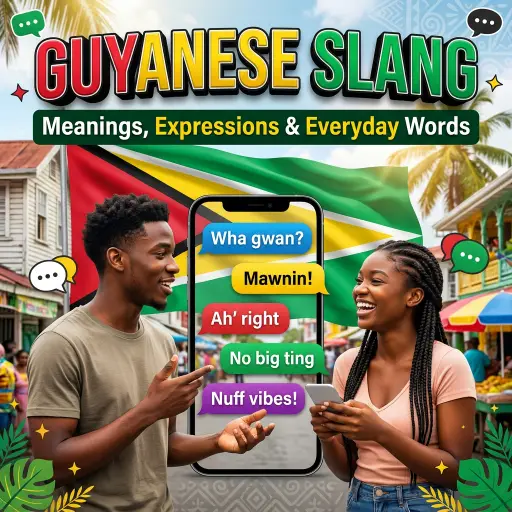
Guyanese slang refers to informal words, phrases, and expressions used by people in Guyana, often influenced by Guyanese Creolese, local culture, and everyday conversations.
You may encounter these expressions on TikTok, Snapchat, Instagram, WhatsApp, and in text messages.
Some Guyanese expressions are easy to understand if you speak English, while others have meanings that may surprise you.
Words such as “pickney,” “liming,” “gyaff,” and “vex” can communicate much more than their literal translations suggest.
People search for these expressions because they want to understand messages from Guyanese friends, follow Caribbean conversations, recognize local humor, or learn how people speak in Guyana.
One thing worth knowing is that Guyanese slang is closely connected to Guyanese Creolese, also called Guyanese Creole.
However, not every Creolese word is slang, and not every informal expression is unique to Guyana.
Guyanese Slang Words and Their Meanings
Before learning individual expressions, remember that Guyanese speech has different styles.
Some people speak closer to Standard Guyanese English, while others use more features of Creolese.
The spellings below are practical written representations. You may see different spellings for the same expression because Creolese does not have one universally followed informal spelling system.
Here are some useful words and phrases to recognize.
1. Liming
Meaning: Hanging out, relaxing, or spending time with friends.
Liming is a familiar Caribbean expression. In Guyanese conversation, it describes spending time with people without necessarily having a special activity planned.
Example: “We liming by the shop this evening.”
In simple English: “We are hanging out near the shop this evening.”
2. Gyaff
Meaning: Chatting, talking, or exchanging stories and gossip.
A gyaff can be a friendly conversation that goes on for a long time. It may involve jokes, personal stories, neighborhood news, or general discussion.
Example: “Them girls sitting down and gyaffing all afternoon.”
In simple English: “Those girls are chatting all afternoon.”
3. Pickney
Meaning: A child or young person.
Pickney is used in several Caribbean English:based Creoles, including Guyanese speech. It is commonly used when talking about children.
Example: “The pickney dem playing outside.”
In simple English: “The children are playing outside.”
4. Banna / Bannah
Meaning: An informal way to address a man, boy, or male friend.
The expression can sound friendly or familiar, depending on the relationship and tone.
Example: “Wha happen, banna?”
In simple English: “What’s happening, man?”
5. Vex
Meaning: Angry, annoyed, or upset.
Vex is used to describe someone’s emotional reaction to something frustrating.
Example: “She get vex when she hear the news.”
In simple English: “She became angry when she heard the news.”
6. Nyam
Meaning: To eat or enjoy food.
Nyam is found in several Caribbean language varieties. It is an informal word connected with eating.
Example: “Come nyam something before you leave.”
In simple English: “Come eat something before you leave.”
7. Nuff
Meaning: A lot, plenty, or many.
People use nuff when talking about a large quantity or number of something.
Example: “Nuff people come to the party.”
In simple English: “A lot of people came to the party.”
8. Bruk
Meaning: Broken or financially broke, depending on context.
The word can describe a damaged object or someone who does not have much money.
Example: “Me bruk this month, so me staying home.”
In simple English: “I’m broke this month, so I’m staying home.”
9. Mash Up
Meaning: Broken, damaged, ruined, or badly affected.
This expression can describe an object, a place, or even someone’s physical condition after a tiring day.
Example: “The road mash up after the heavy rain.”
In simple English: “The road was badly damaged after the heavy rain.”
10. Cut:Eye
Meaning: An angry, disapproving, or unfriendly look.
Cut:eye is a nonverbal expression. Someone may give another person a sharp look to show irritation or disagreement without saying anything.
Example: “She give me a cut:eye when I ask the question.”
In simple English: “She gave me an angry look when I asked the question.”
11. Suck:Teeth
Meaning: A sound made with the tongue and teeth to express annoyance, frustration, or disapproval.
In many Caribbean communities, this sound communicates an emotion without requiring words.
Example: “He suck:teeth and walk away.”
In simple English: “He made an annoyed sound and walked away.”
12. Ole Talk
Meaning: Casual conversation, storytelling, or friendly chatting.
Ole talk often describes relaxed conversations where people share stories and discuss everyday events.
Example: “We sitting outside doing ole talk.”
In simple English: “We are sitting outside having a casual conversation.”
13. Sweet Han’
Meaning: Someone who is especially good at cooking.
This expression describes a person whose food tastes delicious. It is often used as a compliment.
Example: “Your grandmother really have sweet han’.”
In simple English: “Your grandmother is an excellent cook.”
14. Boderation
Meaning: Trouble, annoyance, bother, or an irritating situation.
This expressive word can describe something that causes unnecessary stress or difficulty.
Example: “All this paperwork is pure boderation.”
In simple English: “All this paperwork is such a nuisance.”
15. Jumbie
Meaning: A ghost or supernatural spirit in Caribbean folklore.
Jumbie is associated with traditional stories, beliefs, and folklore. It is not simply another word for a person behaving strangely.
Example: “Grandma tell us stories about a jumbie.”
In simple English: “Grandma tells us stories about a ghost.”
16. Baccoo
Meaning: A mischievous supernatural being in Guyanese folklore.
Baccoo appears in traditional Guyanese stories and beliefs. It is associated with unusual supernatural behavior and local legends.
Example: “The old man tell a story about a baccoo.”
In simple English: “The old man tells a story about a mischievous spirit.”
Cultural note: Jumbie and baccoo belong to Guyanese folklore. Their meanings are cultural and traditional, not ordinary texting abbreviations.
17. Leh We Go
Meaning: Let’s go.
This is an informal way to suggest leaving or starting an activity.
Example: “Leh we go before it start raining.”
In simple English: “Let’s go before it starts raining.”
18. Watch Deh
Meaning: Look over there or pay attention to something.
It directs someone’s attention toward a person, object, or place.
Example: “Watch deh, the bus coming.”
In simple English: “Look over there, the bus is coming.”
19. Wuk
Meaning: Work or a job.
This is an example of how Creolese pronunciation and spelling can differ from Standard English.
Example: “Me going to wuk early tomorrow.”
In simple English: “I’m going to work early tomorrow.”
20. Ova Deh
Meaning: Over there.
This expression is used to point toward a place or location that is not immediately beside the speaker.
Example: “The shop ova deh.”
In simple English: “The shop is over there.”
21. Maanin
Meaning: Morning.
This is a written representation of a Creolese pronunciation.
Example: “Good maan in, everybody.”
In simple English: “Good morning, everybody.”
22. Abee
Meaning: We, us, or our group.
Abee can be used when referring to a group that includes the speaker.
Example: “Abee going to the market.”
In simple English: “We are going to the market.”
23. Wan Wan
Meaning: One by one or gradually.
This expression describes people or things moving or arriving individually.
Example: “The guests coming wan wan.”
In simple English: “The guests are arriving one by one.”
24. Grung
Meaning: Ground or land.
It can refer to the ground itself or a piece of land, depending on the situation.
Example: “He working on the grung.”
In simple English: “He is working on the land.”
25. Bassa:Bassa
Meaning: Confusion, commotion, or a chaotic situation.
This expression describes a situation where people are arguing, things are disorganized, or unnecessary trouble has developed.
Example: “Doh start no bassa:bassa at the party.”
In simple English: “Don’t create any confusion at the party.”
26. Batty
Meaning: Buttocks or backside.
This is an informal body:related expression. Its tone depends on the speaker and situation.
Example: “He fall down and hurt he batty.”
In simple English: “He fell down and hurt his backside.”
27. Chile
Meaning: Child, or an informal way of addressing someone.
In some Caribbean speech, chile can be used to express affection, surprise, frustration, or emphasis.
Example: “Chile, what you doing?”
In simple English: “Child, what are you doing?”
Its use can vary between Caribbean communities.
28. Nuh
Meaning: A conversational particle that can add emphasis, soften a statement, or form part of a question or request.
Its exact function depends on the sentence.
Example: “Come here nuh.”
In simple English: “Please come here.”
29. Me Na Able
Meaning: I can’t manage it, or I’ve had enough.
This expression can communicate frustration, exhaustion, or disbelief.
Example: “This heat, me na able!”
In simple English: “I can’t handle this heat!”
30. Jus’ Now
Meaning: Soon, shortly, or in a little while, depending on context.
The expression can be flexible, so it does not always indicate an exact time.
Example: “I calling you jus’ now.”
In simple English: “I’ll call you shortly.”
These last two expressions are included as informal expressions found in contemporary Guyanese slang collections; their use may vary among speakers.
Guyana Slang Words and Phrases Used in Everyday Messages
People use guyana slang in everyday conversations, text messages, and social media posts. These expressions often come from Guyanese Creolese and reflect the way people communicate with friends, relatives, and members of their communities.
When exploring guyana slang words, you may notice that some expressions look similar to Standard English but have different meanings or pronunciation. Others are closely connected to Caribbean culture and local traditions.
Many guyanese slang phrases are short and easy to recognize once you understand their context. For example, “liming” describes hanging out, “gyaff” means chatting, and “vex” describes feeling angry or annoyed.
Here are a few useful expressions:
| Expression | Meaning | Example |
|---|---|---|
| Liming | Hanging out | We liming this evening. |
| Gyaff | Chatting or gossiping | They sitting down and gyaffing. |
| Vex | Angry or annoyed | She get vex. |
| Pickney | Child | The pickney dem outside. |
| Leh we go | Let’s go | Leh we go now. |
| Nuff | A lot or plenty | Nuff people come today. |
People sometimes use the expression guyanese slangs when searching for collections of local vocabulary. However, individual expressions can differ according to age, location, and personal speaking style.
You may also encounter different guyanese words in informal conversations. Some are everyday Creolese vocabulary, while others are expressions associated with particular cultural situations.
Understanding these differences makes it easier to recognize guyanese slang terms when reading messages or communicating with Guyanese speakers.
If you want to explore guyanese slang words and meanings, pay attention to the complete sentence rather than translating every word individually. The surrounding conversation often provides the clearest explanation.
Where People Use Guyanese Slang
Guyanese expressions are not limited to face:to:face conversations. People also use Creolese and informal local expressions when communicating online.
However, remember that social media examples do not prove that every expression is equally popular on every platform.
Guyanese Slang on TikTok
TikTok is a place where people share cultural humor, local expressions, music, food, and everyday experiences.
A Guyanese creator might use Creolese words in a funny video or explain a phrase that viewers outside Guyana do not recognize.
For example:
Video caption: “When your mother call you three times and you still outside liming.”
Comment: “The pickney dem never listening 😂”
The comment refers to children who are not listening.
Guyanese Slang on Snapchat
On Snapchat, people may use informal expressions in private messages, snaps, and group conversations.
Example:
A: Wha happen, banna?
B: Nothing much, just liming.
Meaning: The two friends are casually asking what is happening and explaining that they are hanging out.
Guyanese Slang on Instagram
Instagram comments and direct messages can include Guyanese words, especially when users communicate with friends or follow Guyanese creators.
Example:
Post: A picture of delicious homemade curry.
Comment: “That food looking sweet! Who cook this?”
A friend might reply with “She have sweet han’!”, meaning she is a good cook.
Guyanese Slang on WhatsApp
WhatsApp is useful for everyday conversations with relatives, friends, and community groups.
Example:
A: Yuh coming outside?
B: Yes, leh we go.
Meaning: “Are you coming outside?” and “Yes, let’s go.”
Guyanese Slang in SMS
People can also use local expressions in ordinary text messages.
Example:
A: You reach home yet?
B: Not yet. I coming jus’ now.
Meaning: The sender expects to arrive shortly, although the exact timing may depend on the situation.
10 Real Chat Examples Using Guyanese Slang
The following conversations are illustrative examples written to help beginners understand the expressions.
They are not presented as recorded conversations or fixed sentences used by every Guyanese speaker.
Example 1: Making Weekend Plans
A: Wha happen, banna? What you doing Saturday?
B: Nothing much. Just liming.
A: Leh we go somewhere and eat.
Meaning: Two friends are greeting each other and planning to spend time together.
Example 2: Talking About Children
A: Where are the children?
B: The pickney dem outside playing.
A: Tell them to come inside soon.
Meaning: Pickney dem refers to the children.
Example 3: Complaining About the Weather
A: This heat is too much today.
B: Me na able!
A: We need some cold drinks.
Meaning: Me na able expresses that the heat is difficult to handle.
Example 4: Talking About Food
A: Who make this curry?
B: My grandmother.
A: She really have sweet han’.
Meaning: Sweet han’ means that someone is a very good cook.
Example 5: Discussing a Friend
A: Why she looking at me like that?
B: Maybe she vex with you.
A: She just give me a cut:eye.
Meaning: Vex means angry, while cut:eye describes an unfriendly look.
Example 6: Sharing Neighborhood News
A: Where everybody gone?
B: Them outside gyaffing.
A: They been talking for hours!
Meaning: Gyaffing means chatting or exchanging stories.
Example 7: Talking About Work
A: You going to work tomorrow?
B: Yes, me going to wuk early.
A: Don’t forget your documents.
Meaning: Wuk means work.
Example 8: Describing a Broken Road
A: How was the journey?
B: Terrible. The road mash up.
A: Was it raining?
B: Yes, heavy rain damage the road.
Meaning: Mash up means badly damaged or ruined.
Example 9: Talking About Money
A: Let’s go shopping this weekend.
B: Me bruk this month.
A: No problem. We can go another time.
Meaning: Bruk means broke or short of money.
Example 10: Sharing a Traditional Story
A: Did your grandmother tell you any old stories?
B: Yes, she tell us about jumbies and baccoos.
A: Those stories sound interesting.
Meaning: Jumbie and baccoo refer to supernatural figures in Guyanese folklore.
How to Reply When Someone Uses Guyanese Slang
You do not need to speak Creolese perfectly to have a friendly conversation with a Guyanese person.
A simple, respectful response is often enough. If you do not understand an expression, asking what it means is perfectly normal.
Funny Replies
If someone uses a playful expression, you can respond with humor.
- “You always have a story!”
- “I need subtitles for this conversation 😂”
- “Teach me some more Guyanese words!”
- “I’m learning, don’t laugh at me!”
- “That expression is too funny!”
Casual Replies
These work in everyday conversations:
- “What’s happening?”
- “I’m good, how about you?”
- “Sounds good!”
- “Let’s go!”
- “Same here!”
Friendly Replies
If you want to show interest in Guyanese culture, try:
- “I like that expression. What does it mean?”
- “Teach me how to pronounce it.”
- “That’s interesting. Do you use it every day?”
- “I’m learning more about Guyanese culture.”
Neutral Replies
If you are unsure what someone means, use clear questions:
- “Could you explain that phrase?”
- “What does that mean in English?”
- “Are you talking about a person or a situation?”
- “I haven’t heard that expression before.”
A good rule: Do not pretend to understand a local expression when you do not. Asking politely is a better way to learn.
Is Guyanese Slang Rude or Offensive?
Guyanese slang is not automatically rude or offensive. Many expressions are ordinary parts of everyday communication, while others can sound disrespectful depending on how they are used.
The meaning, tone, relationship, and situation all matter.
Which Expressions Are Usually Friendly?
Words such as liming, gyaff, pickney, and leh we go can appear in ordinary informal conversations.
For example, telling a friend, “Leh we go,” is simply an informal way of saying, “Let’s go.”
Similarly, saying that someone is liming usually means they are relaxing or spending time with friends.
Which Expressions Need More Care?
Some words describe anger, annoyance, or disrespect.
- Vex: Can describe anger or frustration.
- Cut:eye: Can suggest disapproval or hostility.
- Suck:teeth: Can communicate irritation or disrespect.
- Batty: Refers to a body part and may be inappropriate in formal settings.
These expressions are not necessarily offensive every time they are used, but tone matters.
Is It Appropriate at School or Work?
It depends on the expression and the situation.
In conversations with friends or classmates, informal local language may be perfectly natural.
However, school assignments, official documents, business emails, and professional presentations usually require Standard English or the appropriate formal language.
For example:
- Informal: “Me going to wuk.”
- Formal: “I am going to work.”
Neither sentence needs to be treated as a measure of intelligence. They simply belong to different communication styles.
Guyanese Creolese has its own grammatical structure. It is not simply incorrect English. Guyana’s Ministry of Education specifically explains that Creolese is its own language with its own rules.
education.gov.gy+1
Guyanese Bad Words, Insults, and Curse Words
Not all informal expressions are friendly. Some words can communicate anger, disrespect, frustration, or disapproval.
Therefore, understanding the difference between ordinary slang and offensive language is important when learning Guyanese expressions.
People searching for guyanese bad words often want to understand expressions they have heard in conversations, videos, or online discussions. However, not every strong-sounding word is necessarily a curse word.
Are There Insults in Guyanese Slang?
Yes, some expressions can be used to criticize or offend another person. Searches for guyanese slang insults and guyanese insults usually relate to words or expressions that communicate disrespect, anger, or negative feelings.
For example, “vex” describes someone who is angry or annoyed. “Cut” refers to an unfriendly or disapproving look, while “suck” can communicate irritation or disagreement.
However, these expressions should not automatically be classified as direct insults. Their meaning depends on how someone uses them and the situation in which they appear.
What Are Guyanese Curse Words?
The phrase guyanese curse words generally refers to strong or offensive language associated with Guyanese speech.
It is important to distinguish actual swear words from expressions that simply communicate frustration. For example, “vex” means angry, but it is not automatically a curse word.
The same applies to expressions such as “cut” and “suck.” They can communicate negative feelings without necessarily containing profanity.
Because offensive language can vary between speakers and communities, it is better to understand a word’s meaning and context before repeating it.
When Should You Avoid Strong Expressions?
Be careful when using potentially offensive language in the following situations:
- Professional conversations and workplace meetings.
- School assignments and classroom discussions.
- Conversations with people you do not know well.
- Formal messages and business communication.
- Conversations with older people or community members who may not appreciate strong language.
If you are learning Guyanese Creolese, start with friendly expressions such as “liming,” “bai,” and “leh we go.” These are more suitable for everyday conversations.
Remember that knowing the meaning of an expression does not always mean it is appropriate to use it.
Who Uses Guyanese Slang?
These expressions are used by people from different age groups and communities in Guyana and among Guyanese people living abroad.
However, individual vocabulary can differ according to region, family background, social setting, and personal experience.
Do Gen Z People Use Guyanese Slang?
Yes, younger Guyanese speakers may use local expressions in conversations, social media posts, jokes, and group chats.
Some may combine Creolese with Standard English and internet expressions.
For example:
“That food real nice, nah!”
The combination of local speech and modern online communication helps expressions travel between friends and online communities.
However, not every young person uses the same expressions.
Do Older People Use These Expressions?
Older generations also use Creolese in everyday communication.
In fact, family conversations, traditional storytelling, and community gatherings are important settings where local expressions are passed between generations.
Some traditional expressions may be more familiar to older speakers, while younger people may introduce new ways of writing or using familiar words.
Do Guyanese People Living Abroad Use Them?
Yes. Guyanese communities outside the country may continue using familiar expressions when speaking with relatives and friends.
Social media also allows people in different countries to share jokes, music, videos, and cultural expressions.
This helps people maintain connections with their language and heritage.
How Common Is Guyanese Slang Online?
There is no single reliable statistic showing how frequently every Guyanese expression appears on TikTok, Instagram, or WhatsApp.
Some words are part of everyday speech, while others are associated with particular situations, generations, or cultural traditions.
It is better to understand the expressions individually instead of assuming that every Guyanese person uses every word.
Origin and History of Guyanese Slang
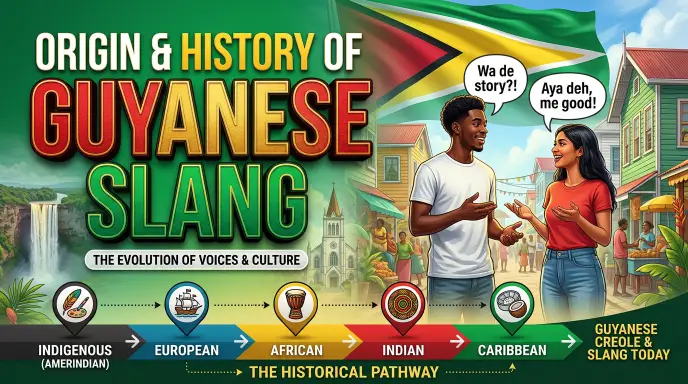
To understand Guyanese expressions, it helps to know a little about Guyana’s history.
Guyana has a diverse cultural background shaped by Indigenous communities, African heritage, Indian heritage, European colonial history, and other cultural influences.
English became the country’s official language during British colonial rule. However, the language people use in everyday life developed through contact between different communities and languages.
How Did Guyanese Creolese Develop?
Guyanese Creolese developed through historical language contact, particularly during the colonial period.
Its vocabulary is largely English:based, but its structure and pronunciation are not identical to Standard English.
The language also reflects influences from African languages, Dutch, Hindi, other Indian languages, and Indigenous languages.
education.gov.gy+2
This history helps explain why some Guyanese expressions sound familiar to English speakers but have different meanings or grammatical patterns.
Why Are Some Words Spelled Differently?
Creolese is primarily a spoken language, and informal writing can vary.
For example:
| Standard English | Guyanese Creolese example |
| Work | Wuk |
| Morning | Maanin |
| Over there | Ova deh |
| Are you hungry? | Yuh hungry? |
These examples are documented by Guyana’s Ministry of Education.
education.gov.gy
The differences are not random spelling mistakes. They can reflect pronunciation and grammatical patterns within the language.
Did Social Media Create Guyanese Slang?
No. Guyanese informal expressions existed long before TikTok, Instagram, and WhatsApp.
Social media has simply created more opportunities for people to share local language with audiences outside Guyana.
A phrase that was once heard mainly in a neighborhood or family gathering can now appear in a video watched by people around the world.
The language existed before the platforms; social media helps it travel further.
Guyanese Slang vs. IDK, IDC, IMO, and BRB
Guyanese expressions and common texting abbreviations are different types of informal communication.
uyanese words often come from local language and cultural traditions, while IDK, IDC, IMO, and BRB are English:based initialisms used in digital messaging.
| Term | Meaning | Type | Usage | Popularity |
| Guyanese slang | Local informal expressions and vocabulary | Regional slang and Creolese expressions | Everyday conversations and cultural communication | Used within Guyana and diaspora communities |
| IDK | I don’t know | Initialism | Expressing uncertainty | Widely recognized online |
| IDC | I don’t care | Initialism | Expressing indifference | Widely recognized online |
| IMO | In my opinion | Initialism | Sharing an opinion | Widely recognized online |
| BRB | Be right back | Initialism | Temporarily leaving a chat | Widely recognized online |
Guyanese Slang vs. IDK
IDK means “I don’t know.” It is used when someone does not have an answer.
Guyanese expressions, on the other hand, can communicate many different ideas, from greetings and emotions to food and everyday activities.
Guyanese Slang vs. IDC
IDC means “I don’t care.”
It expresses indifference, while Guyanese expressions such as vex can describe a particular emotional state, such as being angry or annoyed.
Guyanese Slang vs. IMO
IMO means “in my opinion.”
It introduces a personal opinion. Guyanese Creolese expressions may also be used to share opinions, but they are not all abbreviations.
Guyanese Slang vs. BRB
BRB means “be right back.”
It is a short digital message. Guyanese vocabulary is broader and includes expressions used in ordinary speech, cultural storytelling, and informal communication.
A Real:World Example of Guyanese Slang
Imagine visiting a friend in Georgetown, Guyana.
Your friend invites you to spend the evening with some local friends. When you arrive, everyone is sitting outside, talking, laughing, and sharing stories.
One person asks, “Wha happen, banna?”
You smile because you recognize it as an informal greeting.
Another person says they are just liming with friends. Someone else begins gyaffing about something that happened earlier in the day.
A child runs outside, and an older family member calls out, “The pickney dem need to come inside!”
Later, someone serves a delicious homemade meal. You compliment the cook, and your friend says, “She have sweet han’.”
Even without understanding every expression, you can follow much of the conversation through the situation.
This is what makes learning local language interesting. You are not just memorizing words; you are learning how people communicate, joke, share experiences, and express their culture.
Frequently Asked Questions
What does Guyanese slang mean in text messages?
Guyanese slang refers to informal local expressions used in messages and conversations. Examples include liming (hanging out), gyaff (chatting), and vex (angry).
What does Guyanese slang mean on TikTok?
On TikTok, Guyanese slang refers to local expressions that appear in videos, captions, comments, and conversations. People use them to share humor, culture, and everyday experiences.
Is Guyanese slang a real language?
Guyanese slang is not one separate language. It is a broad label for informal expressions. Guyanese Creolese is a distinct English:based Creole language with its own grammar and structure.
Is Guyanese slang rude or offensive?
Most Guyanese expressions are not automatically offensive. However, words describing anger, disrespect, or body parts may be inappropriate depending on the context and tone.
How should you reply to someone using Guyanese slang?
You can respond naturally with phrases such as “What’s happening?”, “Sounds good!”, or “Let’s go!” If you do not understand an expression, politely ask what it means.
Conclusion
Guyanese slang gives you a glimpse into the language, humor, history, and everyday culture of Guyana.
Expressions such as liming, gyaff, pickney, vex, banna, and sweet han’ can make local conversations more interesting and expressive.
You may encounter these words in face:to:face conversations, TikTok videos, Instagram comments, Snapchat messages, and WhatsApp chats.
Remember that Guyanese slang is closely connected to Creolese, but the two terms are not interchangeable.
Creolese is a language with its own grammar and history, while slang refers to informal expressions used within a language or community.
If you are learning these expressions, start with their meanings and examples. Pay attention to how local speakers use them, and remember that pronunciation and spelling can vary.
Most importantly, respect the cultural background behind the words. Learning Guyanese expressions is not just about sounding local; it is about understanding the people and traditions that keep the language alive.
Discover More Articles!
What Does WZM Mean in Text? Meaning, Examples & Replies
What Does X2 Mean in Text? 10 Real Chat Examples
What Does X Mean in a Text? Meaning, Examples & Usesw

I’m Dylan Foster, a slang and internet culture writer passionate about exploring how people communicate online and in everyday conversations. I write about texting abbreviations, social media expressions, and modern slang to help readers understand meanings, origins, and real-world usage in a simple way.