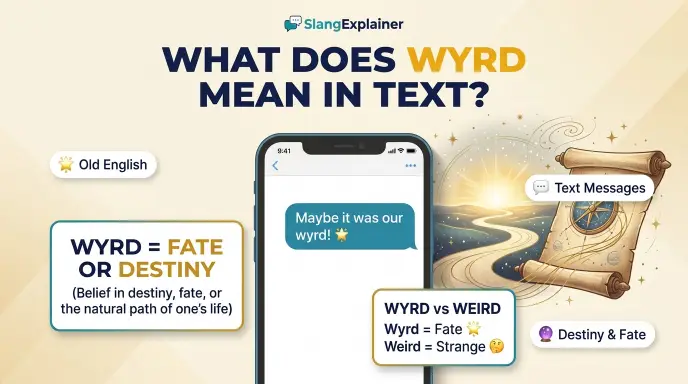
Have you ever received a message containing the word “wyrd” and wondered what the sender meant? If you have seen this unusual word in a text, social media comment, gaming chat, or online discussion, its meaning may depend on the context.
Wyrd usually means “fate” or “destiny.” It is an old English word connected to the idea of what happens in life or what is destined to happen. However, it is not a widely recognized modern texting abbreviation, so someone using it in a casual message might have a different meaning in mind.
For example, someone might write, “Maybe it was my wyrd to meet you.” In this sentence, the word suggests that meeting someone was meant to happen.
You may also see “wyrd” used in fantasy stories, historical discussions, mythology, gaming communities, or conversations about spirituality. In these settings, it can carry a deeper meaning related to fate, life events, and destiny.
It is also worth remembering that wyrd and weird are different spellings with a historical connection. If a friend sends “wyrd” in a quick message, they might be using the older word intentionally or simply making a spelling mistake.
In this guide, you will learn what wyrd means in text, how people use it, what it means in different contexts, and how to reply when someone sends it to you.
Quick Answer: What Does Wyrd Mean in Text?
Wyrd generally means fate, destiny, or the course of events in a person’s life. It comes from Old English and appears in historical literature, mythology, fantasy writing, and some modern spiritual or online communities.
In everyday texting, wyrd does not have one widely established slang meaning. The sender might be referring to destiny, using an oldiffashioned word for a creative effect, or intending to type “weird.”
Example:
- Person A: “It feels like we were supposed to meet.”
- Person B: “Maybe it was our wyrd!”
Here, “wyrd” means that the meeting may have been destined to happen.
If the meaning is unclear, look at the rest of the conversation or ask the sender what they mean.
What Is the Original Meaning of Wyrd?
The original meaning of “wyrd” is closely connected to fate, destiny, chance, and the events that happen throughout life. The word comes from Old English, the early form of the English language spoken many centuries ago.
In historical writing, wyrd could describe what happened to someone, what was going to happen, or the force associated with a person’s destiny. Its exact meaning could change depending on the passage in which it appeared.
Unlike many modern texting abbreviations, wyrd was not originally created to save time while typing on a phone. It has a much older linguistic history.
Today, people may use the word to create a mysterious, historical, poetic, or fantasyifinspired feeling. Someone interested in ancient literature might use it to discuss destiny, while a fantasy writer might use it to describe a character’s path through life.
Here are a few examples:
- “I believe our paths crossed because of wyrd.”
- “His wyrd was shaped by the choices he made.”
- “The story explores the power of wyrd and destiny.”
In each example, the word relates to fate or the course of events rather than a typical texting abbreviation.
It is important to understand that modern users do not all use wyrd in exactly the same way. Some use it in a historical sense, while others may use it creatively or as a variation of “weird.”
Is Wyrd an Acronym or Texting Abbreviation?
No, wyrd is not a widely established acronym in everyday texting. Unlike common abbreviations such as LOL, BRB, and IDK, it does not have one standard expansion made from the first letters of a phrase.
Instead, wyrd is an actual word with historical roots. Its bestifestablished meaning is fate or destiny, particularly in an Old English context.
This distinction matters because unfamiliar words on social media are not always slang abbreviations.
For example:
| Term | Meaning | Common use |
| Wyrd | Fate or destiny | Historical, literary, fantasy, or spiritual contexts |
| LOL | Laughing out loud | Texting and online conversations |
| BRB | Be right back | Casual messages |
| IDK | I don’t know | Everyday texting |
| Weird | Strange or unusual | Everyday conversation |
If someone sends you “wyrd,” do not automatically assume that each letter stands for a separate word. Consider the message around it.
For instance, “Our meeting was weird” could be an intentional reference to destiny, although the sender might also have intended to write “weird.” The surrounding conversation helps you work out which interpretation makes sense.
If you are writing a slang dictionary entry, it is more accurate to explain wyrd as an old word sometimes used in modern online conversations than to invent an acronym meaning for it.
How Is Wyrd Used in Text Messages?
The meaning of wyrd in a text message depends on why the sender chose that particular spelling. It is not as common or standardized as everyday internet slang, but it can appear in messages where people discuss destiny, unusual coincidences, fantasy, or oldiffashioned language.
Here are four possible ways it might be used.
1. To Talk About Fate or Destiny
Someone might use wyrd when they believe an event was meant to happen.
Example:
- Alex: “We both missed the same train and ended up meeting.”
- Sam: “Maybe it was weird!”
In this example, the sender suggests that the unexpected meeting may have been part of a larger pattern of events.
2. To Create a Mysterious Feeling
Wyrd can make a message sound oldiffashioned, poetic, or mysterious.
Example:
- Alex: “The dream felt like a warning.”
- Sam: “Maybe your wyrd is trying to tell you something.”
The sender is using the word creatively to connect a dream with destiny. This is a stylistic use, not a universal meaning of the word.
3. In Fantasy or Gaming Conversations
Fantasy games and stories often explore destiny, prophecies, magical forces, and characters who cannot escape their past.
Example:
- Player A: “Why did the hero return to the cursed castle?”
- Player B: “His wyrd was tied to that place.”
Here, wyrd refers to the hero’s fate within the fictional story.
4. As a Possible Misspelling of Weird
Sometimes the simplest explanation is a typo.
Example:
- Friend A: “That video was wyrd.”
- Friend B: “Do you mean weird?”
The sender might have intended to write “weird,” which means strange or unusual in modern English. A single message is not always enough to determine the intended meaning.
The key is to read the whole conversation before deciding what the sender meant.
10 Realistic Chat Examples of Wyrd
The following examples show how wyrd might appear in different online conversations. These are illustrative examples, not claims that wyrd is common slang on every platform.
| No. | Chat message | Possible meaning |
| 1 | “Maybe it was weird that we met.” | Perhaps the meeting was destined. |
| 2 | “I think our paths were connected by wyrd.” | The meeting feels meaningful or fated. |
| 3 | “His words were written before the journey began.” | His destiny was established in the story. |
| 4What Does WYH Mean in Text? Real & Social Media Use | “The novel is all about wyrd and fate.” | The novel explores destiny. |
| 5 | “That character cannot escape his wyrd.” | The character cannot avoid his fate. |
| 6 | “What if this was always my wyrd?” | What if this was always my destiny? |
| 7 | “The game has an interesting wyrd system.” | The game may use fate as a theme or mechanic. |
| 8 | “Our meeting felt like something out of an old legend.” | The speaker sees the meeting as mysterious or fated. |
| 9 | “That was a weird thing to happen.” | The sender may mean fateifrelated, or may have intended “weird.” |
| 10 | “I read about wyrd in an Old English poem.” | The sender is discussing the historical word. |
Notice that some examples use wyrd in a clear historical or literary sense, while others could be interpreted differently.
If the sender writes about a poem, prophecy, or fantasy character, the meaning is more likely to relate to fate. If the sender is simply describing something strange, they may have meant “weird.”
What Does Wyrd Mean on TikTok, Snapchat, and Instagram?
Wyrd does not have a single verified, platformifwide slang definition on TikTok, Snapchat, or Instagram. Its meaning depends on the post, the community, and the conversation in which it appears.
Here is how to interpret it in different online settings.
Wyrd on TikTok
On TikTok, you might encounter unfamiliar words in captions, comments, storytelling videos, fantasy edits, or discussions about mythology.
If a creator uses wyrd while talking about fate, life choices, or a character’s destiny, the historical meaning is likely relevant.
For example:
“Some people believe every meeting happens for a reason. Maybe that’s wyrd.”
In this context, the word is being used to express a belief or idea about destiny. It should not automatically be treated as a popular TikTok acronym.
Wyrd on Snapchat
Snapchat messages are usually casual and brief. If a friend sends wyrd without explaining it, the word could be intentional, a private joke, a reference to something you discussed, or a typo.
For example:
“You showing up right when I needed help was weird.”
The sender may be describing the timing as fateifrelated or unusually meaningful.
If you are unsure, a simple “What do you mean by wyrd?” can clear things up.
Wyrd on Instagram
On Instagram, wyrd could appear in a caption, comment, username, fantasyifthemed post, or discussion of history and spirituality.
For example:
“Trust the journey and accept your wyrd.”
Here, the word is being used in a reflective or poetic way to refer to destiny.
However, seeing the same word in a different post does not guarantee that it has the same meaning. Always check the surrounding text and the creator’s intended subject.
Wyrd in WhatsApp or SMS
In private messages, the sender’s personal writing habits matter more than any platformifspecific definition.
A person who enjoys mythology might intentionally write weird things. Someone typing quickly might accidentally misspell something weird.
Remember: There is no reliable basis for claiming that wyrd has a completely different standard meaning on each of these platforms.
What Is the Difference Between Wyrd and Weird?
Wyrd and weird look almost identical, and they are historically connected, but their usual meanings in modern English are different.
Wyrd is associated with fate or destiny, especially in Old English literature and modern writing inspired by historical traditions. Weird usually means strange, unusual, unexpected, or difficult to explain.
The modern adjective “weird” developed from an older word associated with fate and supernatural power. This historical connection explains why the two spellings look so similar.
Compare the following examples:
| Word | Example | Meaning |
| Wyrd | “It was my wyrd to travel far.” | It was my destiny to travel far. |
| Weird | “That was a weird dream.” | The dream was strange. |
| Wyrd | “The poem explores wyrd.” | The poem explores fate or destiny. |
| Weird | “Your new hairstyle looks weird.” | The hairstyle looks unusual. |
How Can You Tell Which Word Someone Means?
Look at the topic of the conversation.
- If the message discusses destiny, mythology, prophecy, or ancient literature, wyrd may be intentional.
- If the message describes something strange, surprising, or unusual, the sender may have intended something weird.
- If the word appears in a fantasy game or story, check how that fictional world uses it.
- If neither meaning fits, ask the sender to explain.
For example, if someone texts, “That was so weird,” after watching a strange video, they may simply have mistyped weird. You should not assume they are talking about fate without more context.
This distinction is particularly useful for anyone learning internet slang because spelling mistakes and uncommon vocabulary can look like new abbreviations.
Is Wyrd Rude or Offensive?
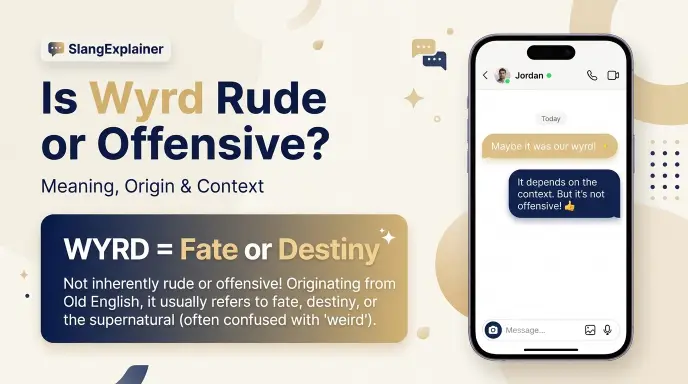
No, wyrd is not inherently rude or offensive. Its historical meaning relates to fate or destiny, and the word itself is not a standard insult.
However, the tone of a message depends on how the sender uses it.
When Wyrd Is Harmless
The word is generally harmless when it appears in a discussion about literature, destiny, mythology, or fantasy.
Examples include:
- “I love how this book explores wyrd.”
- “Maybe it was our wyrd to become friends.”
- “The hero must face his wyrd.”
These sentences use the word to discuss fate or tell a story.
When the Message Could Cause Confusion
A person may be confused if they have never seen something before. They might assume it is a typo or think the sender is trying to use a new slang term.
For example:
- Person A: “That was weird.”
- Person B: “Do you mean weird?”
This is a misunderstanding rather than evidence that the word is offensive.
Can Wyrd Sound Insulting?
The word itself is not a typical insult, but a sarcastic or mocking sentence can still sound rude. The same is true of many ordinary words.
If someone uses wyrd while laughing at you or making a hurtful comment, focus on the overall message rather than the spelling alone.
In short, you do not need to worry that wyrd is automatically offensive when someone sends it to you.
How Should You Reply When Someone Says Wyrd?
Your reply should depend on the message and your relationship with the sender. If the word refers to destiny, you can respond thoughtfully or playfully. If you are unsure what the sender means, ask a quick question.
Here are some natural replies you can use.
Casual Replies
These work when a friend uses wyrd in an ordinary conversation.
- “What do you mean by wyrd?”
- “Do you mean fate?”
- “That’s an interesting way to put it.”
- “Haha, maybe!”
- “I haven’t heard that word before.”
Funny Replies
If the conversation is playful, you could say:
- “Is my destiny sending me a notification?”
- “So the universe planned this whole thing?”
- “Guess fate has a sense of humor!”
- “The plot is getting interesting.”
These replies are playful examples rather than established responses to a common slang expression.
Thoughtful Replies
If the sender is discussing fate or destiny, you could reply:
- “Maybe some things happen for a reason.”
- “I guess our choices shape our future, too.”
- “That’s a deep way to think about life.”
- “Maybe we were meant to cross paths.”
If You Think It Is a Typo
You can ask:
- “Did you mean weird?”
- “Is wyrd a word I’m missing?”
- “Are you talking about fate or something strange?”
There is no need to overthink the message. A short clarification is often the easiest way to understand what the sender intended.
Where Did the Word Wyrd Come From?
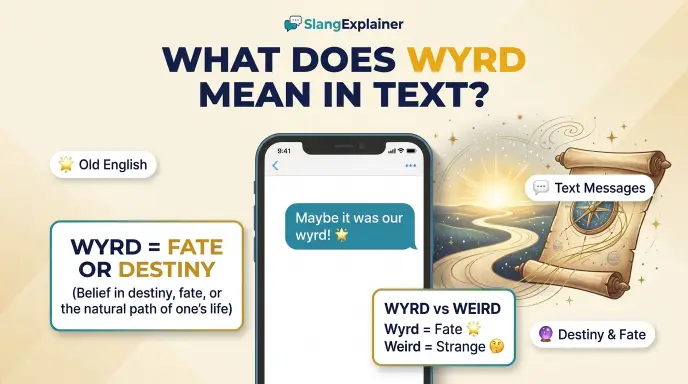
Wyrd has roots in Old English and was used to express ideas connected with fate, fortune, events, and destiny.
The word also has linguistic connections to related Germanic words, including Old Norse urðr, which is associated with fate. Its history is closely linked to the development of the modern English word “weird.”
Wyrd in Old English Literature
In Old English literature, wyrd appears in discussions of human experience, events, and destiny. Its meaning can be broader than the modern English word “fate,” depending on the particular text.
The word is especially relevant when reading historical poems and stories because it reflects how writers described the events that shaped people’s lives.
For a deeper example, the Old English poem The Wanderer includes the phrase “Wyrd bið ful aræd,” often translated as a statement about fate being firmly established. Scholars have also discussed other possible shades of meaning in the word.
Wyrd and Norse Traditions
Wyrd is often discussed alongside Norse concepts of fate because the languages share historical connections. However, it is important not to assume that every Old English and Norse belief about destiny was identical.
In modern writing inspired by these traditions, wyrd may refer to the course of events, the relationship between actions and consequences, or the broader idea of destiny.
How Wyrd Is Used Today
Today, the word can appear in historical discussions, novels, fantasy settings, and some spiritual communities. Writers may choose it because it carries an older, more mysterious feeling than the everyday word “destiny.”
That does not mean everyone who uses wyrd follows a particular belief system. A person may simply like the word, have encountered it in a book, or use it as part of a fictional world.
Understanding its history helps explain why wyrd still appears in modern writing, even though it is not a standard everyday texting abbreviation.
Wyrd vs. Other Common Texting Terms
Wyrd differs from everyday texting abbreviations because it is an established historical word rather than a shortened phrase.
The following comparison can help you distinguish it from more familiar internet expressions.
| Term | Meaning | Typical context |
| Wyrd | Fate or destiny | Historical, literary, or fantasy discussions |
| WYD | What are you doing? | Casual messages |
| WYM | What do you mean? | Asking for clarification |
| IDK | I don’t know | Expressing uncertainty |
| IMO | In my opinion | Sharing a viewpoint |
| Weird | Strange or unusual | Everyday conversations |
For example, if someone sends “WYM?” they are asking you to explain something. If they write “Wyrd,” they may be referring to fate, although the intended meaning depends on context.
These terms should not be treated as interchangeable. Knowing the difference helps you interpret messages accurately instead of guessing based on how the words look.
Common Mistakes People Make About Wyrd
When people encounter an unfamiliar word online, it is easy to assign it a meaning that does not fit. Here are some common mistakes to avoid.
1. Assuming Wyrd Is a Popular Texting Acronym
Wyrd is not a widely standardized abbreviation like LOL or BRB. Its established meaning comes from its history as a word associated with fate and destiny.
2. Confusing Wyrd With Weird
The spellings are closely connected historically, but the words can serve different purposes today. Weird usually means strange, while wyrd is associated with fate.
3. Assuming Every Sender Uses It the Same Way
One person may be discussing Old English literature, while another may be writing fantasy fiction. Someone else may simply have made a typing mistake.
4. Believing It Is Always Spiritual
Although wyrd appears in some modern spiritual discussions, it can also be used in literature, history, gaming, and creative writing. The word alone does not tell you what someone believes.
5. Treating It as Automatically Rude
Wyrd is not inherently offensive. Read the entire message before deciding if the sender is being friendly, sarcastic, or unkind.
The best approach is to use context, check the spelling, and ask for clarification when necessary.
Frequently Asked Questions About Wyrd
Q1. What does wyrd mean in text?
Wyrd usually means fate or destiny. It is an Old English word that may appear in historical discussions, fantasy writing, and modern messages about things that seem meant to happen.
Q2. Does wyrd mean weird?
Not exactly. Wyrd is associated with fate or destiny, while weird usually means strange or unusual in modern English. The words are historically related, so someone typing wyrd might sometimes have intended something weird.
Q3. Is wyrd a texting acronym?
No, wyrd is not a widely recognized texting acronym with a standard expanded meaning. It is an actual word with historical roots.
Q4. What does wyrd mean on social media?
On social media, wyrd may refer to fate or destiny, particularly in literary, fantasy, or spiritual discussions. Its meaning depends on the post and the person using it.
Q5. Is wyrd rude or offensive?
No, wyrd is not inherently rude or offensive. It is generally a neutral word, although the tone of the surrounding message can affect how it comes across.
Q6. How do you respond to words in a text?
If the sender is talking about destiny, you could reply, “Maybe it was meant to happen!” If you are unsure, ask, “Do you mean fate or weird?”
Q7. What is the origin of wyrd?
Wyrd comes from Old English and was used for concepts including fate, fortune, and events. It is historically connected to the modern English word weird and related Germanic words.
Q8. Is wyrd still used today?
Yes, but it is not a common everyday texting abbreviation. It can appear in historical writing, fantasy stories, mythology discussions, and some modern spiritual or creative communities.
Conclusion
The meaning of what wyrd means in text is best understood by looking at the word’s history and the context in which someone uses it.
Wyrd generally means fate or destiny and comes from Old English. Today, it may appear in fantasy stories, historical discussions, social media posts, and conversations about events that seem meant to happen. It is not a widely recognized texting acronym, and it should not automatically be treated as a synonym for weird.
If someone sends you weird, check the rest of the message before deciding what they mean. They might be talking about destiny, using an oldiffashioned word for creative effect, or simply making a spelling mistake.
Understanding this difference will help you interpret unfamiliar online language more confidently and respond naturally in your conversations.

I’m Dylan Foster, a slang and internet culture writer passionate about exploring how people communicate online and in everyday conversations. I write about texting abbreviations, social media expressions, and modern slang to help readers understand meanings, origins, and real-world usage in a simple way.