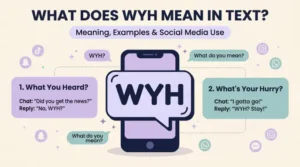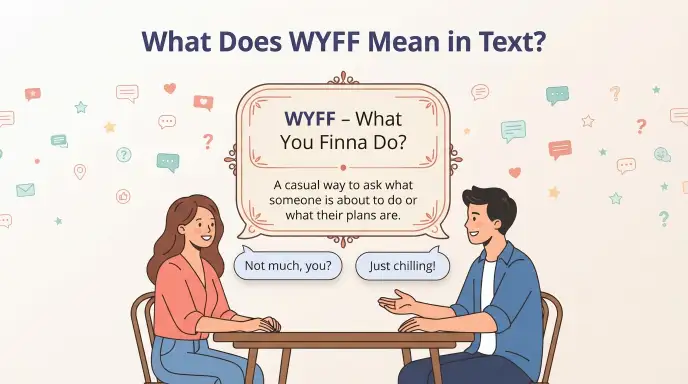
WYFF in text commonly means “What You Finna Do?”, a casual way to ask what someone is about to do or what their plans are. It can appear in texts, TikTok comments, Snapchat, Instagram DMs, and other casual chats.
If you have seen “WYFF?” in a message and had no idea how to answer, you are not alone. WYFF is much less standardized than common texting shortcuts such as LOL, BRB, or IDK.
There is also an important detail: WYFF can have different meanings depending on the conversation. Some online users use it as a variation of “Where You From?” or similar phrases. Because of that, the words around WYFF matter.
This guide explains the most useful meanings, where people use the term, how to respond, and when it is better to avoid it.
WYFF Meaning in Text
The most commonly documented current texting interpretation of WYFF is “What You Finna Do?” In everyday English, that means “What are you about to do?”, “What are you going to do?”, or simply “What are your plans?”
For example:
“WYFF tonight?”
A natural translation would be:
“What are you going to do tonight?”
The expression is informal. It is the kind of shorthand you might see between friends, in a private message, or in a casual online conversation.
Is WYFF slang, an acronym, or an abbreviation?
WYFF is best described as informal texting slang or an internet abbreviation rather than a standardized acronym.
It is formed from the first letters of a phrase, but unlike familiar abbreviations such as IDK (“I don’t know”) or BRB (“be right back”), WYFF does not have one universally accepted definition.
That distinction is important.
Several current online sources give different interpretations for WYFF, including “What You Finna Do?” and variations of “Where You From?”
So, if you see WYFF, do not assume that every person uses it in exactly the same way.
What does “finna” mean?
The word “finna” is informal English meaning something like “about to” or “going to.”
So:
“What you finna do?”
basically means:
“What are you about to do?”
WYFF is simply a shortened texting version of that casual question.
The context matters
Consider these two messages:
“WYFF later?”
This could naturally be asking about someone’s plans.
Now consider:
“Hey, WYFF? I’m from Chicago.”
Here, the sender may be using WYFF to mean something closer to “Where You From?”
That second interpretation is also found in current online usage, although it is not as universally established as common abbreviations such as WYD or WYA.
When the meaning is unclear, look at the rest of the conversation before replying.
Where People Use WYFF
WYFF is mainly associated with casual digital communication. It is not something you would normally use in a school essay, business email, formal announcement, or professional report.
The platform can provide clues about how the sender intends it.
WYFF on TikTok
On TikTok, short slang terms can appear in comments, captions, replies, and private messages.
Someone might write:
“WYFF after this?”
If the discussion is about plans, the person may be asking what you are going to do next.
TikTok comments often depend heavily on context. A short abbreviation may be understood by one group but confusing to another.
That is one reason WYFF can feel unclear when you first encounter it.
WYFF on Snapchat
Snapchat is another natural setting for informal abbreviations.
Friends may use WYFF in a quick chat instead of typing a complete question.
For example:
A: WYFF tonight?
B: Probably just staying home.
The short form keeps the conversation fast and casual.
Snapchat conversations can also include inside jokes, personal abbreviations, and creative spellings, so context is especially important.
WYFF on Instagram
On Instagram, WYFF may appear in DMs or comments.
A person starting a conversation might use the abbreviation as a quick question about plans. In another conversation, someone could use it as a variation of “Where You From?”
For example:
“You seem cool. WYFF?”
Depending on the conversation, the sender could be asking where you are from rather than what you are doing.
If you are unsure, asking for clarification is completely reasonable.
WYFF on WhatsApp
WhatsApp conversations often mix standard abbreviations with regional slang and personal texting habits.
Friends might use WYFF in a group chat when discussing plans:
“WYFF this weekend?”
The intended meaning may be something like:
“What are you going to do this weekend?”
Because WhatsApp is used across many countries, though, the meaning can vary between groups.
WYFF in SMS texting
Traditional SMS messages can also contain slang abbreviations, especially between friends.
A person might type:
“WYFF after school?”
The abbreviation saves typing and gives the message a relaxed tone.
Still, if the recipient does not know the abbreviation, writing the full question is clearer.
10 Real Chat Examples of WYFF
The easiest way to understand texting slang is to see it in natural conversations.
Example 1: Asking About Tonight
A: WYFF tonight?
B: Nothing much. I might watch a movie.
A: Same lol.
Here, WYFF is naturally understood as asking about someone’s plans.
Example 2: Making Weekend Plans
A: WYFF this weekend?
B: Probably going to the mall.
A: Want to meet up?
The sender is using WYFF as a quick way to ask what the other person plans to do.
Example 3: Casual CheckifIn
A: Hey, WYFF?
B: Just finishing homework. You?
A: Playing a game.
This is a relaxed conversation between friends.
Example 4: Making Plans With Friends
A: WYFF after work?
B: I’m free after 7.
A: Perfect. Let’s get food.
Here, the question is clearly about upcoming plans.
Example 5: Talking About a Party
A: WYFF Saturday?
B: Going to Mia’s party.
A: Oh nice, I’ll probably be there too.
The surrounding topic makes the intended meaning easy to understand.
Example 6: Asking Where Someone Is From
A: Hey, WYFF?
B: I’m from Lahore. What about you?
A: I’m from Karachi.
In this context, WYFF may be intended as a variation of “Where You From?”
This is why it is risky to assume that WYFF always has one fixed meaning.
Example 7: A New Online Friend
A: Your profile looks familiar. WYFF?
B: I’m from Texas. You?
A: California.
The answer “I’m from Texas” gives a strong clue that the sender intended a locationifrelated meaning.
Example 8: A Confusing Message
A: WYFF?
B: Wait, what do you mean? 😂
A: What you finna do?
B: Ohhh, I’m just going home.
This is a realistic example of why clarification can be better than guessing.
Example 9: Casual Group Chat
A: WYFF after class?
B: Library.
C: I’m going home.
A: Anyone want coffee?
The abbreviation keeps the group conversation short and informal.
Example 10: Friendly Conversation
A: WYFF later?
B: Probably chilling at home.
A: Want to play online?
B: Sure!
Here, WYFF functions as a casual way to ask about someone’s plans.
How to Reply When Someone Says “WYFF”
Your reply depends on what the sender appears to mean.
If WYFF means “What You Finna Do?”, simply tell the person what you plan to do.
For example:
“Not much, just relaxing.”
or:
“I’m going out with some friends.”
If it appears to mean “Where You From?”, answer with your location or background instead.
For example:
“I’m from Lahore. What about you?”
When the meaning is unclear, there is nothing wrong with asking:
“What do you mean by WYFF?”
That is much better than confidently giving an unrelated answer.
Funny replies
If you already know the sender well, you can make the response playful.
- “WYFF? Trying to survive 😂”
- “Probably doing absolutely nothing.”
- “Planning my world domination. You?”
- “Why, what are you planning? 👀”
- “That depends… why do you ask? 😂”
These work best with friends who understand your sense of humor.
Casual replies
For a normal conversation, keep it simple.
- “Just chilling.”
- “Not much, you?”
- “Heading home.”
- “Probably watching a movie.”
- “Going out later.”
Friendly replies
If you want to keep the conversation going:
- “I’m meeting some friends later. What about you?”
- “Probably grabbing food. Want to come?”
- “Nothing planned yet. What are you doing?”
- “Just relaxing today. How about you?”
Neutral replies
If you do not know the person very well, use a straightforward response.
- “I’m not sure yet.”
- “I have plans later.”
- “I’m heading home.”
- “Could you clarify what you mean by WYFF?”
The last option is especially useful if the abbreviation does not fit the conversation.
Is WYFF Rude or Offensive?
WYFF is not automatically rude or offensive.
Its tone is usually casual. However, the exact meaning and tone depend on the sender, the conversation, and what comes before or after it.
For example:
“WYFF tonight?”
sounds like a relaxed question between friends.
It does not automatically carry an insult or offensive meaning.
Is WYFF safe to use?
In casual conversations, WYFF can be fine if the people involved understand the abbreviation.
However, because it is not a universally standardized term, some people may not understand it.
If you are communicating with someone unfamiliar with internet slang, writing the full question is often better.
Is WYFF appropriate at school?
It depends on the setting.
A private message to a friend about plans is different from a formal school assignment.
You generally should not use WYFF in:
- Essays
- School reports
- Formal presentations
- Academic writing
- Official school emails
For schoolwork, write the complete question instead.
Is WYFF appropriate at work?
Usually, no.
Even if coworkers use slang casually in private chats, WYFF is not appropriate for formal business communication unless the workplace is extremely informal and everyone understands the expression.
For professional communication, clarity matters more than saving a few keystrokes.
Instead of:
“WYFF after the meeting?”
write:
“What are you planning to do after the meeting?”
That removes any possibility of confusion.
Who Uses This Term?
WYFF is most likely to appear among people who regularly use online slang and shortened texting language.
Younger internet users
Younger users, including some members of Gen Z, are more likely to encounter and experiment with shortifform internet language.
That does not mean every Gen Z user knows WYFF.
In fact, WYFF appears to be considerably less standardized than extremely common terms such as LOL, IDK, BRB, or WYD.
Gen Z usage
Gen Z communication often combines:
- Abbreviations
- Initialisms
- Slang
- Shortened words
- Memes
- Emojis
- Deliberate misspellings
WYFF fits into that broader style of fast, informal online communication.
However, it should not be treated as a universal Gen Z term. One person’s slang may be completely unfamiliar to another person’s online community.
Common platforms
WYFF can appear in:
- TikTok
- Snapchat
- SMS
- Group chats
- Online communities
- Casual DMs
Its frequency is much harder to establish than the popularity of highly standardized abbreviations.
That is another reason to describe WYFF as contextifdependent rather than universally established.
Origin of the Term
There is no single, wellifestablished origin story for WYFF as a texting expression.
That is important because internet slang often develops organically.
A phrase may begin in a small online community, become common in private messages, and then spread to other platforms. Users may also modify existing abbreviations to make them sound more conversational or playful.
The “finna” connection
One current interpretation of WYFF is “What You Finna Do?”
The word “finna” is established informal English associated with the meaning “about to” or “going to.” The word has roots in Southern American English and African American English.
As informal language moved across music, social media, texting, and online communities, words such as “finna” became familiar to a much wider audience.
This provides a plausible linguistic background for the “What You Finna Do?” interpretation.
However, that does not prove that every use of WYFF came from one specific person, platform, or moment.
Why are there multiple meanings?
Internet slang is flexible.
People shorten phrases based on sound, convenience, group habits, and context. A fourifletter abbreviation can therefore develop multiple meanings in different communities.
Current online references demonstrate exactly this problem with WYFF: some describe it as “What You Finna Do?”, while others connect it to “Where You From?” or other phrases.
So the most accurate answer is not to pretend that WYFF has one official expansion.
The surrounding conversation is your best clue.
WYFF vs. IDK vs. IDC vs. IMO vs. BRB
WYFF belongs to the same broad world of casual digital communication as familiar texting abbreviations, but its meaning is less standardized.
| Term | Meaning | Type | Usage | Popularity |
| WYFF | Usually “What You Finna Do?”; other interpretations exist | Texting slang / abbreviation | Casual chats, DMs, social media | Less standardized |
| IDK | I Don’t Know | Initialism | Texts, DMs, social media | Very common |
| IDC | I Don’t Care | Initialism | Casual texting and chats | Very common |
| IMO | In My Opinion | Initialism | Texting, comments, online discussions | Very common |
| BRB | Be Right Back | Initialism | Texting, chats, gaming | Very common |
The biggest difference is standardization.
Most people who see “IDK” immediately understand it.
WYFF is different. The reader may need the surrounding message to determine what the sender intended.
That makes WYFF more contextifsensitive than the other abbreviations in the table.
Real: World Usage Example
Imagine two friends are messaging on a Saturday afternoon.
One friend has been busy all week and wants to make plans. Instead of typing a full sentence, they send:
“WYFF tonight?”
The other friend replies:
“Nothing planned yet. Why?”
The first friend could then say:
“Want to grab dinner?”
In this situation, WYFF works as a quick conversation starter.
It is informal, short, and easy to type.
Now imagine the same abbreviation appears in a conversation with a stranger:
“WYFF?”
If you are unsure if they mean “What You Finna Do?” or “Where You From?”, the best response is not to guess.
You can simply ask:
“Do you mean what I’m doing or where I’m from?”
That one sentence can prevent an awkward misunderstanding.
This is a useful rule for internet slang in general: context is more reliable than the letters alone.
How to Tell Which Meaning WYFF Has
If you see WYFF and are not sure what it means, use a few simple clues.
Look at the words around it
If the conversation mentions tonight, tomorrow, later, or plans, a meaning related to “What You Finna Do?” is more likely.
If the conversation is about cities, countries, accents, or hometowns, a “Where You From?” interpretation may fit better.
Look at the relationship
A close friend may use WYFF in a playful or personal way.
A stranger may be using a more familiar meaning or may even have made a typo.
Look at the platform
TikTok comments, Snapchat messages, Instagram DMs, and private texts can all develop their own slang habits.
Do not assume a term means exactly the same thing everywhere.
Consider asking
If the message still makes no sense, ask.
“What does WYFF mean here?”
There is nothing embarrassing about asking. Slang changes quickly, and even frequent internet users encounter unfamiliar abbreviations.
WYFF vs. Similar Texting Terms
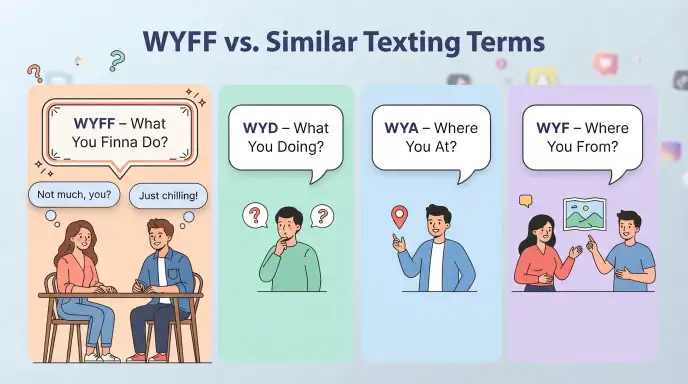
WYFF can look similar to several other abbreviations, which can make it even more confusing.
WYD
WYD usually means “What You Doing?” or “What are you doing?”
Example:
“WYD tonight?”
This is much more widely recognized than WYFF.
WYA
WYA usually means “Where You At?”
Example:
“WYA? We’re outside.”
This asks about someone’s current location.
WYF
WYF is commonly used to mean “Where You From?”
Example:
“WYF?”
The extra F in WYFF is one reason people sometimes interpret WYFF as a variation or playful extension of WYF. Current references do not agree on one fixed explanation, though.
WBU
WBU means “What About You?”
Example:
A: I’m staying home.
B: WBU?
These comparisons can help you avoid mixing up similariflooking abbreviations.
When You Should Avoid Using WYFF
Even if you understand the slang, there are situations where spelling things out is a better choice.
Avoid WYFF when:
- You are writing to a teacher.
- You are contacting a customer.
- You are sending a professional email.
- You are writing an application.
- You are communicating with someone who may not know internet slang.
- The meaning could easily be misunderstood.
The purpose of an abbreviation is to make communication easier.
If the abbreviation creates confusion, it defeats that purpose.
For a formal setting, simply write:
“What are you planning to do?”
or:
“Where are you from?”
depending on what you actually mean.
Frequently Asked Questions
Q1: What does WYFF mean in text messages?
WYFF commonly means “What You Finna Do?”, meaning “What are you about to do?” or “What are your plans?” Some users give it other meanings, so context matters.
Q2: What does WYFF mean on TikTok?
On TikTok, WYFF may be used as casual texting slang, especially when asking about someone’s plans. Some users may use it differently, so check the surrounding comment or conversation.
Q3: Is WYFF slang?
Yes. WYFF is best treated as informal texting slang or an abbreviation rather than a standardized English expression. Its meaning can vary between online communities.
Q4: Is WYFF rude or offensive?
WYFF is not inherently rude or offensive. It is generally casual, but it may be inappropriate in formal school or professional communication.
Q5: How should you reply to WYFF?
If it means “What You Finna Do?”, tell the person your plans, such as “Just chilling” or “Going out later.” If the meaning is unclear, ask what they mean.
Conclusion
So, what does WYFF mean in text? The most useful current interpretation is “What You Finna Do?”, a casual way of asking what someone is about to do or what their plans are. It is commonly associated with informal texting, DMs, and social media conversations.
However, WYFF is not as standardized as abbreviations such as IDK, IMO, or BRB. Some people use it in connection with “Where You From?” and other phrases, which means the surrounding conversation matters.
Use WYFF with friends or in relaxed online conversations when you know the other person will understand it. For school, work, or formal communication, it is better to write the full question.
When in doubt, do not guess. Simply ask what the sender means. With internet slang, a little context can make four confusing letters suddenly make perfect sense.

I’m Dylan Foster, a slang and internet culture writer passionate about exploring how people communicate online and in everyday conversations. I write about texting abbreviations, social media expressions, and modern slang to help readers understand meanings, origins, and real-world usage in a simple way.